


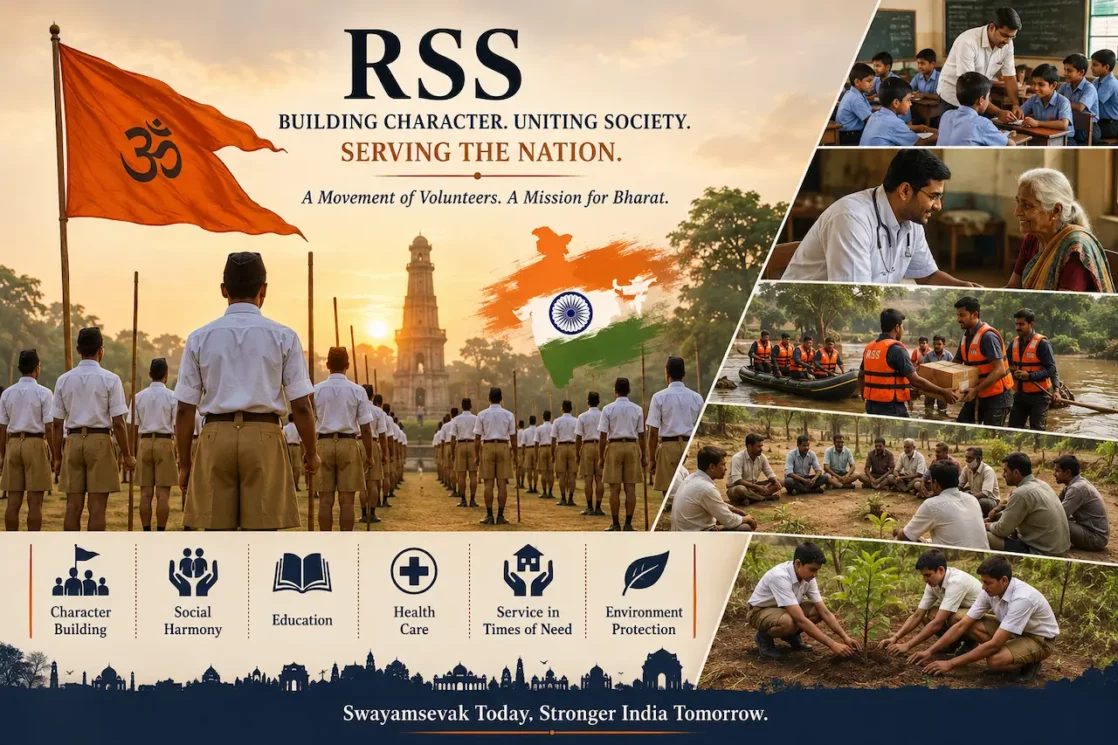
Few organizations in modern India evoke as much discussion, admiration, criticism, and curiosity as the Rashtriya Swayamsevak Sangh (RSS). Founded in 1925, the RSS has grown from a small gathering of volunteers in Nagpur into one of the world’s largest voluntary socio-cultural organizations. Yet, despite its size and influence, a question continues to surface in political debates: Why is the RSS not registered as a central organization, and how does it continue to function without such registration?
The answer lies not merely in law but in history, philosophy, organizational design, and the very nature of the RSS itself.
At the heart of the controversy is a misunderstanding. Many people assume that every large organization must be registered under a corporate, trust, or NGO framework. However, Indian law does not mandate that every association of individuals must register itself. The Constitution of India guarantees citizens the freedom to assemble and form associations. Thousands of religious groups, spiritual congregations, cultural organizations, community forums, and voluntary bodies across the country function without central registration.
The RSS belongs to this category. It is not a corporation, a business enterprise, or a government-funded institution. It is essentially a voluntary association of individuals united by a common mission: national character building, social cohesion, and cultural awakening.
Supporters of the RSS argue that registration is not a requirement because the organization does not operate as a centralized asset-owning entity. Instead, specific schools, service projects, hospitals, trusts, educational institutions, and affiliated organizations operate under their respective legal structures and registrations. The RSS itself functions as a volunteer movement rather than a conventional institution.
Its origins explain much about this structure.
When Dr. Keshav Baliram Hedgewar founded the RSS in 1925, India was under British colonial rule. The organization emerged during a period of national humiliation, social fragmentation, and cultural insecurity. Colonial policies had weakened traditional institutions, while centuries of foreign invasions and internal divisions had left Hindu society fragmented along caste, regional, and sectarian lines.
Dr. Hedgewar believed that India’s political freedom could not be sustained without social unity and national consciousness. His vision was simple yet profound: before building a strong nation, one must build strong citizens.
The RSS therefore focused not on electoral politics but on character formation. Daily shakhas were designed to cultivate discipline, physical fitness, patriotism, selflessness, leadership, and social responsibility. Nearly a century later, this remains the core activity of the organization.
Critics often focus on the RSS’s influence, but supporters point to a more fundamental achievement: the creation of a vast volunteer culture.
In a country where public attention often revolves around elections, slogans, and political rivalries, RSS volunteers work in thousands of villages and towns through long-term social engagement. The organization rarely advertises these activities, yet its network extends into education, healthcare, tribal welfare, disaster relief, rural development, environmental protection, women’s empowerment, and social harmony initiatives.
Perhaps one of the RSS’s most significant contributions has been its consistent effort to combat social divisions within Hindu society.
For decades, RSS leaders have publicly spoken against untouchability and caste discrimination. Former RSS Sarsanghchalak Balasaheb Deoras famously declared that if untouchability was not wrong, nothing in the world could be considered wrong. Through community meals, social integration programmes, and outreach activities, the organization has sought to reduce barriers that historically divided communities.
Supporters argue that this social integration effort has helped foster a stronger sense of national identity that transcends caste boundaries.
Another major area of contribution has been education.
Thousands of schools inspired by RSS ideals, particularly in rural and tribal regions, have provided affordable education where government infrastructure was either weak or absent. These institutions have often focused not only on academics but also on values, discipline, cultural awareness, and community service.
In remote tribal areas, volunteers have established hostels, health centres, literacy programmes, and vocational training initiatives. These efforts are rarely covered in national headlines, yet they have touched millions of lives over several decades.
Disaster relief represents another dimension of RSS service.
Whether during earthquakes, floods, cyclones, pandemics, or other emergencies, RSS volunteers have frequently been among the first responders on the ground. During the Gujarat earthquake, the Uttarakhand floods, the Kerala floods, the COVID-19 pandemic, and numerous local crises, volunteers organized food distribution, medical assistance, rehabilitation efforts, and community support.
Unlike many institutional relief efforts, RSS volunteers often continue rehabilitation work long after media attention has moved elsewhere.
The organization’s supporters also emphasize its role in fostering nationalism.
This nationalism, in their view, is not merely political loyalty but a deeper emotional attachment to India’s civilizational heritage, cultural traditions, and collective destiny. They argue that RSS helped restore confidence in indigenous traditions during a period when many Indians viewed their own culture through a colonial lens.
Through daily interaction, training camps, intellectual discussions, and social service activities, the RSS has sought to cultivate citizens who place national interest above personal gain.
This emphasis on self-discipline and sacrifice has produced generations of full-time workers known as pracharaks. These individuals often dedicate their entire lives to social work, living modestly and serving communities without pursuing wealth or personal recognition.
Few modern organizations can claim such a large cadre of lifelong volunteers.
The question of funding is also frequently misunderstood.
RSS operations are primarily sustained through voluntary contributions known as Gurudakshina. These donations come from members and supporters rather than government grants. Because the organization depends largely on grassroots contributions, supporters argue that it maintains a degree of independence that many institutions cannot claim.
The annual Gurudakshina tradition is not merely a fundraising exercise; it symbolizes self-reliance and collective responsibility. Every volunteer contributes according to capacity, reinforcing the idea that the organization belongs to its members rather than external benefactors.
It is also worth noting that elections are conducted within the RSS structure. Key organizational positions are periodically filled through established internal processes. Financial records associated with relevant entities are audited where legally required. The image of a completely unaccountable organization therefore does not accurately reflect reality.
Today, the RSS oversees more than 58,000 shakhas, with a substantial presence in rural India. Yet supporters see this not as the culmination of its mission but as only the beginning.
Their vision extends beyond political cycles. They believe that building a society characterized by honesty, social responsibility, ethical leadership, and national unity requires generations of sustained effort. Elections may occur every five years, but character formation is a continuous process that can take decades.
This long-term perspective perhaps explains why the RSS has survived political hostility, government bans, ideological opposition, and changing social conditions. Governments have come and gone, political parties have risen and fallen, yet the organization continues to expand because its foundation rests on volunteer participation rather than state patronage.
One may agree or disagree with the RSS’s worldview. In a democracy, such debate is both natural and necessary. However, legal status and ideological disagreement should not be conflated.
The central question is not whether the RSS is registered. The more meaningful question is why an organization that began with a handful of volunteers nearly a century ago continues to attract millions of people across generations.
For its supporters, the answer is straightforward: the RSS has endured because it offers a model of nation-building rooted in service, discipline, cultural confidence, social reform, and selfless volunteerism. Its registration status may remain a subject of political debate, but its impact on India’s social landscape is difficult to ignore.
Nearly a century after its founding, the RSS remains less a conventional organization and more a continuing social movement—one that seeks to shape not merely institutions, but the character of society itself.
