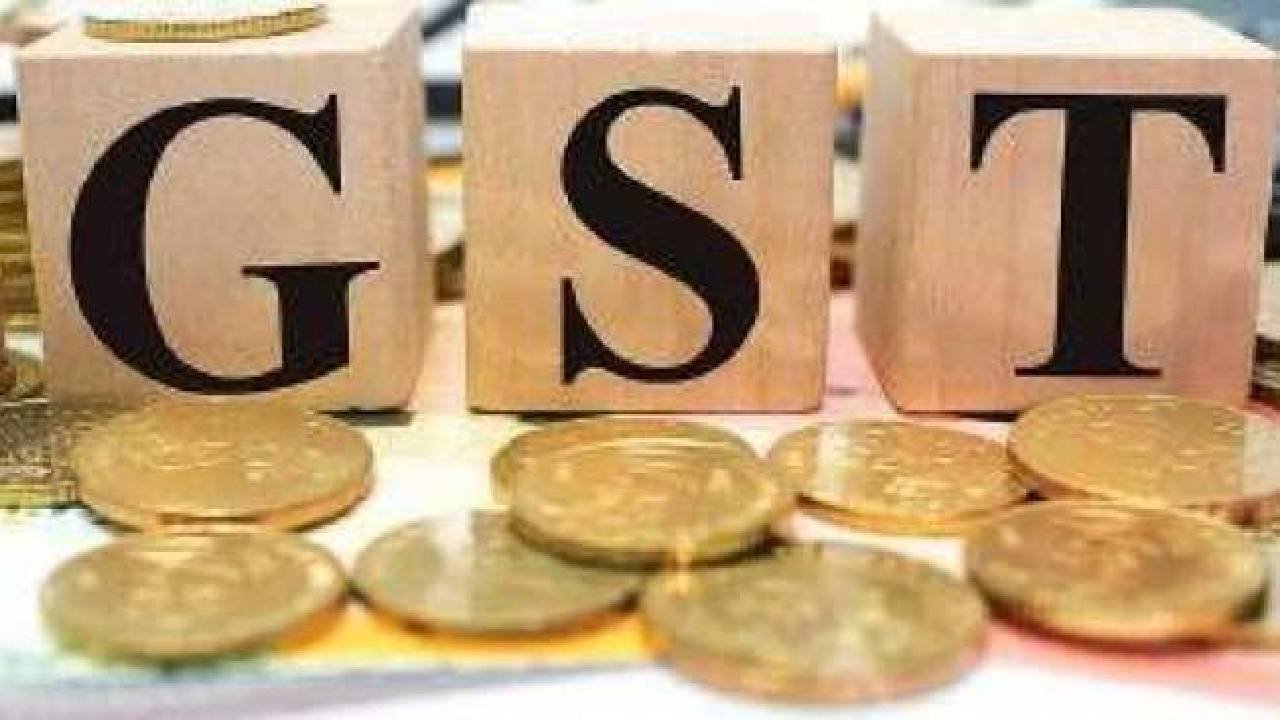
Maharashtra is set to lose between Rs 7,000 and Rs 10,000 crore under the new Goods and Services Tax (GST) slab structure that came into effect on Monday. Despite the looming shortfall, the state government has not yet decided to demand compensation, unlike opposition-ruled states that have already raised the issue. BJP-ruled states, however, have chosen to align with the Centre’s decision without protest.
According to trade and government sources, the revenue loss could exceed ₹10,000 crore, but the BJP has moved quickly to convert the GST cuts into a political opportunity. The party has instructed trade bodies, shops, and malls to highlight consumer savings by displaying the revised GST rates alongside the old ones. Advertisements are also being rolled out to underline the benefits to the end consumer.
The All India Organisation of Chemists and Druggists’ Maharashtra wing has already begun displaying the revised tax slabs at medical shops. Medicines that earlier attracted 12% GST now fall under 5%, reducing MRPs by 6.25%. Products that were taxed at 18% and shifted to 5% will see an 11.02% drop in MRPs. Items previously taxed at 5% and now exempted will become cheaper by 4.77%, while goods that moved from 12% to zero tax will save 10.72% on MRPs.
The chemists’ body has also decided to clear its old stock, earlier purchased under 12% and 18% GST, by charging just 5%. With the BJP planning an extensive campaign to amplify these consumer savings, political observers say the party is keen to ensure the GST restructuring translates into electoral advantage in Maharashtra.
Blast in Khyber Pakhtunkhwa Kills More Than 20, Including Women, Children and Militants 3
At least 24 people, including women and children, were killed and several others injured on Monday when a cache of explosives stored at a Pakistani Taliban compound detonated in northwest Pakistan’s Khyber Pakhtunkhwa province, police said.
The incident occurred in the Matur Dara area of Tirah Valley in Khyber district, near the Afghanistan border. Local authorities rejected claims that the site was struck by Pakistan Air Force jets, stating instead that the explosion was triggered by bomb-making materials stored inside the compound.
According to Tirah Police Station’s Station House Officer Zafar Khan, the dead included 14 militants and 10 civilians. Witnesses in the area, however, alleged that airstrikes were carried out.
The compound was reportedly a key hub for militant leaders and Afghan fighters, serving as a training ground for sniper operations and the production of improvised explosive devices (IEDs). Militants are known to establish such facilities within civilian populations, making them difficult for security forces to target. Poor storage conditions and training activities often result in accidental blasts.
Pakistan has witnessed a surge in terrorist incidents since the Taliban’s takeover of Afghanistan in 2021, despite Islamabad’s hopes that a friendly regime in Kabul would help curb militancy.
SC Declines to Quash Money Laundering Case Against Jacqueline Fernandez 5
Actor Jacqueline Fernandez on Monday failed to secure relief from the Supreme Court, which declined to interfere with a Delhi High Court order rejecting her plea to quash an Enforcement Case Information Report (ECIR) in the Rs 200 crore money laundering case involving alleged conman Sukesh Chandrasekhar.
A bench of Justices Dipankar Datta and Augustine George Masih told senior advocate Mukul Rohatgi, appearing for Fernandez, “You withdraw this. Come at an appropriate stage. That would be the better option. We will not interfere at this stage.” The matter was dismissed with liberty to approach the court later.
Fernandez had challenged the Delhi High Court’s July 3 order that dismissed her petition against the ECIR. The actor is named as an accused in the case against Chandrasekhar, who allegedly duped the spouses of Ranbaxy’s former promoters, Shivinder and Malvinder Singh, of Rs 200 crore.
Rohatgi argued that Fernandez had no role in laundering money and was only at the receiving end of Chandrasekhar’s gifts, worth at least Rs 5.71 crore. He maintained that the conman, already jailed, was “infatuated” with the film star and impersonated senior government officials to deceive victims.
The Enforcement Directorate, however, has alleged that Fernandez knowingly accepted gifts despite being aware of Chandrasekhar’s criminal background. The Delhi High Court had earlier refused to quash the charges, noting that peaceful protest rights and criminal liability under the Prevention of Money Laundering Act (PMLA) must be assessed at the stage of framing charges.
The Supreme Court bench cited its earlier Vijay Madanlal Choudhary ruling upholding ED’s powers under the PMLA, observing that allegations at the charge stage have to be accepted. Rohatgi requested that high court remarks not prejudice Fernandez during trial, to which the bench clarified that the observations were limited to dismissal of her plea.
The Enforcement Directorate has filed multiple chargesheets against Chandrasekhar and his wife, Leena Paulose, accusing them of using hawala routes and shell companies to launder the proceeds of crime. Both were earlier arrested under provisions of the Maharashtra Control of Organised Crime Act (MCOCA).
SC Seeks Delhi Police Response on Bail Pleas of Umar Khalid, Sharjeel Imam in 2020 Riots Case 7
The Supreme Court on Monday issued a notice to Delhi Police on the bail pleas of activists Umar Khalid, Sharjeel Imam, Gulfisha Fatima, and Meeran Haider in the UAPA case linked to the alleged conspiracy behind the February 2020 Delhi riots. A bench of Justices Aravind Kumar and N V Anjaria has posted the matter for hearing on October 7.
The activists have challenged the September 2 Delhi High Court order that denied bail to nine accused, including Khalid and Imam, observing that “conspiratorial” violence under the guise of protests cannot be permitted. Alongside them, Gulfisha Fatima, Haider, Mohd Saleem Khan, Shifa Ur Rehman, Athar Khan, Abdul Khalid Saifi, and Shadab Ahmed were also denied bail. Another accused, Tasleem Ahmed, faced a similar rejection by a separate high court bench on the same date.
The high court held that while the Constitution protects peaceful protests and free speech under Article 19(1)(a), these rights are not absolute and remain subject to reasonable restrictions. The order stated that unfettered protests could harm the constitutional framework and disturb law and order.
Khalid, Imam, and others were booked under the Unlawful Activities (Prevention) Act (UAPA) and various provisions of the Indian Penal Code for allegedly masterminding the riots, which erupted during protests against the Citizenship (Amendment) Act (CAA) and the National Register of Citizens (NRC). The 2020 violence left 53 people dead and over 700 injured.
The accused, who have consistently denied the charges, have been in jail since 2020 and moved the high court after a trial court rejected their bail pleas.
PM Modi Launches 'GST Utsav' on Navratri, Calls for Savings and Self-Reliance 9
Prime Minister Narendra Modi on Monday marked the beginning of Navratri 2025 with greetings and a festive message that tied spiritual devotion to economic empowerment. Linking the occasion to the government’s newly launched “GST Utsav,” he urged citizens to embrace both savings and self-reliance.
In a post on X, the Prime Minister said, “This Navratri holds special significance. Along with the GST Savings Festival, the mantra of self-reliance will gain new energy during this period. Let us come together in collective efforts to fulfil the resolve of a developed and self-reliant India.”
On Sunday, PM Modi announced the launch of the nationwide GST Utsav from the first day of Navratri, describing it as a festival of savings for the people. With new GST rates coming into effect from September 22, he said citizens would be able to buy a wide range of products at lower prices. “Next Gen GST reforms being implemented from tomorrow—it is like a GST saving festival. From tomorrow, you will be able to buy your favourite items with ease,” he said in his address.
Alongside the GST announcement, PM Modi shared a soulful rendition of the bhajan Ya Devi Sarv Bhuteshu by the late Pandit Jasraj, calling Navratri a celebration of pure devotion. He also invited citizens to share their favourite devotional songs, promising to repost some in the coming days.
Extending greetings, he said, “Heartfelt Navratri greetings to all of you. May this sacred festival, filled with devotion, courage, restraint, and determination, bring new strength and new faith into everyone’s life. Jai Mata Di!”
He further noted the significance of the first day of Navratri dedicated to Maa Shailputri, expressing hope that her blessings bring good fortune and health to all.
Sharadiya Navratri, observed in the Hindu lunar month of Ashwin, is a nine-night festival dedicated to Goddess Durga and her nine forms. Celebrated with fasting, devotional singing, Garba and Dandiya, the festival will conclude on October 2 with Vijayadashami, or Dussehra.
The Chronological Formation and Political Evolution of Maharashtra 11
The story of Maharashtra is not just the story of a state’s birth; it is the story of an identity forged through sweat, protest, betrayal, and blood. It is a tale of linguistic pride, social churn, caste power games, ideological clashes, and the eventual transformation of a land once defined by stability into an unpredictable laboratory of alliances, defections, and political brinkmanship. To trace Maharashtra’s political evolution chronologically is to walk through India’s post-independence political journey itself — because few states mirror the national churn as closely as Maharashtra has, and few leaders embody its contradictions as sharply as those who have ruled it.
When India gained independence in 1947, the idea of states as we know them today did not exist. The linguistic reorganization that would later define the Indian map was still a distant storm. Bombay Presidency, as it was called then, was a multilingual, multiethnic entity, awkwardly clubbing together Gujarati, Marathi, Konkani, and even Sindhi-speaking populations under one roof. For the Marathi-speaking masses, this felt like suffocation, a denial of their identity in their own land. The seeds of the Samyukta Maharashtra Movement were sown in this restlessness. Writers, poets, intellectuals, and political activists began mobilizing, insisting that Marathi language and culture deserved its own state. The slogan “Samyukta Maharashtra with Mumbai” became the emotional heartbeat of this struggle.
The movement was not merely about language — it was about self-respect. The Marathi manoos, historically proud inheritors of the legacy of Shivaji Maharaj, felt reduced to second-class citizens in Bombay, where Gujarati industrialists, Sindhi traders, and colonial hangovers dominated business and politics. From 1956 to 1960, protests rocked the state, demanding a separate Marathi-speaking entity. The agitation was fierce, often bloody. On November 21, 1955, police fired on protestors at Flora Fountain in Mumbai, killing 105. Their sacrifice turned the agitation into a people’s war. The Congress at the center resisted for long, fearing that carving Maharashtra would ignite similar demands elsewhere. But the demand was unstoppable. Finally, on May 1, 1960, Maharashtra was born, with Mumbai as its capital. The state entered the map drenched in martyr’s blood and fiery resolve.
The first decades of Maharashtra politics were dominated by the Congress. It was natural: the party had been at the helm of the freedom struggle and enjoyed legitimacy unmatched by any rival. The Congress constructed the political economy of the new state through two pillars: cooperatives and the Maratha-Kunbi dominance. Sugar cooperatives became the backbone of rural Maharashtra, and they doubled up as political factories producing Congress satraps. Leaders like Yashwantrao Chavan became synonymous with Congress supremacy. But what looked like a stable structure was actually a house of cards resting on caste arithmetic and patronage.
Through the 1960s and 70s, the Congress was almost unchallenged, but politics was shifting beneath the surface. The Maratha caste, once warriors, reinvented themselves as landlords, cooperative barons, and political bosses. Dalits, mobilized by Dr. B. R. Ambedkar’s legacy, demanded a seat at the table. Urban workers in Mumbai rallied under trade unions, their slogans echoing through textile mills. Farmers in rural belts began agitations, demanding fair prices and representation. Maharashtra was a bubbling cauldron, and sooner or later, it would overflow.
That overflow came in the 1980s with the rise of a party unlike any other: the Shiv Sena. Born in 1966, it was Bal Thackeray’s brainchild, a cartoonist turned rabble-rouser who tapped into the deep insecurities of the Marathi manoos in Mumbai. Thackeray’s Sena weaponized identity politics, targeting South Indians, Gujaratis, and later Muslims, as “outsiders” stealing Marathi jobs. His fiery speeches, delivered with razor wit and menace, turned Shiv Sena shakhas into centers of street power. Congress still held the state, but the Sena had captured the Marathi soul, especially in Mumbai. The Sena’s politics was not of policy, but of pride and muscle. The Shiv Sainik was less a party worker and more a soldier of the streets, enforcing loyalty with intimidation and devotion.
Meanwhile, Maharashtra’s social movements were also reshaping politics. The Dalit Panthers, inspired by the Black Panthers in the US, rose in the 1970s, channeling Ambedkarite anger into cultural and political assertion. Farmers’ movements like those led by Sharad Joshi challenged the state’s neglect of agriculture. The 1970s and 80s saw the Congress’s dominance punctured by dissent from multiple directions — caste movements, regional identity, and economic protests. Yet, the Congress survived, not by reforming, but by co-opting. It absorbed leaders, distributed patronage, and expanded its cooperative web.
The 1990s were a turning point. Congress began to crumble under the weight of its own contradictions. Corruption scandals, factional wars, and the decline of textile mills in Mumbai eroded its base. Shiv Sena, in alliance with the Bharatiya Janata Party (BJP), captured power in 1995 — a shock that ended decades of Congress rule. Bal Thackeray was now the “remote control” of Maharashtra politics, with Manohar Joshi as Chief Minister. This era marked the beginning of coalition politics and the slow but steady rise of the BJP.
Sharad Pawar, the master strategist, left Congress multiple times to form his own outfits, most famously the Nationalist Congress Party (NCP) in 1999. The NCP-Congress alliance dominated for fifteen years, but stability was deceptive. Power-sharing was riddled with corruption, from irrigation scams to cooperative bank collapses. Governance stagnated, and dynasties flourished. The Congress-NCP years symbolized everything that would later fuel anti-incumbency: arrogance, inefficiency, and entanglement with business cartels.
Then came 2014 — the year Maharashtra’s politics turned upside down. Riding on Narendra Modi’s national wave, the BJP under Devendra Fadnavis seized Maharashtra in a way few expected. Fadnavis, a Brahmin in a state historically dominated by Marathas, was a political outlier. But he proved to be a master strategist. Unlike the dynasts of Congress and NCP, Fadnavis projected a clean, development-oriented image. As Chief Minister, he pushed infrastructure projects like the Mumbai Metro, coastal roads, and industrial corridors. He tightened governance, cut through bureaucratic lethargy, and positioned himself as the face of a “New Maharashtra.” For the first time, a non-Maratha leader had not only survived but thrived at the top.
Yet Maharashtra is never predictable. In 2019, when BJP and Shiv Sena fell out after elections, Maharashtra saw one of its most bizarre episodes: midnight swearing-ins, shifting alliances, and defections. Uddhav Thackeray, Bal Thackeray’s heir, broke with BJP and joined hands with Congress and NCP to form the Maha Vikas Aghadi (MVA). It was a coalition of contradictions — Hindutva Sena, secular Congress, and opportunist NCP. For two and a half years, the experiment held, more out of hatred for BJP than love for each other. But cracks were inevitable. In 2022, Eknath Shinde led a rebellion, splitting Shiv Sena and joining hands with BJP. Devendra Fadnavis, once CM, swallowed his pride to become Deputy CM — a move that shocked many but revealed his maturity as a long-term strategist.
The current Fadnavis–Shinde–Ajit Pawar axis represents the chaotic, unpredictable Maharashtra of today. Stability has been replaced with chess moves. Every week brings rumors of defections, raids, new alliances. Ideology has evaporated; survival is the only ideology. Congress, once the empire, is now a shadow. Shiv Sena is split into warring camps. NCP has fractured into father and nephew factions. And through this storm, Fadnavis remains the calm operator — not always in the CM’s chair, but always with his hand on the levers.
The evolution of Maharashtra politics is thus a journey from linguistic pride to coalition chaos. Born out of the sacrifice of Samyukta Maharashtra martyrs, the state became a Congress bastion, then a Shiv Sena laboratory of identity politics, then a battlefield of corruption and dynasties, and finally a stage for BJP’s rise under Devendra Fadnavis. If Congress represented stability, Sena represented pride, and NCP represented opportunism, then BJP under Fadnavis represents ambition — an ambition to not just govern Maharashtra but to redefine its political DNA.
The challenges now are immense. Caste tensions, Maratha reservation demands, farmer distress, urban-rural divides, unemployment, and the specter of communal polarization haunt Maharashtra. Its politics, once predictable, is now a daily soap opera. But if there is one constant, it is the Marathi pride that began this journey in 1960. That pride has been exploited, manipulated, betrayed, but never extinguished. It remains the heartbeat of Maharashtra, and whoever harnesses it defines the future.
And in this evolving story, Devendra Fadnavis stands out. A leader who came from outside the Maratha dominance, who weathered betrayals, who took risks, and who continues to wield influence even when not wearing the crown. His career symbolizes Maharashtra’s unpredictable churn: resilience, ambition, and survival in a land where yesterday’s king can be today’s pawn, and today’s pawn can become tomorrow’s king.
Maharashtra’s political evolution is not over. It is a saga still unfolding, with new betrayals, new alliances, and new battles yet to come. But if history tells us anything, it is this: Maharashtra never forgets its martyrs, never forgives arrogance, and never allows stability for too long. It thrives in turbulence, and it is in that turbulence that its true political identity is forged.
Delhi Court Quashes Takedown Order in Adani Defamation Case Against Journalists 13
A Delhi court has set aside an order that directed four journalists to remove alleged defamatory content against Adani Enterprises Limited (AEL), ruling that the sweeping directive effectively decided the case without trial and violated constitutional free speech protections.
District Judge Ashish Aggarwal said the civil court’s September 6 order was “not sustainable” and asked it to pass a fresh order after hearing both the journalists and AEL. The journalists — Ravi Nair, Abir Dasgupta, Ayaskanta Das, and Ayush Joshi — had challenged the earlier ruling, arguing it silenced critical reporting without giving them a chance to defend their work.
The court noted that unless journalists were heard, it could not be assumed that their articles were “unverified, inaccurate, or irresponsible.” Citing Article 19(1)(a) of the Constitution, the judge stressed that content cannot be removed from the public domain without a prima facie finding of it being defamatory.
Judge Aggarwal also flagged that the civil court’s order had empowered AEL to seek removal of even future articles considered unfavorable, a move he warned would have a “chilling effect” on free expression and leave authors in “constant peril.” He added that by exposing writers to contempt proceedings without prior adjudication, the earlier ruling deprived them of the opportunity to defend themselves.
Highlighting procedural lapses, the judge observed that provisions of the Civil Procedure Code were overlooked and that the trial court failed to decide the interim injunction application within the 30-day period required by law.
Allowing the appeal, the judge clarified that he made no findings on whether the articles were defamatory, and directed the civil court to hear both parties afresh before deciding the application.
The case stems from a defamation suit filed by AEL, in which a civil court had earlier ordered ten defendants, including journalists and organizations, to take down articles and posts critical of the company.
SEBI Clears Adani Group of Hindenburg Allegations, Says Charges Unfounded 15
The Securities and Exchange Board of India (SEBI) has given a clean chit to the Adani Group and its associated entities in the Hindenburg case, ruling that the allegations “are not established.”
In its order issued on Thursday, SEBI said the proceedings were closed without directions, as the flagged transactions were genuine business dealings and not fraudulent or in violation of related party transaction (RPT) disclosure norms. The regulator stated that since no liability was established, the question of penalty did not arise.
SEBI clarified there was no breach of Listing Obligations and Disclosure Requirements (LODR) by Adani, rejecting claims of concealed related party transactions. It further explained that the broader definition covering indirect dealings came only after the 2021 amendment to LODR norms and could not be applied retrospectively.
The order also noted that the loans and fund movements cited in the allegations had been fully repaid and did not amount to undisclosed related party transactions or market manipulation.
The controversy stemmed from a January 2023 report by US-based Hindenburg Research, which accused the Adani Group of stock manipulation, accounting irregularities, and hiding related-party dealings through shell companies. The report triggered a massive sell-off, erasing over $100 billion in Adani’s market value, and led the Supreme Court to direct SEBI to conduct an inquiry.
Maharashtra Doctors Stage Strike Over Govt Nod to Register Homeopaths 17
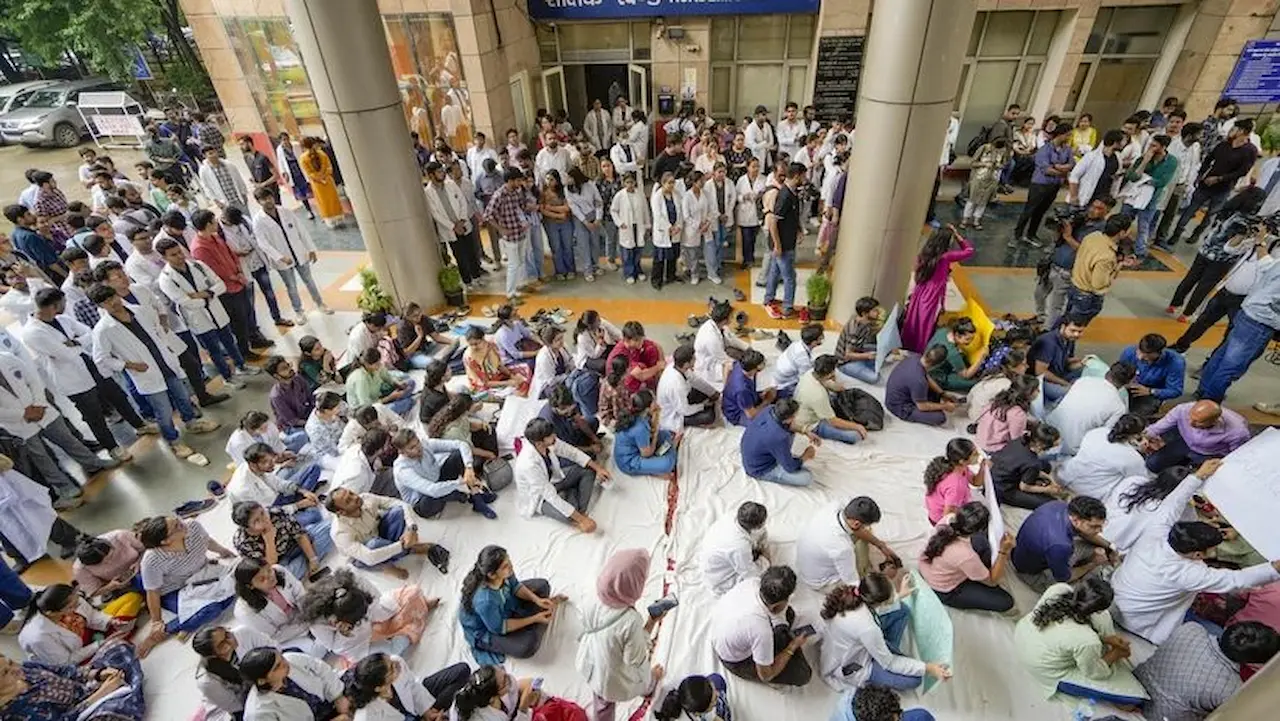
Doctors across Maharashtra went on a 24-hour strike on Thursday to oppose the state government’s decision to allow the registration of homeopaths with a certificate in modern pharmacology under the Maharashtra Medical Council.
According to Indian Medical Association (IMA) Maharashtra president Dr. Santosh Kadam, nearly 1.8 lakh allopathic doctors, including those working in private hospitals, joined the strike. While emergency and critical care services continued, outpatient and routine medical services were impacted.
The IMA argued that granting registration to homeopaths who completed the one-year Certificate Course in Modern Pharmacology (CCMP) poses a serious risk to patient safety and the overall quality of healthcare.
Earlier this year, the government had asked the Maharashtra Medical Council (MMC) to register such practitioners, but the order was withdrawn after protests. A strike planned for July 11 was deferred following a meeting between IMA representatives and Chief Minister Devendra Fadnavis. However, on September 5, the government revived the registration process through a fresh circular, reigniting the controversy.
In response, all resident doctors’ associations of state-run and Brihanmumbai Municipal Corporation medical colleges, the Federation of All India Medical Association, the Association of State Medical Interns, and the Government Medical College Association declared support for the strike, calling the decision unacceptable.
Rahul Gandhi Accuses CEC Gyanesh Kumar of Shielding ‘Vote Thieves’ and Undermining Democracy 19
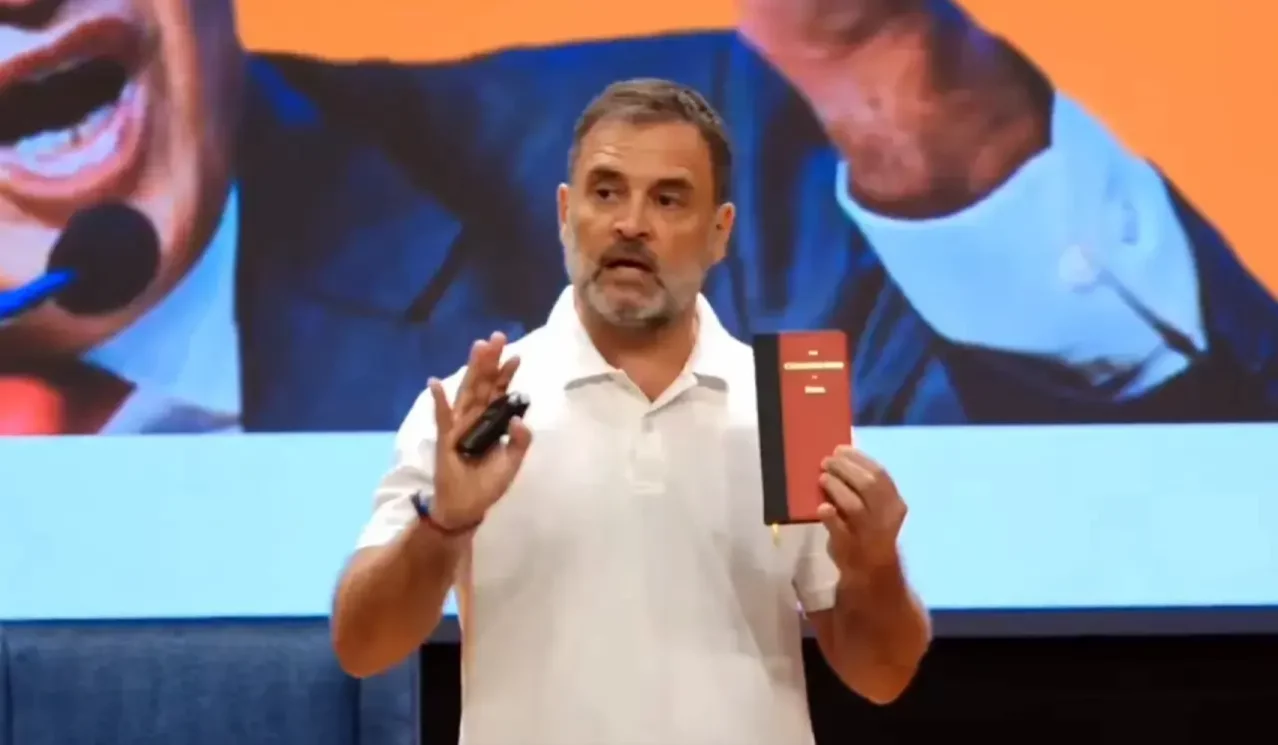
Congress leader Rahul Gandhi on Thursday launched a sharp attack on Chief Election Commissioner (CEC) Gyanesh Kumar, accusing him of protecting “vote chors” and those who have destroyed Indian democracy. Addressing a press conference at the Congress’ Indira Bhawan headquarters, Gandhi cited alleged large-scale voter deletions in Karnataka and fraudulent additions in Maharashtra as evidence of systematic electoral manipulation.
Calling his revelations a “milestone” in exposing how elections are being rigged, the Leader of Opposition in the Lok Sabha said this was not the “hydrogen bomb” of disclosures he has promised, which would come later. He pointed to Karnataka’s Aland constituency, where he claimed 6,018 votes—mostly of Congress supporters—were targeted for deletion in 2023. “The booth-level officer discovered her uncle’s vote had been deleted. It turned out someone else had hijacked the process through software,” Gandhi alleged.
He further claimed that applications impersonating voters were filed automatically using mobile numbers from outside Karnataka. On stage, he presented a voter whose name was targeted for deletion and another person whose identity was used to file the deletion request—both denied involvement.
In Maharashtra’s Rajura constituency, Gandhi alleged votes were added fraudulently with the help of automated software. He claimed millions of voters across India were being systematically targeted. “I am the Leader of Opposition, I will not make claims without 100 percent proof,” he said.
Gandhi accused the Election Commission of stonewalling the Karnataka CID, which has sent 18 letters over 18 months seeking details such as destination IPs and OTP trails linked to the deletions. “They are not providing information because it will expose where this operation is being conducted,” he said, alleging that CEC Gyanesh Kumar is shielding those behind the conspiracy.
“Every youngster in India must know this—they are stealing your future. By withholding information, the EC is defending the murderers of democracy,” Gandhi charged.
He reminded reporters that at the conclusion of his Voter Adhikar Yatra on September 1, he had promised a “hydrogen bomb” of revelations, warning that after its release, Prime Minister Narendra Modi would not be able to show his face to the country. Last month, he had also claimed that over one lakh votes were “stolen” in Karnataka’s Mahadevapura constituency during the 2024 Lok Sabha polls, describing “vote chori” as an “atom bomb on our democracy.”