As Maharashtra limps toward its long-delayed civic elections, the state’s political theatre is in full swing—and what a grotesque spectacle it is. Parties are not contesting to serve the people; they’re scrambling to stay relevant, to save their face, and most importantly, to claim their share in the spoils of power. In this circus of shifting loyalties, public bickering, fake virtue, and dangerous distractions, the ordinary voter—the Marathi Manoos—is reduced to a disposable extra, expected to clap, vote, and suffer in silence.
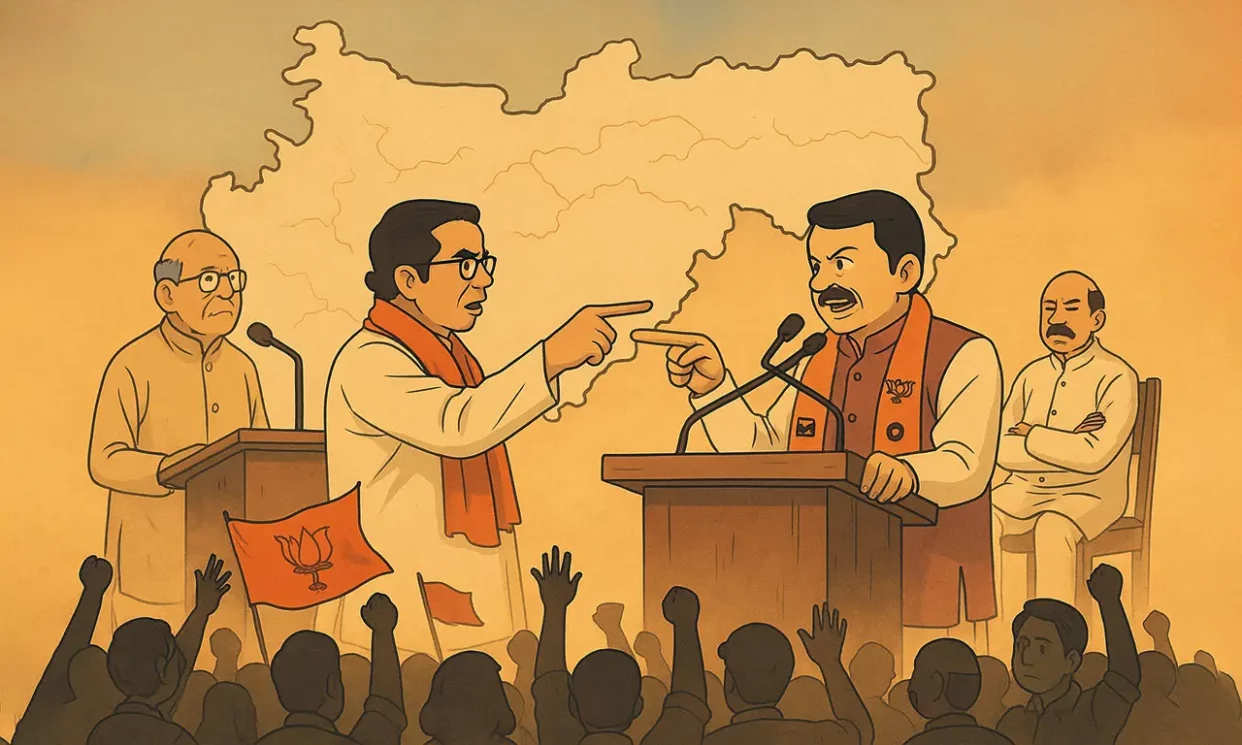
At the centre of this chaos is the ongoing tug-of-war between the Mahayuti alliance and the Mahavikas Aghadi. While the Mahayuti, comprising BJP, Shinde Sena, and Ajit Pawar’s NCP faction, boasts of power, money, and machinery, it is suffering from a severe trust deficit within its own ranks. Eknath Shinde, once hailed as the bold rebel who toppled Uddhav Thackeray’s government, is now struggling to maintain his authority even within his own faction. Infighting between Shinde Sena and NCP is spilling into the public domain—what began as a petty quarrel over the Guardian Minister post in Raigad has escalated into a bizarre war of viral “Aghori pooja” videos and political blackmail. NCP’s Suraj Chavan mocks Shinde Sena’s Bharat Gogavale, and in retaliation, Shinde’s camp threatens to leak videos of Sunil Tatkare. It’s no longer a question of who governs Raigad—it’s a matter of who can disgrace whom first.
Meanwhile, the BJP remains the grand puppeteer, watching its allies quarrel while focusing on its real agenda: controlling the municipal corporations, especially the BMC, through meticulous planning, resource dominance, and brute electoral force. While Shinde is bleeding credibility and Ajit Pawar’s influence is shrinking, Devendra Fadnavis appears to be the only man with a coherent plan. But even he is facing fire on multiple fronts.
On one side, Uddhav Thackeray’s Shiv Sena (UBT) is exploiting every opportunity to ignite Marathi pride. With a loyal voter base still intact and fiery rhetoric through Saamana, Uddhav continues to portray himself as the rightful heir of Maharashtra’s Marathi legacy. His MP Vinayak Raut, not mincing words, publicly referred to CM Shinde as an “impotent politician”—a direct and brutal strike meant to shake up his weakening image.
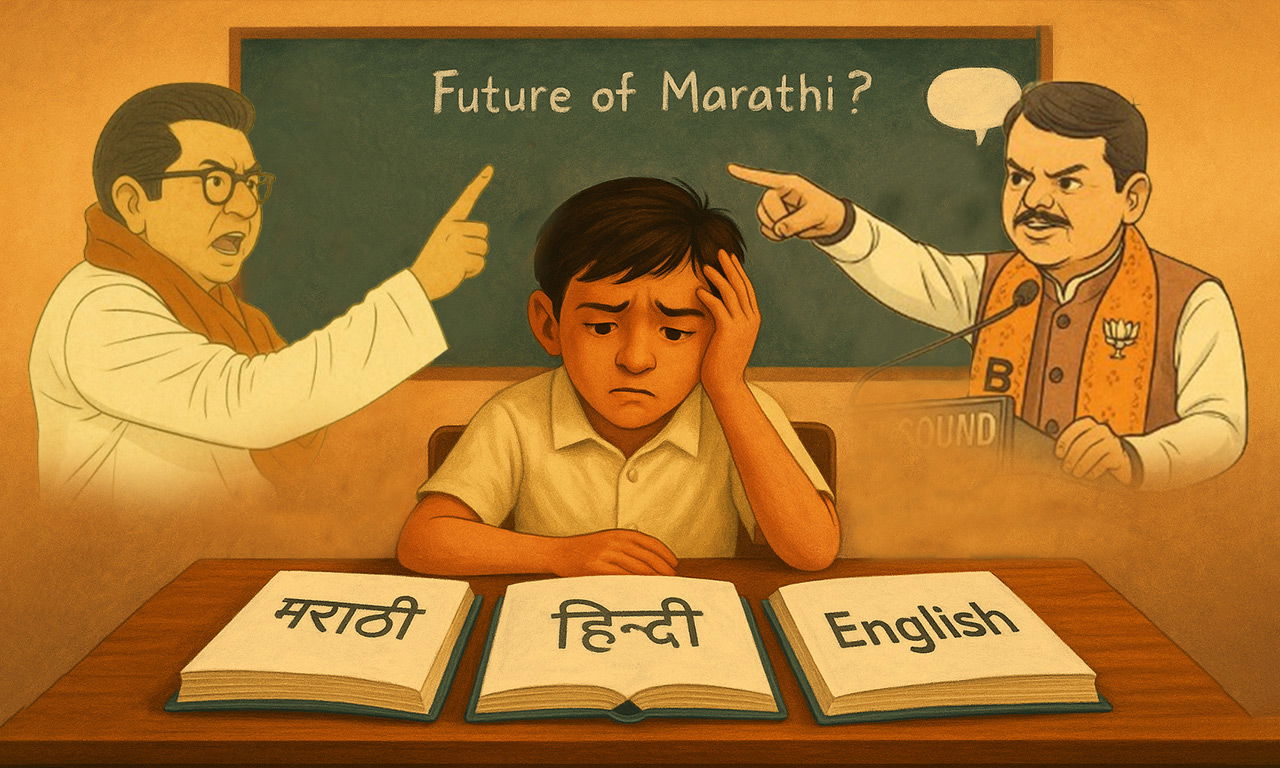
And then, there is Raj Thackeray. The ever-unpredictable MNS chief has flared up the language issue yet again. At a high-profile event celebrating the Estimates Committees of Parliament, banners were printed in Hindi and English—but not in Marathi. Raj didn’t just object; he tore through the government’s apathy, reminding them of Maharashtra’s hard-fought linguistic identity and invoking C.D. Deshmukh’s resignation during the Samyukta Maharashtra movement. Ironically, while Raj and Uddhav’s workers often find themselves on the same platform, no formal alliance has been struck. Shiv Sena (UBT)’s Sanjay Raut diplomatically advised “patience,” but everyone can sense the strategic hesitation and deep-rooted rivalry that still lingers between the Thackeray cousins.
Amidst all this tamasha, the BJP government tried to sneak in a seemingly “harmless” language policy—implementing Hindi as a default third language in Marathi and English medium schools. But the backlash was instant and severe. Faced with rising opposition, CM Fadnavis had to call an emergency meeting with Eknath Shinde, Education Minister Dada Bhuse, and officials to save face. The result? Another promise of consultation and yet another PowerPoint presentation in the making. It’s the same old bureaucratic charade: Delay, distract, and defuse.
And if that wasn’t enough, the tragic and continuing crisis of Maharashtra’s farmers remains on the back burner. Over 12,600 suicides from 2015 to 2019. Seven deaths a day in 2023. And what does the government do? Appoint a committee under Bachchu Kadu to “look into” the issue of loan waivers. Not a single word on irrigation reforms, sustainable pricing, or long-term structural solutions. The message to farmers is clear—your death matters less than our data.
And now, even the civic polls—the most basic exercise of democracy—are being toyed with. After years of delay, the new ward boundaries are conveniently being redrawn by two Urban Development Department secretaries. A June 10 government order had no fixed schedule. Two days later, a letter magically added timelines. Now, the final announcement will come 18 days later, and elections will likely be pushed to the end of November—post Diwali, post public outrage, post everything. It’s a masterclass in democratic procrastination.
So here we are—standing in the eye of Maharashtra’s political hurricane. Where leaders perform rituals, abuse each other, forge secret pacts, delay polls, and debate language—while farmers die, students suffer, and the common man is forced to pick between the lesser evil. Every party wants to win, not for the people, but for their own survival. And in this power-hungry circus, the voter is merely an audience member, tricked into believing he has a say when all he has is a seat—at the back row, far from the stage, far from the truth.
This isn’t governance. This is a drama with too many clowns, no ringmaster, and a society that keeps paying the price—again and again.