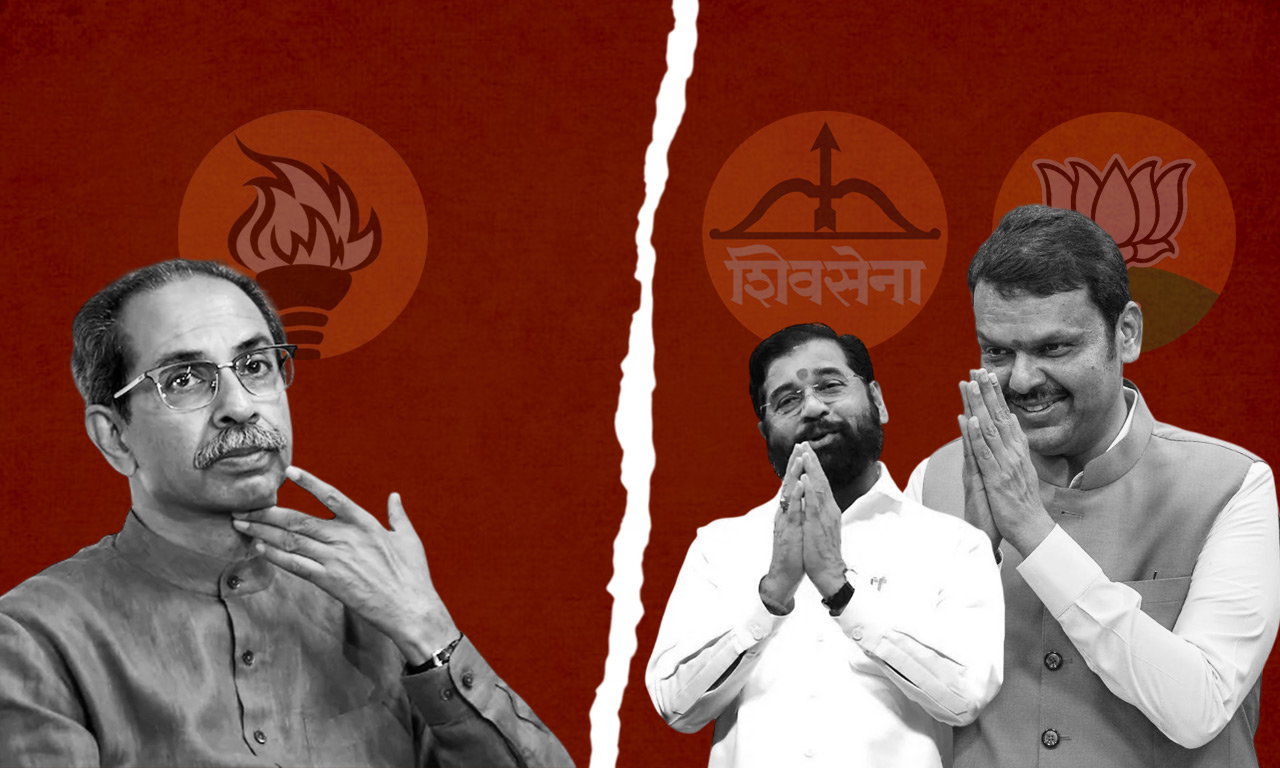
The political battleground in Maharashtra has intensified, and the civic polls — particularly those in Mumbai, Thane, Nashik, and Pune — have now become the make-or-break moment for every major political player. For the Bharatiya Janata Party (BJP), these elections are not just about local governance but a strategic mission to assert complete dominance across urban Maharashtra. For the Shiv Sena (UBT), led by Uddhav Thackeray, these polls represent a desperate attempt at survival — a last-ditch effort to prove that the party still has a pulse after being stripped of its name, symbol, and soul.
In this high-stakes scenario, the recent defection of Sudhakar Badgujar — once a loyal lieutenant of Sanjay Raut — has added to Uddhav’s woes. His dramatic entry into the BJP, backed by a caravan of over 100 buses and thousands of supporters, was more than a political switch — it was a public spectacle that sent shockwaves through the Shiv Sena (UBT). Even internal opposition from BJP leaders like Seema Hiray couldn’t stop his induction, proving that when the mission is big, party discipline gives way to grand strategy. And behind that grand strategy is one name — Devendra Fadnavis, Maharashtra’s undisputed master planner.
Despite initial resistance from local units, the efforts of BJP heavyweights like Girish Mahajan and Ravindra Chavan ensured Badgujar’s entry. And he wasn’t alone. Joining him were former Social Welfare Minister Baban Gholap, ex-MNS corporator Dilip Datir, NCP’s Manohar Borade, Balasaheb Sanap, and social activist Kailash Chumble. This is not random induction — it’s a carefully crafted plan to hollow out the opposition, region by region, leader by leader.
Uddhav Thackeray’s Shiv Sena is now bleeding from within. And this isn’t just political — it’s ideological. The very leaders who once upheld the legacy of Balasaheb Thackeray are now abandoning the son, accusing him of compromising the party’s core principles for a short-lived alliance with Congress and NCP. What was once a stronghold of Hindutva is now a sinking ship, and its passengers are jumping off — not just to save themselves but to sail ahead with the wind of power blowing in BJP’s direction.
Badgujar, who began his political journey as an independent corporator in 2007 and later rose through the ranks of the Nashik Municipal Corporation, held crucial posts as leader of the house and opposition leader. Though he faced defeats in the 2019 and 2024 Assembly polls, his grassroots strength remains intact. His departure, coupled with hints of criminal charges, adds both controversy and significance to his BJP induction. Notably, he was considered a trusted confidant of Shiv Sena MP Sanjay Raut — making his switch even more symbolic of the disintegration within Uddhav’s faction.
And this is just the beginning. Buzz within political circles suggests that more Shiv Sena (UBT) leaders are quietly knocking on the doors of Eknath Shinde and Devendra Fadnavis, hoping for a safe landing before the civic polls. The Mahayuti alliance’s resounding comeback in the state — dominating 236 of 288 Assembly segments — has shifted the power dynamics. The Maha Vikas Aghadi (MVA) is gasping for relevance, while the BJP-Shinde juggernaut is rolling ahead with confidence.
The civic elections have always been vital — they decide the control of local administration, urban planning, infrastructure projects, and budget allocations, and hold the power to nurture the next generation of political leaders. But this time, the stakes are unprecedented. For the BJP, it’s an opportunity to translate its Assembly-level dominance into municipal machinery. For Shinde’s Sena, it’s a chance to reinforce its claim as the real Shiv Sena. And for Uddhav, it’s a matter of political survival.
MVA’s looming defeat is more than an electoral loss — it’s a dismantling of Uddhav’s leadership narrative. In just three years, he has lost power, party, and perception. The rebellion led by Shinde wasn’t just about positions — it was about restoring Balasaheb’s ideology, a pitch that has clearly resonated with voters. Today, Shinde’s camp calls this an “ideological victory,” and rightly so.
Meanwhile, Fadnavis continues to prove why he is the BJP’s most trusted strategist in Maharashtra. From ward-level booth structuring to stitching alliances, his foresight is unmatched. His plan is clear: break the opposition’s morale before the first ballot is cast. As Badgujar himself said after joining BJP, the party will focus on micro-level block booth management. He confidently stated that in Nashik West — where BJP earlier won 18 out of 44 seats compared to Shiv Sena’s 22 — the target is now 35 seats.
In Nashik East, the BJP already holds 29 out of 47 seats and 19 of 31 in Nashik Central. The margins are narrowing, and the BJP is determined to bridge the gap — not with slogans, but with structure, discipline, and defections.
Five key reasons explain Uddhav’s collapse:
- Ideological betrayal – Aligning with Congress and NCP was a rupture from Shiv Sena’s original Hindutva ethos.
- Leadership vacuum – Uddhav’s aloof style distanced him from grassroots workers and long-time loyalists.
- Loss of symbol and identity – Losing the bow-and-arrow and party name was a moral and operational blow.
- Internal unrest – Prominent leaders felt sidelined, prompting them to leave rather than stay and fade.
- Strategic inertia – While Fadnavis was building equations, Uddhav was caught in nostalgia.
The civic polls are no longer just urban elections — they’re a political referendum. A battle for narrative. A test of loyalty and ideology. And with each passing day, it becomes clearer: the BJP and Shinde Sena are not just contesting elections — they are scripting the endgame of Uddhav Thackeray’s political chapter.