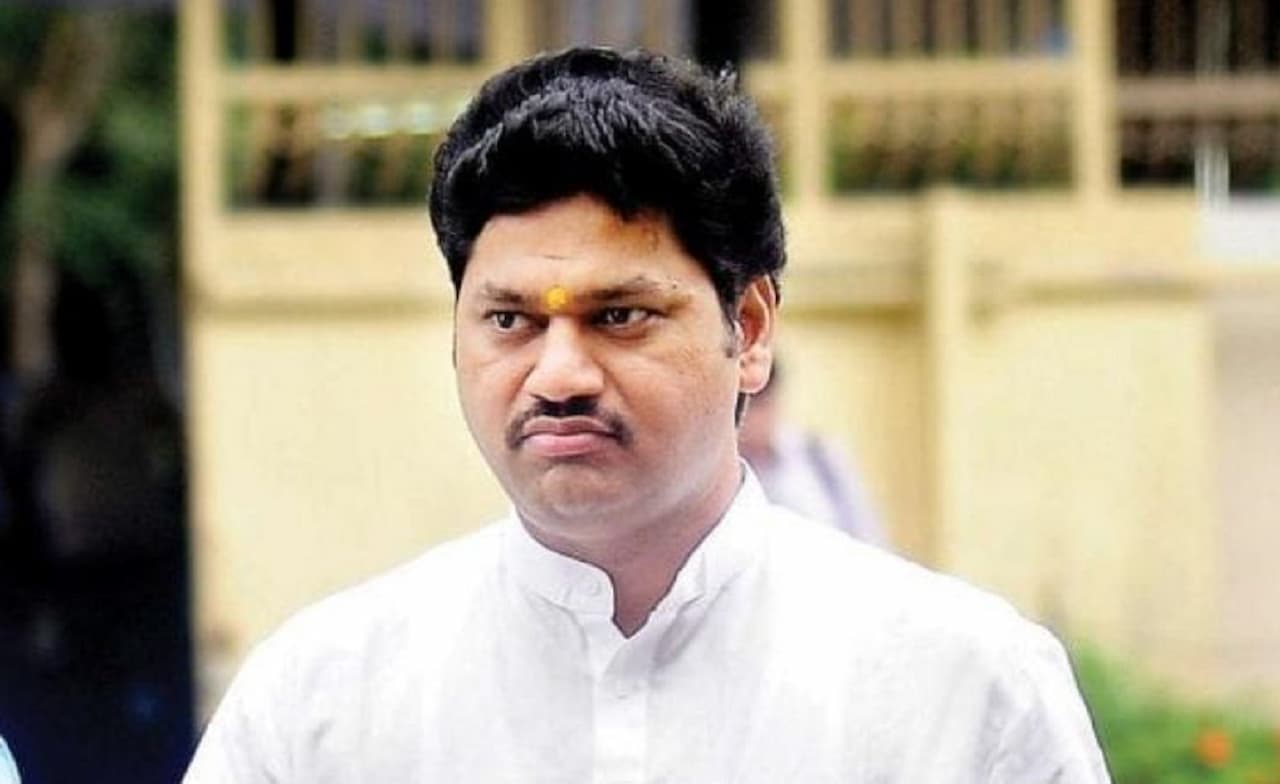
Maharashtra Minister Dhananjay Munde is facing mounting pressure to resign amid allegations linking his close aide Walmik Karad to an extortion case and the murder of Massajog sarpanch Santosh Deshmukh. His estranged wife Karuna Sharma-Munde claimed on Sunday that senior leaders had already sought his resignation, which would be announced before the state budget session.
The 13-day budget session begins Monday, and the speculation over Munde’s exit has intensified. Speaking to a Marathi news channel, Sharma stated, “As per my sources, Munde’s resignation was sought two days ago, and he will have to step down before the session.”
She further pointed out that Munde had earlier admitted Karad was his close aide and had promised to resign if Karad was found guilty. With Karad now named in the chargesheet, Sharma asserted, “For moral or other reasons, Munde will have to resign.”
The case has caused a political storm, as the chargesheet alleges that Karad ordered the murder of anyone obstructing his extortion attempts from a wind energy company. This revelation has provided fresh ammunition to the opposition, demanding Munde’s immediate resignation.
When contacted for a response, Munde stated that he would attend the state cabinet meeting later in the day, avoiding direct comments on the resignation speculation. With the budget session around the corner, all eyes are now on whether Munde will step down or fight back against the mounting controversy.
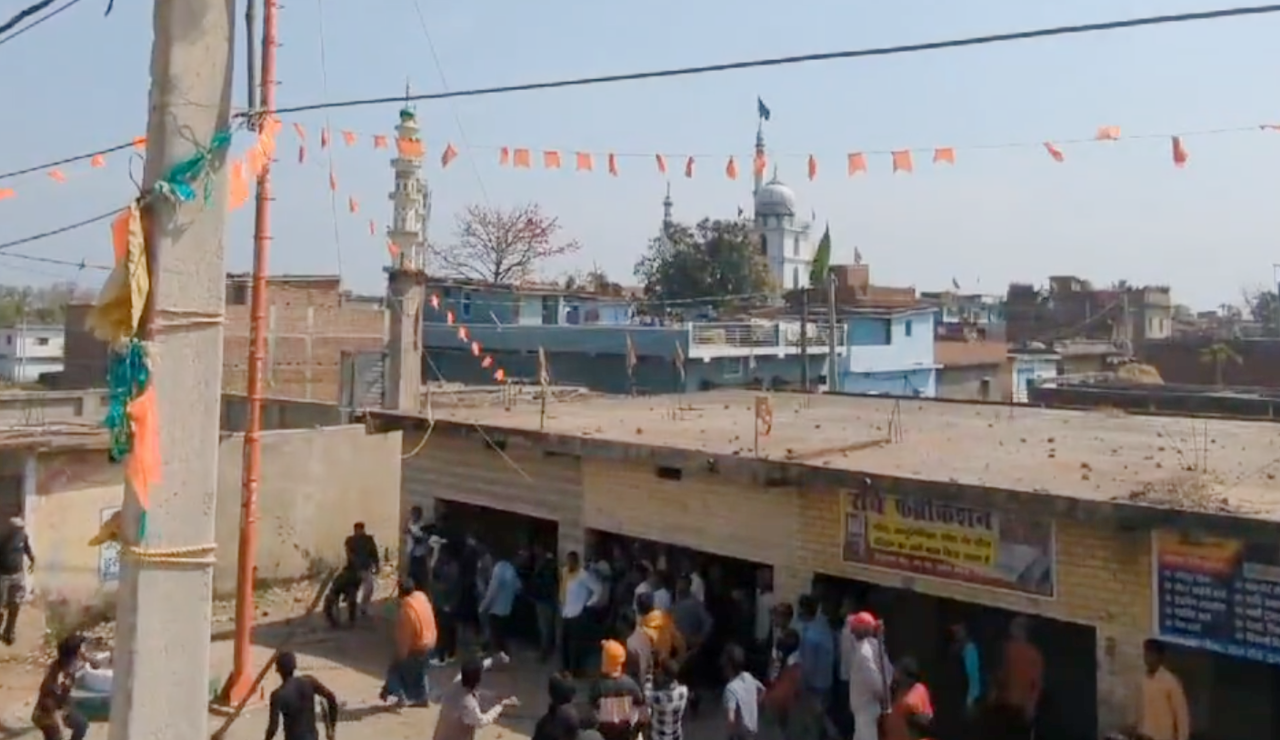
Tensions Grip Hazaribag: Communal Clash Over Religious Flags on Maha Shivratri 4
A day after violent clashes erupted in Hazaribag’s Ichak area over the installation of religious flags and loudspeakers during Mahashivratri, the region is gradually returning to normal, officials said on Thursday. The communal tensions had led to several injuries and heightened security concerns.
Shops and markets have reopened, and law enforcement remains on high alert to prevent any further unrest. Three individuals have been arrested in connection with the clashes, confirmed Santosh Kumar, Officer-in-Charge of Ichak Police Station. Meanwhile, Hazaribag Sadar Sub-Divisional Officer R.K. Gupta assured that the situation is now peaceful.
To restore harmony, authorities have scheduled a peace committee meeting later in the day. Meanwhile, heavy security deployment continues within Ichak police station limits to prevent further escalation.
On Wednesday, violent clashes broke out between two communities over the installation of religious flags and loudspeakers for Mahashivratri celebrations. The confrontation quickly turned chaotic, leading to several injuries and raising tensions in the district.
With police and administrative officials working to defuse tensions, the incident has reignited debates about religious processions, public order, and communal harmony in the region.
Pune Horror: Rs 1 Lakh Reward Announced for Fugitive in Swargate Bus Rape Case 6
Pune Police have announced a ₹1 lakh reward for information leading to the arrest of Dattatray Ramdas Gade (37), a history-sheeter accused of raping a 26-year-old woman inside a state transport bus at Swargate bus station. The fugitive has been on the run since the horrific assault in the early hours of Tuesday morning, prompting police to form 13 special teams to track him down.
Pune Police Commissioner Amitesh Kumar urged the public to assist in the investigation, assuring that the identity of informants will be kept confidential. Citizens can share leads by calling 020-24442769 or 9881670659.
Gade, who has a criminal history of theft, robbery, and chain-snatching in Pune and Ahilyanagar district, was out on bail since 2019. Despite his past record, he was free to roam, raising serious concerns about law enforcement lapses.
The horrifying attack took place inside a parked ‘Shiv Shahi’ AC bus at Swargate, one of Maharashtra’s largest bus depots. The survivor, a medical professional, recounted that Gade deceptively led her to the empty bus, pretending to guide her to a Satara-bound vehicle. Once inside, he overpowered and raped her before escaping.
The incident has triggered massive outrage, with the Opposition slamming the BJP-led Maharashtra government over its failure to ensure women’s safety. Critics argue that repeat offenders like Gade roaming free pose a serious threat to public security, urging stricter law enforcement and accountability.
As the hunt for Gade intensifies, pressure mounts on the police and state government to restore faith in public safety.
Beed Erupts: Villagers Launch Hunger Strike Over 'Shoddy' Probe Into Sarpanch's Murder 8
Residents of Massajog village in Maharashtra’s Beed district have launched an indefinite hunger strike, protesting against what they call a “dissatisfactory” probe into the murder of their sarpanch, Santosh Deshmukh. The villagers are demanding a reinvestigation into alleged lapses by Kej police in the initial phase and the immediate arrest of absconding accused Krushna Andhale.
The ‘Annatyag Andolan’ (hunger strike) will continue until officials meet the protesters and assure them of concrete action, said Dhananjay Deshmukh, the slain sarpanch’s brother, who is leading the agitation alongside family members. A group of villagers had met Beed Superintendent of Police (SP) Navneet Kanwat on Monday, expressing frustration over the lack of transparency in the probe.
Dhananjay Deshmukh claimed that Kej police had withheld crucial details from the SP, raising suspicions of deliberate negligence or conspiracy. The case was later transferred to the Criminal Investigation Department (CID), but villagers insist that “mistakes” in the initial probe suggest foul play.
Adding to the demands, villagers have called for a fast-track court hearing and the appointment of a special public prosecutor. Earlier, they staged a ‘Jal Samadhi’ protest, standing in water for hours to press their demands.
Santosh Deshmukh was abducted and murdered on December 9, 2024, allegedly for opposing an extortion attempt on a wind energy company operating in the area. The extortion case led to the arrest of Walmik Karad, a close aide of Maharashtra minister and NCP leader Dhananjay Munde. However, villagers believe that influential figures might be shielding key culprits.
Kej police were accused of deliberate inaction between December 6 and 9, leading to the suspension of a sub-inspector and the transfer of the district superintendent of police. SP Kanwat assured that a delegation would meet the protesters and review their grievances. “We have asked them to submit their demands in writing. Once received, an inquiry will be conducted into their allegations about the initial investigation,” he told PTI on Tuesday.
With rising political pressure and widespread public outrage, the Santosh Deshmukh murder case is fast becoming a litmus test for Maharashtra’s law enforcement and political leadership.
If Mumbai had a heartbeat, it would probably sound like the crunch of a perfectly toasted brun maska pav or the sizzle of a deep-fried vada pav. This humble bread isn’t just food—it’s a way of life, a great equaliser, and possibly the only thing in Mumbai that remains inflation-proof. From the first bite in the morning to the last hurried snack before catching the last local, Pav is the city’s most loyal companion.
The relationship between Mumbaikars and Pav is deep, emotional, and slightly obsessive. Whether it’s the iconic vada pav fuelling hungry office-goers or the buttery indulgence of maska pav paired with Irani chai, this fluffy creation keeps the city moving. There’s an old saying, “Mumbai me kabhi koi bhooka nahi sota” (No one sleeps hungry in Mumbai), and if you dig deeper, you’ll find that pav plays a major role in this edible socialism. A single pav is almost equivalent to one or two chapatis, but let’s be honest, who wants chapati when vada pav is an option?
For every struggling person who arrives in the city with nothing but big dreams and an empty wallet, vada pav is a survival kit. I, too, have been there. Back in my days of battling rent, traffic, and life, vada pav was my go-to meal. Two vada pavs in the morning, and I was set for the day. Who needs fancy protein diets when you have deep-fried potato goodness stuffed inside a pillowy pav, served with gunpowder chutney? It’s the ultimate nutrition plan—endorsed by broke bachelors and last-week-of-the-month salary survivors across Mumbai. When budgets are tight, and the craving for outside food is real, there’s always vada pav. It’s affordable, reliable, and doesn’t judge you for ordering five at a time.
Historically, pav owes its existence to the Portuguese, who brought it to India’s western coast. But while history may claim it was their invention, Mumbai made pav its own. This versatile bread is the backbone of street food, adapting seamlessly to every dish—pav bhaji, misal pav, dabeli—you name it. It’s not just food; it’s an edible cushion that soaks up every spicy, buttery, or tangy flavor that the city throws at it. No Michelin-starred restaurant in Mumbai can ever replicate the magic of a street-side vendor slathering butter on a pav and tossing it on a hot griddle until it turns into a golden, crispy delight.
But, like every beloved star, our Mumbai pav is under threat. The Brihanmumbai Municipal Corporation (BMC), in its newfound zeal for cleaner energy, has decided to prohibit the use of wood and charcoal in bakeries. A noble cause, but at what cost? Bakers are now worried that this will disrupt pav production, making it pricier and potentially affecting the sacred affordability of vada pav and misal pav. Imagine a world where vada pav costs Rs 30 instead of Rs 15—horrifying, isn’t it?
The Indian Bakers Association has already expressed concern, pointing out that pav is a staple in Mumbai’s daily diet. The BMC’s decision follows a Bombay High Court directive to shift from traditional baking methods to cleaner fuels like electricity, CNG, PNG, and LPG. But here’s the catch—many traditional bakeries aren’t built for this transition. Their iconic dome-shaped ovens, spread across compact 150-square-foot spaces, aren’t designed for electric baking. Switching to LPG and PNG isn’t just inconvenient but also potentially hazardous—imagine a bakery lined with ten LPG cylinders waiting to cause citywide panic.
If these traditional baking methods are phased out, pav prices could rise from Rs 3 to Rs 5, sending ripple effects across Mumbai’s entire street food ecosystem. Suddenly, our beloved vada pav, misal pav, maska pav, and dabeli will no longer be ‘the people’s snack’ but a luxury. The city that survives on affordable food could face the unthinkable—overpriced pav. And if we are all being nudged toward healthier eating habits, isn’t traditionally baked bread healthier than those cooked with artificial gas heat?
Mumbai has already become expensive—our rent, travel, and even cutting chai have all felt the pinch. Pav was the last affordable hero standing, and now, it too is under threat. Dear BMC, if you must save the environment, please do. But while you’re at it, could you also save the spirit of Mumbai—the pav? Let’s not make the one thing that unites Mumbaikars across all classes a victim of modern bureaucracy.
Odisha Govt Promises Action as KIIT Row Escalates; Congress Demands Arrest of Founder 11
The Odisha government has vowed to take strict action against those responsible for the death of a Nepalese student at Kalinga Institute of Industrial Technology (KIIT) and the alleged assault on students from Nepal. As tensions escalate, Congress activists staged a massive protest, demanding the immediate arrest of KIIT founder Achyuta Samanta.
A large number of youth and student activists of Congress gathered outside KIIT’s main gate, burning an effigy of Samanta and attempting to storm the campus. A scuffle broke out between security personnel and protesters as they tried to breach the institute’s premises.
The demonstration followed demands in the Odisha Assembly for a judicial inquiry into the death of the 20-year-old student and subsequent attacks on Nepalese students. Higher Education Minister Suryabanshi Suraj stated that the government is awaiting the findings of a high-level committee before initiating action. He confirmed that eight top functionaries of KIIT, including its founder, have already deposed before the panel.
Police investigations have led to the arrest of at least 10 people, including bouncers, security guards, and officials of the institute. One person has been charged with abetment to suicide, with police verifying his role in harassing the deceased student. A viral audio clip linked to the case has been sent for a voice spectrograph test, and if found authentic, charges under the IT Act will also be filed.
Senior Congress leader and former Odisha chief secretary Bijay Patnaik has alleged racial discrimination at KIIT, claiming that only Nepalese students were forcibly evicted from the campus. He further accused the institute’s staff of using derogatory language against Nepal, a country that shares close ties with India.
Patnaik also slammed the “silence” of the University Grants Commission (UGC) and the central government, demanding that KIIT be issued a show-cause notice questioning its “Deemed to be University” status over alleged discriminatory practices.
Calling the incident a stain on Odisha’s reputation, Patnaik warned that foreign students and their parents would now hesitate to send their children to study in the state. He urged the Odisha Governor to set up a special cell to address complaints from international students.
Raising political heat, Patnaik accused KIIT’s founder of enjoying political patronage under the previous BJD government and challenged the new BJP-led administration to prove its commitment to justice. “The KIIT controversy is now a test for the BJP government to show that it is different from the BJD dispensation,” he asserted.
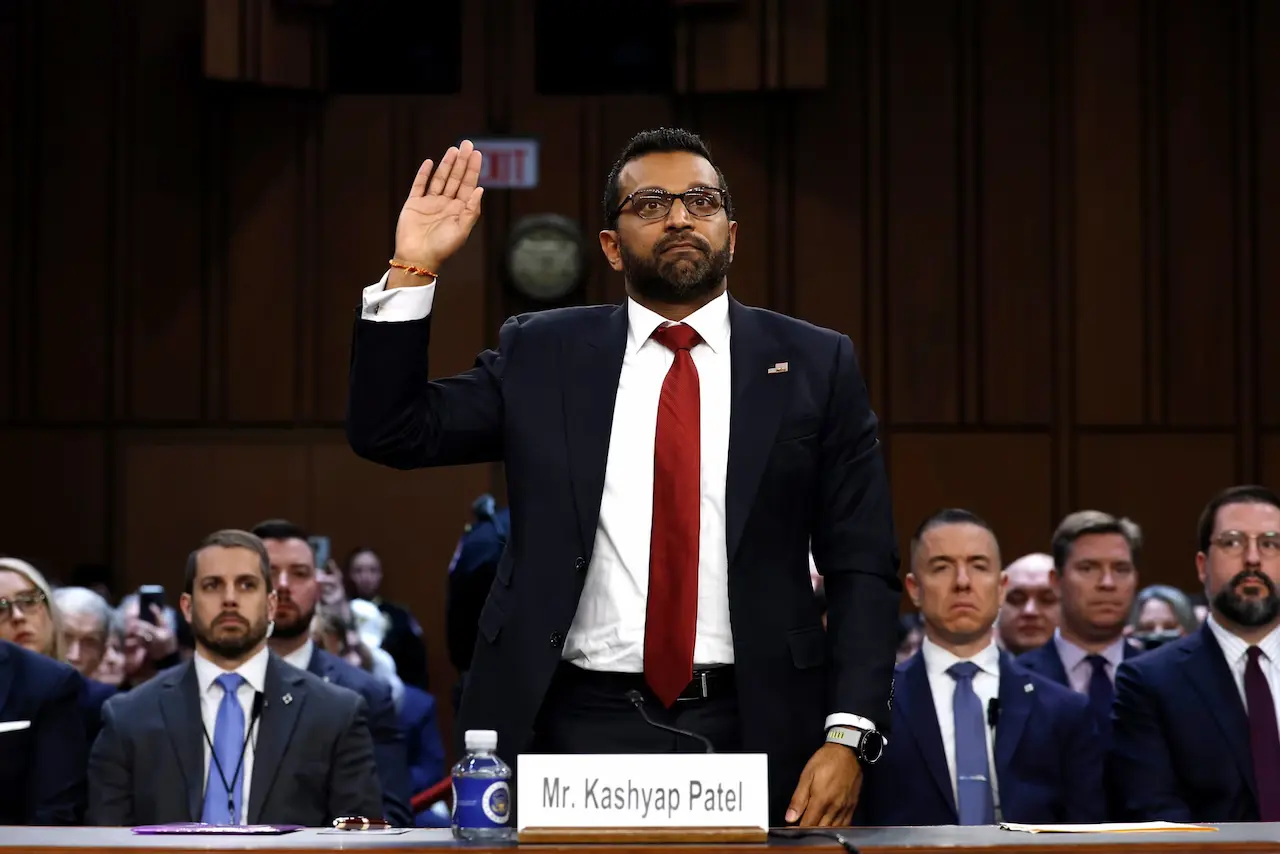
Kash Patel Takes Over as FBI Director Amid Political Storm and Retribution Fears 13
Kash Patel has officially assumed the role of FBI Director, calling the appointment the “greatest honor” of his life. His Senate confirmation on Thursday passed by a narrow 51-49 vote, with Republican Senators Susan Collins and Lisa Murkowski breaking ranks to oppose him.
President Donald Trump, speaking ahead of Patel’s swearing-in on Friday, praised him as “the best ever” for the position, adding that “agents love this guy.” The ceremony, conducted by Attorney General Pam Bondi, was attended by key Republican allies, including Sen. Ted Cruz and Rep. Jim Jordan.
Patel takes over an FBI embroiled in turmoil, with the Justice Department ousting senior officials and demanding names of agents involved in the January 6 Capitol riot investigations. His appointment has sparked Democratic concerns that he may use the FBI to target Trump’s political opponents, citing his past remarks about going after “anti-Trump conspirators” in government and media.
At his confirmation hearing, Patel denied any plans for retribution, vowing to uphold the Constitution. However, in his speech on Friday, he lashed out at the press, accusing reporters of publishing “fake, malicious, slanderous, and defamatory” stories about him.
Backed by Republicans frustrated over what they perceive as law enforcement bias against conservatives under President Joe Biden, Patel has pledged to implement major reforms at the FBI. He aims to reduce the agency’s Washington presence and shift focus back to traditional crime-fighting rather than intelligence-gathering.
While asserting that the FBI’s national security mission remains critical, Patel warned that anyone threatening the country “will face the full wrath of the DOJ and FBI”. He vowed a global manhunt against criminals, stating, “We will find you, and we will decide your end-state.”
A former Justice Department counterterrorism prosecutor, Patel replaces Christopher Wray, who resigned at the end of Biden’s presidency. Wray, who was originally appointed by Trump in 2017, fell out of favor with the former president after the FBI raided Mar-a-Lago in 2022 in connection with classified documents.
While FBI directors traditionally serve 10-year terms to maintain independence from political influence, Trump has now replaced two—James Comey and Wray—within just a few years, raising concerns about the bureau’s future under Patel’s leadership.
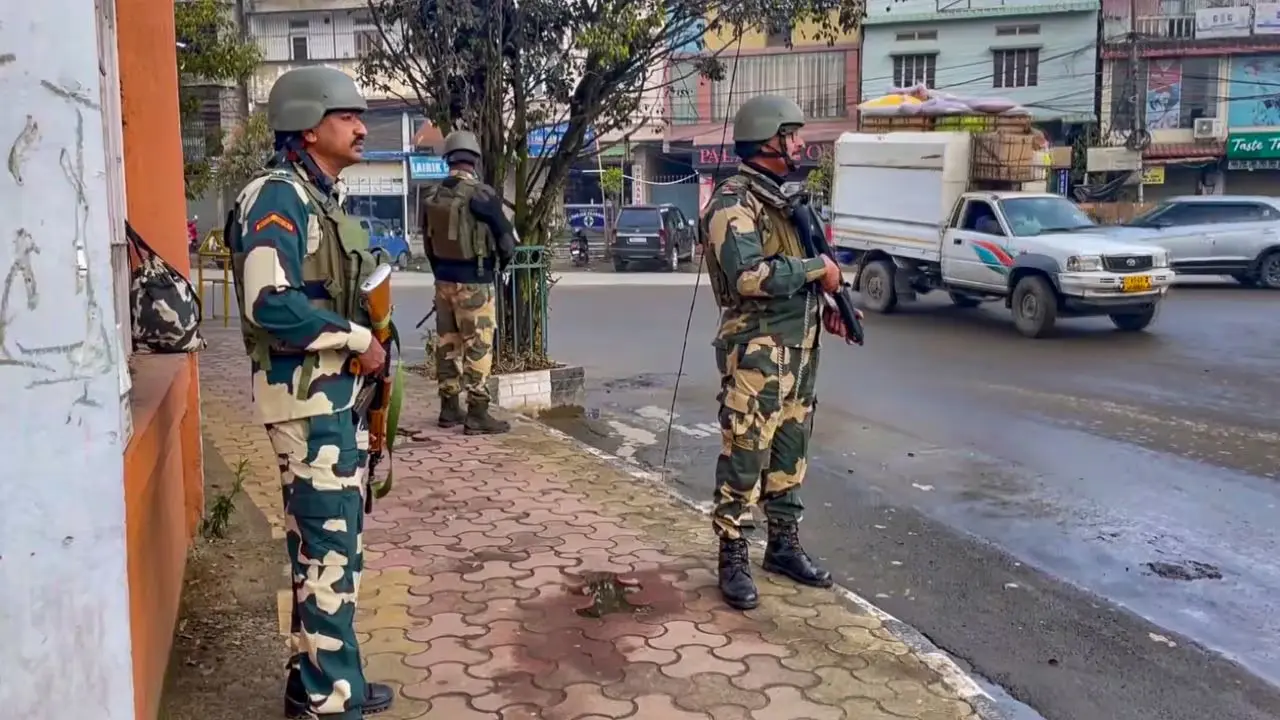
Manipur Under President’s Rule: Major Bureaucratic Reshuffle with 11 Transfers 15
In a major bureaucratic reshuffle following the imposition of President’s Rule in Manipur, the state government has transferred 11 senior officials, including six police officers, according to an official statement issued on Friday.
Among the key transfers, Tamenglong Superintendent of Police (SP) Babitarani Swain has been reassigned as SP of Chandel district, while the Chandel SP has been moved to Tamenglong. Inspector General of Police (IGP) Kabib K, previously handling Internal Security, Narcotics, and Border Affairs, has been shifted to IGP Zone-III. Additionally, DIGP (NAB) Ningshen Worngam has been promoted and posted as IGP (Internal Security & Narcotics Affairs).
The administrative reshuffle also impacts top bureaucrats, with Commissioner cum Secretary N Geoffrey, who previously handled portfolios including the Chief Minister’s Secretariat, Social Welfare, and Cabinet Affairs, now posted solely as Commissioner cum Secretary for Social Welfare.
The political turmoil in Manipur escalated after Chief Minister N. Biren Singh resigned, prompting the imposition of President’s Rule on February 13. The Manipur Legislative Assembly, which has tenure until 2027, has been placed under suspended animation, leaving governance under direct central control.
With this reshuffle, the administration is expected to streamline governance amid the ongoing crisis, but concerns remain over political instability and security challenges in the northeastern state.
The Battle for Mumbai: BMC Elections and Maharashtra's Political Power Struggle 17
The forthcoming Brihanmumbai Municipal Corporation (BMC) elections hold profound political significance, not only for Mumbai but for the larger landscape of Maharashtra. As the richest municipal body in India, the BMC has long been a stronghold of the Uddhav Thackeray-led Shiv Sena, now known as the Shiv Sena (UBT). However, the political equation has undergone a dramatic transformation following the split within the party and the emergence of the ruling Mahayuti alliance, comprising the Bharatiya Janata Party (BJP), Eknath Shinde’s Shiv Sena, and Ajit Pawar’s faction of the Nationalist Congress Party (NCP). With the electoral battle drawing closer, the contest for control over the BMC is intensifying, particularly as the Shiv Sena (UBT) grapples with internal turmoil and a growing exodus of leaders.
The recent defection of several prominent leaders from the Uddhav Thackeray faction to the Shinde camp has further exacerbated the crisis within the party. In an effort to stem the tide of desertions, Uddhav Thackeray convened a crucial meeting of party MLAs and MPs to reinforce unity and counter the alleged ‘Operation Tiger’—a targeted strategy by the ruling alliance to weaken the Thackeray-led faction. The ruling Shiv Sena, under the leadership of Deputy Chief Minister Eknath Shinde, has been systematically luring leaders away from the UBT faction. Recently, multiple office-bearers from the Konkan region, along with key leaders like Rajan Salvi and former MLA Subhash Bane, switched allegiance to Shinde’s faction. Adding to the turmoil, Chiplun MLA Bhaskar Jadhav has expressed dissatisfaction, fueling speculation that he, too, may defect. The erosion of leadership within the Shiv Sena (UBT) poses a direct challenge to Thackeray’s ability to retain control over the BMC, making the upcoming elections a decisive test of his political relevance.
Amid these developments, internal party discipline has emerged as a focal point of concern. Aaditya Thackeray, during the ongoing Budget Session in Delhi, issued strict directives to party MPs, warning them against attending any events organized by the Shinde-led Shiv Sena without prior approval from the UBT leadership. This move, however, has reportedly caused discontent among certain party members. Meanwhile, delays in ‘Operation Tiger’ in Pune have momentarily stalled the entry of several former MLAs and over 20 municipal corporators into the ruling alliance. Despite these temporary setbacks, the overall trend of defections remains a significant cause for worry within Thackeray’s camp.
The administrative control of the BMC has been in limbo for the past two and a half years, with an administrator overseeing its functioning. The legal battle over the municipal ward structure adds another layer of complexity. The Eknath Shinde-led government’s decision to reduce the number of wards in the BMC from 236 to 227 through an ordinance is currently under judicial scrutiny. Additionally, the Supreme Court is deliberating on key matters concerning the number of councillors per ward in urban and rural bodies, as well as determining whether the state government or the Election Commission should hold the authority to decide ward delimitation. Even if the court delivers a verdict soon, officials estimate that it could take at least three more months to finalize preparations and conduct the polls. With municipal elections pending not just for the BMC but also for 29 municipal corporations and approximately 280 nagar parishads and nagar panchayats across the state, Maharashtra’s civic electoral landscape remains uncertain.
In response to the political crisis, Uddhav Thackeray’s faction is adopting a multi-pronged strategy to mitigate damage and consolidate its base. Senior leaders, including deputy leaders and secretaries, have been entrusted with critical responsibilities aimed at preventing further defections and maintaining organizational stability. A special core group of 14 senior leaders—including Subhash Desai, Diwakar Raote, Aaditya Thackeray, Anant Geete, Sanjay Raut, Chandrakant Khaire, Bhaskar Jadhav, Vinayak Raut, Anil Desai, Anil Parab, Arvind Sawant, Ambadas Danve, Rajan Vichare, and Sunil Prabhu—will meet weekly to assess developments and formulate strategic responses. Additionally, statewide outreach programs have been initiated, with key party leaders engaging with the grassroots cadre to address grievances and strengthen party loyalty.
Disciplinary measures are also being reinforced to curb internal dissent. Those found engaging in anti-party activities while still being part of the Shiv Sena (UBT) will face strict action. Thackeray’s faction currently boasts 14 senior leaders, 43 deputy leaders, and 10 secretaries, all of whom are tasked with fortifying the party’s structural integrity across Maharashtra. As part of its damage control exercise, the party has also initiated weekly review meetings every Tuesday at Sena Bhavan, where regional and district-level leaders will report on the ground situation and devise necessary countermeasures.
Despite these efforts, the challenge remains formidable. The exodus of leaders continues to weaken Thackeray’s faction, and the looming municipal elections will be a crucial test of its ability to retain the reins of the BMC. With the Mahayuti alliance aggressively working to expand its footprint in Mumbai’s civic governance, the battle for the BMC is poised to be one of the most consequential political showdowns in recent times. The elections will not only determine control over Mumbai’s municipal administration but will also serve as a barometer for the shifting political dynamics in Maharashtra. The coming months will reveal whether Uddhav Thackeray’s strategic interventions can arrest the wave of defections or if the Mahayuti’s relentless consolidation will ultimately reshape the city’s political future.
Wrong to Infer From Maharashtra Results That Congress Has Weakened; Course Correction Soon: State Chief Sapkal 19
Maharashtra Congress president Harshwardhan Sapkal has said it would be wrong to conclude that his party has weakened after its worst-ever performance in the recent Maharashtra assembly polls.
Calling the present scenario a “do-or-die situation”, Sapkal, who recently took charge as the Maharashtra Congress chief, said he has accepted the challenge to revitalise the state unit.
“It is a wrong perception that the cadre is demoralised… election results were shocking and the cadre is eager for a course correction. We won only 16 seats but that doesn’t mean we have become weak. You will see their enthusiasm once we get into the action mode,” Sapkal told PTI in an interview.
The Congress, a partner of the Shiv Sena (UBT) and NCP (SP) in the opposition Maha Vikas Aghadi (MVA) bloc, won just 16 of the 288 assembly seats in last year’s Maharashtra polls despite fielding candidates in 101 constituencies.
Sapkal accused the BJP-led government of not wanting to hold local body elections, saying he doesn’t foresee any such polls in the near future. Civic elections in Maharashtra have been pending for nearly two years.
“The Panchayati Raj amendments resulted in the devolution of power at the grassroots level. But the government doesn’t want local body elections to happen. People have also forgotten that there were elected representatives in the form of corporators and Zilla Parishad members,” he said.
Stressing the need for civic polls, Sapkal alleged that the idea of India was envisaged in the 73rd and 74th Constitutional Amendments, which established local self-governance in urban and rural areas, but was not being allowed to take shape.
“There are 4,250 MLAs and 750 MPs in the country. How can such a large country of 140 crore people, about 30 states, 8,000 cities, and more than 6 lakh villages function under the leadership of about 5,000 elected representatives?”
“But the BJP wants all powers in the hands of the chief minister in states and the prime minister and Union home minister at the Centre. Legal complications were created over OBC (Other Backward Classes) quota in many states and there were many litigations,” he claimed.
Sapkal said he has accepted the challenge to lead the state Congress unit which saw its worst-ever performance in last year’s assembly polls. “I have the support and backing of the cadre and leaders. It’s a do-or-die situation for us,” he said.
The prevailing political strategy is perception creation, and the BJP tried to trap us by shaping a narrative against the Congress, he said.
The ground reality is all about issues connected to people’s livelihood like the cost of cultivation, crop rate for farmers, unemployment and price rise, he said. But the government wants to protect the interests of a few, he alleged.
“Today, there are only two ideologies – BJP and Congress. We have to fight the ideological battle unitedly and in a disciplined way,” he said.
The Congress leader claimed caste and religion are being used to create a trust deficit in society and said there was a need to maintain social harmony.
“We must work towards ensuring harmony in the state whose social fabric has been strained. We have to establish ‘sadbhavana (goodwill)’. Otherwise, the crisis will affect not just the future generations but our own lifetime as well,” he said.
The structure of the Congress is solid and capable of handling this social crisis, he said.
“The links of coordination among voters, cadre and leaders which have loosened need to be strengthened. Responsibility and accountability need to be fixed. Giving mass leaders responsibility, accommodating loyalists and replacing inefficient office-bearers will be my focus areas,” he said.
Sadbhavana meetings and training programmes all over the state will also be his priority areas, Sapkal said.
Unlike the BJP whose backbone is the RSS, the Congress’s backbone is its legacy and traditions, said Sapkal.
“The Congress’ DNA is the country’s DNA because the Congress is a mass-based party. We need to address any loopholes within the party,” he said.
Sapkal said even though the Congress faces challenging times, it trusts the people of the country and will continue to raise their issues.
“There is not a single village in the country which doesn’t have a Congress worker. In times of struggle, everyone unites. At present, a lot of doubts are being raised about the party but the fact is that the Congress is still strong,” he asserted.