


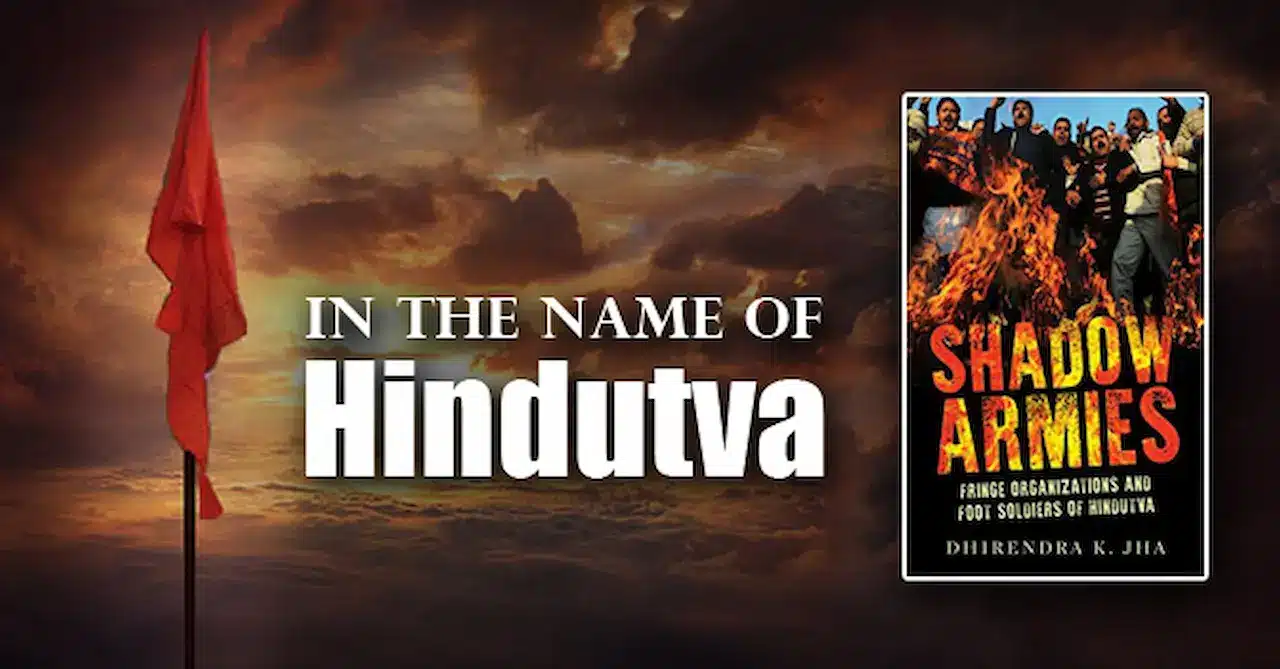
I opened Shadow Armies: Fringe Organizations and Foot Soldiers of Hindutva expecting rigor—cold facts, verifiable linkages, evidence that survives cross-examination. What I found instead was prosecution without a courtroom. The book doesn’t investigate; it indicates. It doesn’t interrogate assumptions; it sermonises. From page one, it’s clear the author isn’t searching for truth but assembling a case—brick by selective brick—against Hindutva and, by convenient extension, against the Rashtriya Swayamsevak Sangh and the Bharatiya Janata Party.
The intellectual backbone of this narrative rests on a reckless shortcut: ideological proximity equals operational control. That isn’t courage—it’s laziness dressed up as bravery. Every fringe group, every local outfit, every individual crime is dragged under one oversized umbrella and christened “foot soldiers,” as if millions of RSS volunteers across generations operate from a single, hidden command room. No documents. No command chains. No financial trails. No institutional directives. Just insinuation, repeated until it starts masquerading as proof. Call it a “shadow,” and suddenly the absence of evidence becomes evidence. Clever trick. Cheap method.
What the book studiously avoids is the most inconvenient question of all: why are the RSS and Hindutva permanent targets? Not because they’re invisible—they’re among the most visible social formations in India. Not because they’re uniquely violent—India’s bloodiest chapters were written by separatists, Maoists, jihadi networks, and caste militias. They are targeted because they endure. Because they’re rooted. Because they mobilise without foreign funding, without intellectual clearance certificates, and without apologies. In an elite ecosystem trained to distrust Hindu assertion while normalising every other identity politics, a disciplined Hindu organisation becomes an existential irritant.
Reading Shadow Armies feels less like history and more like a refurbishment of an old prejudice for a new market. It mistakes mass participation for menace, structure for conspiracy, and cultural confidence for extremism. The anxiety it reveals belongs not to Hindutva but to an ideological class unsettled by its resilience. When hostility comes before inquiry, history is not written—it’s replaced by propaganda with footnotes.
The book’s favourite trope—that the BJP’s rise from two Lok Sabha seats in 1984 to a decisive majority in 2014 “caused” a mushrooming of violent Hindu organisations—is not analysis; it’s ideological storytelling. The conclusion is decided first; causality is reverse-engineered later. Electoral success is treated as forensic evidence. Popular mandate is reframed as moral deviance. Democracy itself is hauled into the dock for choosing the “wrong” side.
The claim that the BJP’s ascent was “accompanied” by groups whose sole purpose is to polarise and kill “in the name of Hindutva” borders on bad faith. Hindu social organisations didn’t pop into existence in the 1990s. Many pre-date the BJP’s relevance—arising as cultural, religious, or reactionary responses to decades of selective secularism, minority appeasement, academic capture, and routine delegitimisation of Hindu identity. Political rise doesn’t manufacture social churn; it reflects it.
The most dishonest move here is the deliberate blurring of ideology and command. The BJP does not run these organisations. The RSS does not issue operational orders to them. Hindutva is not a central headquarters dispatching kill lists. If ideological influence equals culpability, then by that logic every Left-inspired riot must be pinned on Marxist theorists, every Islamist terror act on religious institutions, and every separatist violence on sympathetic intellectuals. That standard collapses the moment the subject becomes Hindu society.
Entities as dissimilar as spiritual groups, youth outfits, and local pressure formations are lumped together to fabricate a single sinister machine. This isn’t investigation; it’s aggregation. Distinctions are erased because nuance doesn’t serve fear.
Take Sanatan Sanstha. Allegations against individuals are endlessly paraded as organisational guilt, as if due process were optional. Even the still-sub judice murder of Gauri Lankesh is exploited to indict an entire ideological spectrum. Verdicts are ignored, closure denied—only perpetual accusation remains. Courts are replaced by outrage.
Then comes Yogi Adityanath and the Hindu Yuva Vahini, wheeled out as proof of state-sponsored extremism. What’s quietly buried is chronology. HVY predates Adityanath’s constitutional role and emerged in regions long abandoned by governance. Criticise methods if you must—but turning it into a nationwide “shadow army” requires either selective amnesia or deliberate exaggeration.
The real discomfort here isn’t violence; it’s legitimacy. The BJP shattered a monopoly that believed narrative control and moral authority were hereditary rights. When voters across caste and class chose the BJP—again and again—the response wasn’t introspection. It was pathology: something must be wrong with the voters; something dark must be manipulating them.
Hence the myth of “shadow armies”—a convenient ghost story that spares the establishment from admitting a simpler, harsher truth: Hindutva gained ground because it resonated—socially, culturally, politically. Indians voted for something: identity, governance, confidence. They weren’t herded by imaginary foot soldiers.
This book isn’t about understanding India. It’s about controlling how India is allowed to be understood—criminalising cultural assertion, delegitimising democratic mandates, and placing Hindu society under permanent suspicion. When ideology blinds inquiry, scholarship dies. What’s left is propaganda—smoothly written, heavily footnoted, and hollow at the core.
