


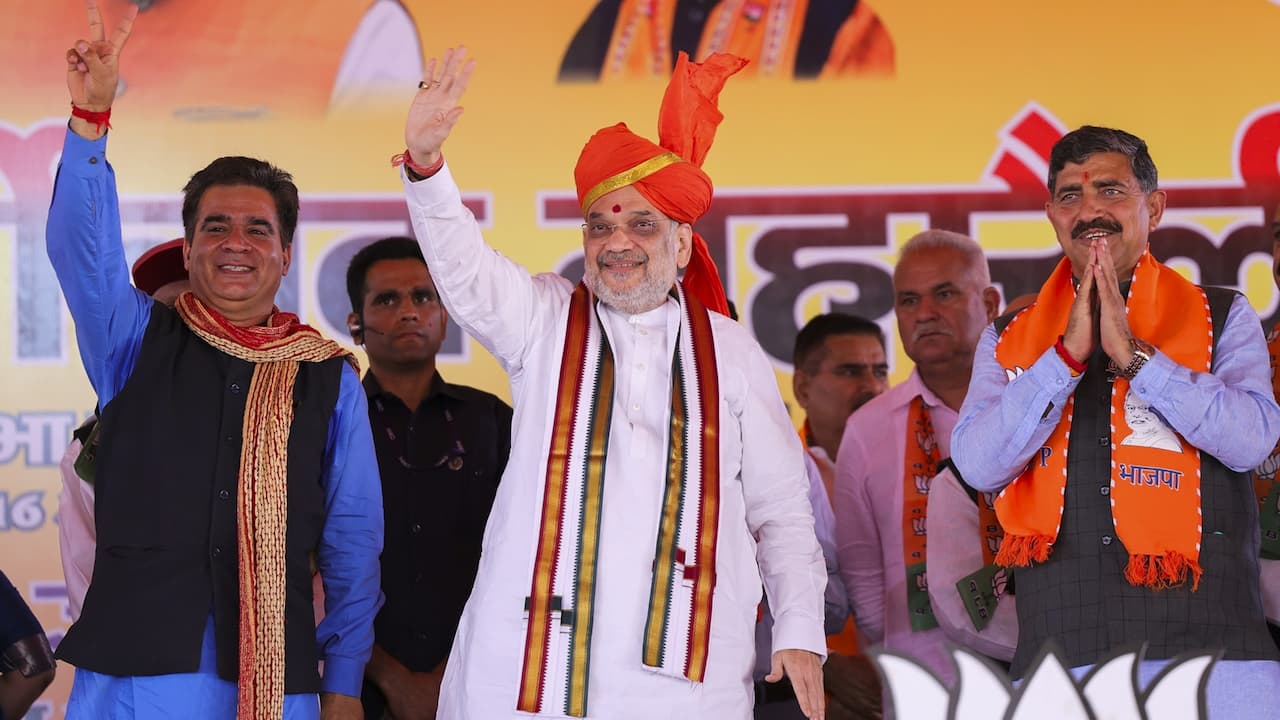
BJP was very likely to lose in Kashmir valley, especially as they don’t have political allies there anymore. On the other hand, Congress leader Rahul Gandhi officially launched the party’s campaign for the upcoming Assembly election in Jammu and Kashmir, declaring that the Congress would “restore statehood to J&K after coming to power.” He emphasized that the Bharatiya Janata Party (BJP) must restore statehood to the region, or the INDIA (Indian National Developmental, Inclusive Alliance) bloc, led by opposition parties, would take it up as their first priority upon defeating Prime Minister Narendra Modi and his party. Gandhi, who is also the Leader of the Opposition in the Lok Sabha, stated, “We will ensure the return of statehood to the region, whether the BJP wants it or not. We will pressurize the government under the banner of the INDIA alliance.” His statements reaffirm the Congress’s commitment to reversing the BJP-led government’s decision to revoke Jammu and Kashmir’s statehood in 2019.
Come September, Jammu and Kashmir will witness its first assembly election in a decade, providing the people a long-awaited chance to elect local representatives and have a say in government decision-making. The polls, set to take place for 90 assembly seats—43 in Jammu and 47 in Kashmir—will be conducted in three phases from September 18 to October 1. This will be the first assembly election since the abrogation of Article 370 and the region’s downgrading to Union Territory status in August 2019. In the June Lok Sabha election, the National Conference (NC) and the Bharatiya Janata Party (BJP) secured two seats each, with the NC dominating in Kashmir and the BJP in Jammu. The fifth seat was won by Awami Ittehad Party (AIP) candidate Sheikh Abdul Rashid, commonly known as Engineer Rashid. In Jammu, the BJP had a strong showing with over 24 percent of the vote share, followed by the Congress at 19.4 percent. In the Kashmir Valley, the National Conference captured 22.3 percent of the vote, while the Peoples Democratic Party (PDP) managed 8.5 percent. This division of votes reflects the region’s political landscape, with the BJP maintaining its dominance in the Jammu region and the NC and PDP continuing to hold influence in Kashmir.
Jammu and Kashmir has been under direct central rule for over six years, since June 2018, and this election marks a significant moment for the region as it prepares to restore local governance. Over four years after the Bharatiya Janata Party (BJP) revoked the special status of Indian-administered Kashmir, the party has decided not to contest this year’s general election in the region. Political analysts and opposition leaders suggest that this decision signals possible discontent in the region over the move, as well as an implicit acknowledgment by the BJP of the challenges it faces there. Relations between Kashmir and Delhi have been strained for decades, with a prolonged insurgency against Indian rule and military action resulting in thousands of deaths in the Himalayan region over the past several decades. The situation worsened in 2019 when Prime Minister Narendra Modi’s government revoked most of Article 370, which had granted significant autonomy to Jammu and Kashmir. The region was subsequently bifurcated into two federally-administered territories: Ladakh, and Jammu and Kashmir.
Following the 2019 decision, the government also imposed a strict communication blockade and detained hundreds of political leaders, including three former chief ministers, for extended periods. Since then, Modi and his ministers have consistently defended the move, claiming that it has brought peace to the region. In recent years, local BJP leaders have conducted extensive grassroots campaigns in Kashmir, attempting to broaden the party’s support base. However, the BJP’s decision not to field candidates in the ongoing general election in Kashmir—the first since the revocation of Article 370—has surprised many. While the party has fielded candidates in two Hindu-majority seats in Jammu, it has not done so in the three Muslim-majority seats of the Kashmir Valley.
The BJP’s chief spokesperson in Jammu and Kashmir, Sunil Seth, explained that elections were not the party’s priority, stating that their main objective was to “win the hearts of the people.” He further emphasized that integrating Kashmir fully with the rest of India had been a long-term goal, and they did not want to create the impression that the effort was merely for electoral gains. Critics, however, argue that the decision reflects the party’s recognition that securing a victory in the region would be challenging.
