


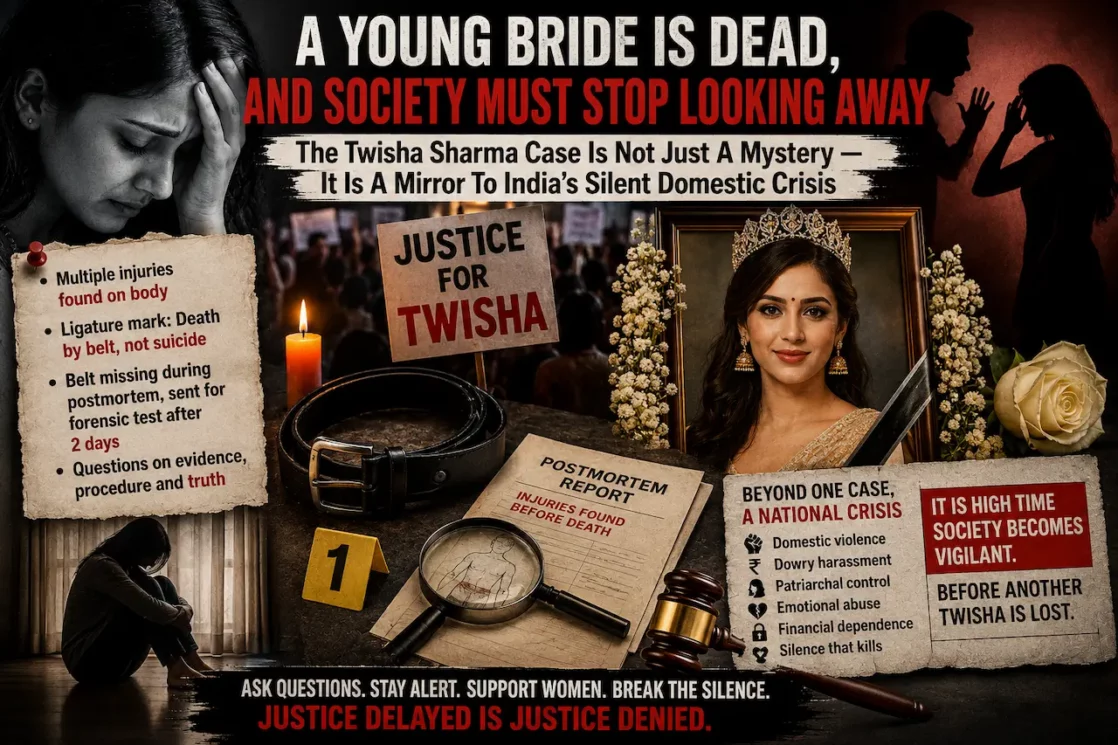
Bhopal is not merely witnessing another sensational headline. The death of Twisha Sharma has now become a disturbing symbol of everything Indian society refuses to confront honestly — toxic marriages, hidden domestic abuse, dowry pressure, emotional torture, social hypocrisy, and the dangerous protection of influence over truth.
What initially appeared to be a straightforward case of suicide has slowly transformed into a deeply controversial and emotionally explosive investigation. Every new forensic detail, every legal development, and every public statement emerging from this case has raised even more troubling questions.
And the most dangerous thing about this case is not only the death itself — it is the possibility that the truth may get buried beneath status, power, legal games, and carefully manufactured narratives.
Twisha Sharma was not an anonymous woman lost in statistics. She was educated, ambitious, independent, and known in public life. Before entering the corporate world, she had participated in beauty pageants, earned recognition as a former Miss Pune, and appeared in film projects including Mugguru Monagallu and Zara Sambhal Kay. She later moved away from cinema and worked as a marketing manager in the hospitality and restaurant sector.
Like countless young women in India, she stepped into marriage carrying dreams, trust, emotional hope, and the belief that she was entering a secure future.
But barely five months after marrying Samarth Singh in December 2025, she was found dead inside her husband’s residence in Bhopal’s Katara Hills area.
The first version presented to the public was simple: suicide.
But the deeper the investigation goes, the weaker that simplicity appears.
According to reports, the postmortem documented multiple ante-mortem injuries on Twisha’s body — abrasions on the neck, bruises on the arm, wrist, finger, and even injuries beneath the scalp. The report also reportedly noted classic signs associated with asphyxia, including bluish discolouration of the ears and fingernails, facial congestion, and petechial haemorrhages in the eye.
Then came the most explosive revelation — the ligature report.
Investigators reportedly concluded that Twisha died due to asphyxia caused by a belt allegedly used as the ligature material. But this revelation immediately triggered another deeply disturbing question: if the belt was such critical evidence, why was it reportedly absent during the initial postmortem examination?
How does a crucial piece of forensic evidence disappear during one of the most sensitive stages of investigation and then suddenly reappear two days later for forensic analysis?
Who handled that evidence?
Where was it kept?
Why was it not sealed immediately?
Was protocol violated?
Was there negligence?
Or was someone trying to shape the narrative before forensic scrutiny complicated the official version?
These are not conspiracy theories. These are legitimate investigative concerns that any transparent system must answer clearly and fearlessly.
The situation becomes even more complicated because the accused family is not socially powerless. Twisha’s husband Samarth Singh and his mother, retired judge Giribala Singh, now stand accused amid growing allegations of mental harassment and dowry-related abuse. While Samarth is reportedly absconding and police have announced a reward linked to his arrest, anticipatory bail granted to the retired judge has already triggered public debate about how differently the justice system appears to function when influence enters the room.
This is precisely why public trust begins collapsing in high-profile cases.
Ordinary citizens start wondering whether investigations remain genuinely independent when powerful names become involved. People begin questioning whether evidence is being examined honestly or merely managed carefully.
The growing anger surrounding this case intensified further during a press conference involving the lawyer representing the former judge. When journalists questioned him regarding reports about the divorce of the family’s elder daughter-in-law, the response was not calm clarification but visible irritation. “Can’t you get divorced too?” he reportedly snapped back.
But the media’s question was not irrelevant gossip.
The question mattered because allegations are now surfacing that previous daughters-in-law in the family may also have faced distress and humiliation. Whether those allegations are eventually proven or disproven is a separate matter. But dismissing such questions with aggression instead of transparency only deepens public suspicion.
And this is where the Twisha Sharma case stops being about one family alone.
It becomes a mirror reflecting a brutal social reality that India still refuses to acknowledge openly.
Behind thousands of respectable homes, many women continue to live under suffocating emotional pressure. They are expected to tolerate humiliation silently in the name of adjustment, marriage, tradition, and family honour. They are taught that “good women” endure everything quietly.
If the husband drinks excessively, tolerate it.
If he becomes violent, stay silent.
If in-laws mentally torture you, compromise.
If dowry pressure continues, adjust.
If your mental health collapses, hide it.
If you cry for help, society often sends you back to the same house with advice to “save the marriage.”
This silence is deadly.
India today faces a deeply uncomfortable reality: suicide among married women has quietly become a national crisis.
Data repeatedly shows that married women form a disturbingly high percentage of female suicides in the country. Unlike many Western societies where marriage often acts as emotional support, for countless Indian women marriage becomes the beginning of social isolation, emotional dependency, financial helplessness, and psychological imprisonment.
Domestic violence remains one of the strongest hidden triggers. Dowry harassment continues despite decades of laws and public campaigns. Patriarchal control inside households still dictates how women dress, speak, work, socialize, and live. Many women lose not only freedom after marriage — they lose identity itself.
And the tragedy is that abuse does not always leave visible wounds. Sometimes the most dangerous violence is emotional. Constant humiliation, Gaslighting, Threats, Control, Isolation, Mockery, Manipulation, Fear, Financial dependency, Subtle intimidation. These things slowly destroy a person internally long before society notices anything is wrong.What makes matters worse is the social obsession with appearances.
Parents often investigate salary packages, luxury homes, family status, political influence, property, and caste background before marriage. But they rarely ask the most important questions.
How does the man behave under stress?
Does he abuse substances?
Does he show violent tendencies?
How does the family treat women?
What is the emotional environment inside that household?
What is their history with daughters-in-law?
Do they believe marriage is partnership — or ownership?
These questions are not disrespectful. They are necessary.
Because expensive weddings and respectable surnames cannot protect a daughter from psychological destruction inside a toxic home.
Society must also stop glorifying silent suffering in women. Endurance is not always strength. Sometimes endurance becomes slow emotional death.
If a daughter repeatedly expresses fear, distress, humiliation, or emotional exhaustion after marriage, families must take it seriously immediately. Not after public scandal. Not after violence escalates. And certainly not after a funeral.
The Twisha Sharma case deserves neither media hysteria nor blind assumptions. No investigation should become a public lynching. But neither should uncomfortable questions be buried under influence, legal intimidation, or reputation management.
A fearless investigation is not anti-family.
Transparency is not character assassination.
Demanding accountability is not disrespect.
And asking difficult questions is not conspiracy.
If evidence appears inconsistent, if forensic gaps exist, if timelines raise suspicion, and if crucial questions remain unanswered, then society has every right to demand clarity.
Because once people begin believing that truth itself can be negotiated by power, institutions lose moral authority.
A young woman is dead.
And somewhere between forensic reports, legal strategies, missing evidence, public statements, and emotional outrage lies the truth of what happened inside that house.
India owes Twisha Sharma more than headlines.
It owes her honesty.
It owes her accountability.
And above all, it owes her justice.
