


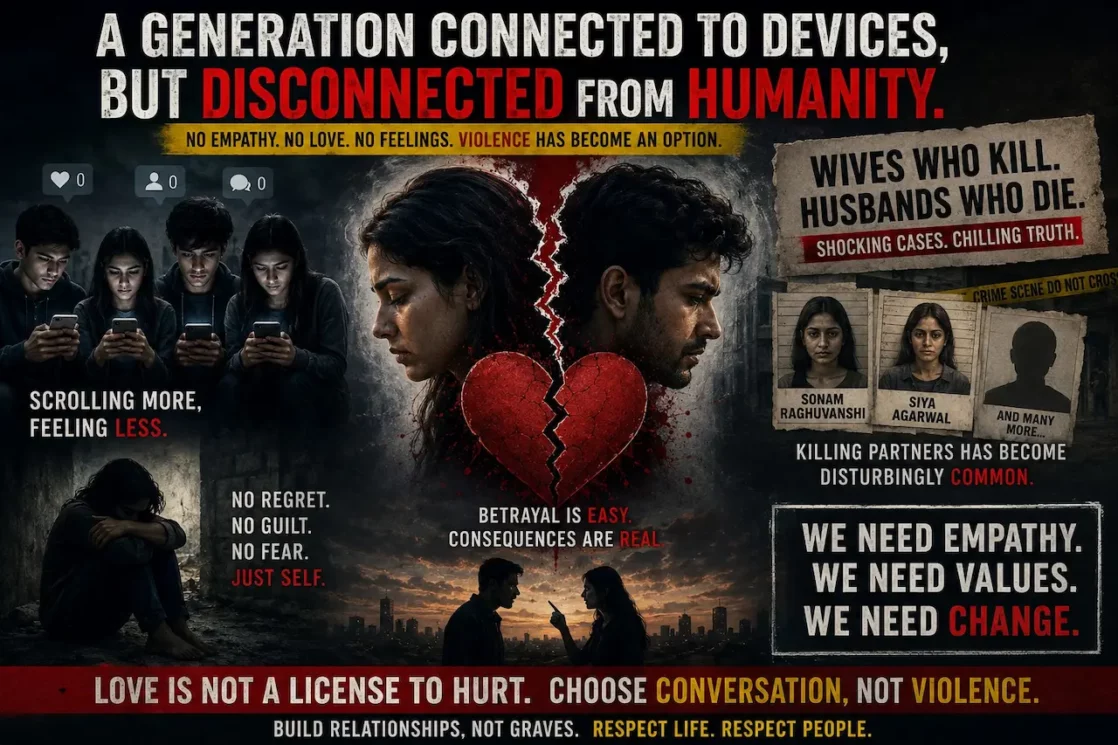
There was a time when relationships ended with tears, heartbreak, and painful conversations. Today, an increasingly disturbing pattern is emerging—some relationships are ending not with separation, but with calculated violence. What is even more unsettling is not merely the crime itself, but the apparent absence of remorse that follows.
The recent cases involving Sonam Raghuvanshi and Siya Goyal have horrified the nation. While the legal process must determine individual guilt and every accused deserves a fair trial, reports surrounding these cases have left society asking uncomfortable questions. Investigators have alleged that during interrogation, there was little visible remorse. One report even claimed that Siya requested pizza while in police custody—a request that officers reportedly rejected, reminding her she was facing murder charges, not enjoying a holiday.
Whether every detail ultimately stands scrutiny in court is secondary to the larger question these cases force us to confront.
What has happened to our collective conscience?
Why does it appear that for some people today, eliminating a partner has become easier than ending a relationship?
Marriage is no prison. Relationships are not life sentences. Every individual has the right to walk away from a toxic, unhappy, or incompatible partnership. Divorce exists. Separation exists. Legal remedies exist. Family courts exist. Counselling exists. Yet some individuals are choosing deception over dialogue and murder over exit.
That is what should alarm us.
This is not merely about crime. It is about the gradual death of empathy.
Across India, investigators have uncovered several shocking spousal homicide cases over the past year. In Kanpur, a woman allegedly conspired with her lover to kill her husband. In another case, a retired Army soldier was allegedly murdered, his body dismembered and discarded while a false missing complaint was filed. In Haryana, a YouTuber and her alleged accomplice stand accused of strangling her husband before dumping his body. In Uttar Pradesh, another newly married woman allegedly plotted her husband’s murder within weeks of the wedding.
Each case has its own facts, motives and legal complexities. Some involve alleged extramarital affairs. Others revolve around financial disputes, property conflicts, or long-standing resentment. Some stem from abusive marriages, while others appear to involve cold calculation.
No single explanation fits every case.
But a common thread keeps emerging—the shocking ability of some perpetrators to compartmentalize human life.
How does someone share meals with another person, celebrate festivals together, promise lifelong companionship—and then allegedly plan their death with remarkable composure?
That question should haunt us.
Experts have long pointed out that spousal homicide is a complex phenomenon. Women who kill their husbands often do so under vastly different circumstances. Many documented cases involve years of severe domestic violence, relentless abuse, coercive control, or situations where victims feel completely trapped. Others involve extramarital relationships, financial motives, inheritance disputes, untreated mental illness, or personality disorders.
Likewise, men continue to account for the overwhelming majority of intimate partner killings in India. Every year, countless women lose their lives to dowry deaths, domestic violence, and marital cruelty. These realities cannot be ignored simply because recent headlines have focused on wives accused of murder.
Violence has no gender.
Neither does evil.
Yet what makes these recent incidents particularly disturbing is not only the act itself but the perception that some accused individuals displayed little visible guilt afterward. If those observations are accurate, they point towards something much deeper than criminal intent. They suggest emotional detachment.
That emotional detachment may well be one of the defining psychological crises of our age.
We are raising a generation that is more digitally connected than ever before but emotionally disconnected from one another.
Relationships have become increasingly transactional. Convenience often replaces commitment. Instant gratification replaces patience. Social media encourages people to curate perfect lives while hiding fractured realities. Dating apps create the illusion that every disagreement can simply be replaced by another partner waiting one swipe away.
The result?
Human beings begin to resemble disposable commodities.
When people become disposable, empathy disappears.
When empathy disappears, betrayal becomes easier.
When betrayal becomes easier, violence no longer seems unimaginable.
Parents teach children to score marks but rarely teach emotional resilience. Schools discuss careers but seldom teach conflict resolution. Families celebrate weddings worth crores while ignoring whether the couple possesses the emotional maturity required for marriage itself.
Perhaps our greatest educational failure is that we have produced brilliant professionals who cannot handle rejection, disappointment, or emotional conflict.
A generation that knows how to earn money but not manage anger.
A generation fluent in technology but illiterate in compassion.
Of course, not every failed marriage ends in violence. The overwhelming majority of people navigate heartbreak without committing crimes. Yet these exceptional cases reveal uncomfortable truths about what happens when emotional immaturity combines with resentment, entitlement, or manipulation.
There is another difficult conversation society must finally have.
Justice cannot operate through gender stereotypes.
For decades, discussions around domestic violence have rightly focused on protecting women. That work remains essential. However, recognising female victimhood should never prevent us from acknowledging male victimhood. Men too can be emotionally abused, manipulated, blackmailed, falsely accused, assaulted, or even murdered by intimate partners.
Compassion cannot be selective.
The law should protect every victim equally, regardless of gender.
That requires stronger gender-neutral legal safeguards, accessible mental health services, quicker family court interventions, better counselling facilities, and greater public awareness that ending a marriage is always preferable to destroying a life.
Above all, we need to rebuild empathy.
Empathy is what prevents ordinary people from becoming criminals.
Empathy reminds us that even the person we no longer love is still a human being.
Empathy allows separation without hatred.
Empathy allows disagreement without destruction.
Perhaps the most frightening question raised by these recent tragedies is not why some people kill.
Human history has always known violence.
The more disturbing question is this:
How does someone allegedly kill a person they once claimed to love—and then carry on as though nothing happened?
If that question no longer shocks us, then perhaps the greater tragedy is not these crimes themselves.
The greater tragedy is that society may slowly be losing its ability to feel.
And when a civilisation loses empathy, no law alone can save it.
