


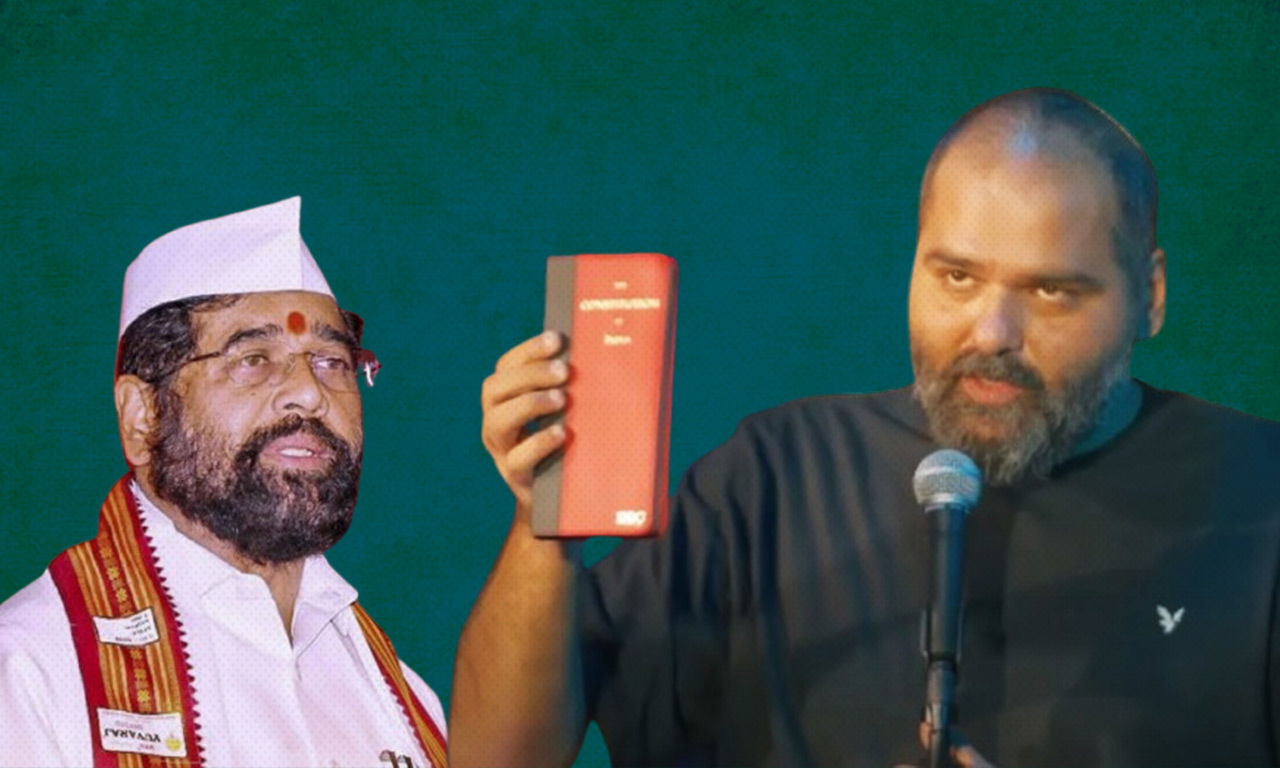
Let me be perfectly neutral—if that’s still legal—and say this: the whole Kunal Kamra saga has been inflated beyond reasonable proportions, like a political balloon with too much hot air and no escape valve. What began as a comedy set has now snowballed into a full-blown constitutional crisis—or at least, that’s what the politicians would like you to believe. The dramatic overreaction, complete with FIRs, vandalism, and privilege motions, makes one wonder whether we’ve all somehow woken up in a political parody skit. Except, unfortunately, the joke’s on democracy.
Now, Kunal Kamra is not exactly a stranger to controversy. If controversies were frequent flyer miles, he’d be cruising in a private jet by now. Since 2014, he’s been poking fun at the ruling establishment with surgical precision, something the powers that be find less humorous and more heretical. In his latest act of comedic blasphemy, Kamra dared—gasp—to sing a parody song referencing Maharashtra’s Deputy Chief Minister Eknath Shinde as a “gaddar,” a term that has now apparently joined the list of banned words alongside common sense and self-reflection.
For context (in case your remote broke and you missed this soap opera), Eknath Shinde pulled a Houdini in June 2022 by leading a rebellion against Uddhav Thackeray, taking a loyal brigade of MLAs on a political pilgrimage to Guwahati—because nothing says party ethics like cross-state defections. His justification? That Thackeray had watered down Hindutva by cozying up to the NCP and Congress. Cue melodrama, legal battles, and backroom bargaining, and soon Shinde emerged as the rightful heir to the Shiv Sena throne—according to the Election Commission, not necessarily the voters.
Naturally, Kamra found this entire situation too juicy to ignore. In a recent performance, he riffed: “Pehle Shiv Sena BJP se bahar gayi, fir Shiv Sena, Shiv Sena se bahar gayi, NCP bhi NCP se bahar gayi… ek voter ko 9 button de diye.” If confusion was a strategy, this election was a masterpiece. But apparently, calling out political somersaults through stand-up comedy now qualifies as a national security threat.
Enter the Zero FIR, served hot and spicy, courtesy Shiv Sena MLA Murji Patel. The police, in a tremendous display of urgency usually reserved for traffic fines and street vendors, summoned Kamra, who lives in Puducherry. Through his lawyer, Kamra politely asked for a week’s time citing work—because even professional troublemakers have schedules. Meanwhile, Shiv Sena’s more muscular wing expressed their disagreement the old-fashioned way—by vandalising the venue of Kamra’s show and the hotel it was hosted in. Nothing screams dignity quite like breaking chairs because a joke hurts your feelings.
As if this wasn’t dramatic enough, the Maharashtra Legislative Council got in on the act, with breach of privilege motions flying around like wedding confetti. One might think they’d have better things to do—like governance, maybe? But apparently, nothing screams legislative pride like hauling a comedian over the coals for a song parody. Shakespeare would be rolling in his grave, likely muttering, “Et tu, parody?”
Despite Kamra never naming names in his act, the allusions were sharper than a Twitter roast. His jibe about “ending dynastic politics by stealing someone’s father” was a direct dig at the intra-Sena family feud and the iconic Shiv Sena symbol war, where ECI handed the bow and arrow (and the emotional legacy) to Shinde. This, of course, added fuel to an already blazing fire. Kamra’s critics branded him a “habitual offender,” a “contract comedian,” and probably next in line for the title of Enemy of the State.
Still, Kamra stayed cool. He posted a picture holding the Indian Constitution, as if to say, “I read the manual—did you?” And herein lies the rub. A joke is not a crime. A parody is not sedition. And satire, like the Constitution, is meant to be protected, not prosecuted. Unless, of course, the state sees the Constitution as more of a suggestion than a binding document.
While the BMC conveniently discovered “unauthorised structures” outside the comedy venue (what timing!), the message was loud and clear: you can joke, but not about them. The timing and intensity of this crackdown raises a question that would make even Kafka proud—when does the law stop being about justice and start being about control?
Let’s not kid ourselves. The phrase “hurt sentiments” has become the Swiss Army knife of political victimhood. Used liberally, it justifies everything from censorship to violence. Meanwhile, irony took early retirement—Ajit Pawar, who once labelled Shinde a traitor, now shares office snacks with him in the same cabinet. So, satire is dangerous, but hypocrisy? Totally chill.
What’s most disturbing here isn’t the legal overreach or even the thuggery. It’s the systematic shrinking of our public discourse. The attack on Kamra is not just an attack on a comedian—it’s an attack on the very idea that dissent can be funny. And what’s more democratic than the ability to laugh at our leaders?
Support for Kamra poured in across social media, with many echoing a simple truth: if politicians can call each other names on live TV, then surely a stand-up comic should be allowed to sing a joke. The right to free speech is not an à la carte menu, reserved only for the powerful. It either applies to everyone, or it’s a performance in bad faith.
Kamra, love him or loathe him, said nothing that politicians themselves haven’t said. The difference? He did it on stage, with rhythm, rhyme, and timing. For that, he’s being punished. If this is the standard going forward, then every cartoonist, satirist, and high-school mimic better lawyer up. The comedian may have performed a parody, but the real joke here is on the idea of freedom of expression.
Let’s see where this leads—but one thing’s certain: we’re rapidly turning into a country where political satire needs police protection, and comedians are forced to carry the Constitution like a passport. And if that doesn’t make you laugh or cry, then congratulations—you’re already living the punchline.
