


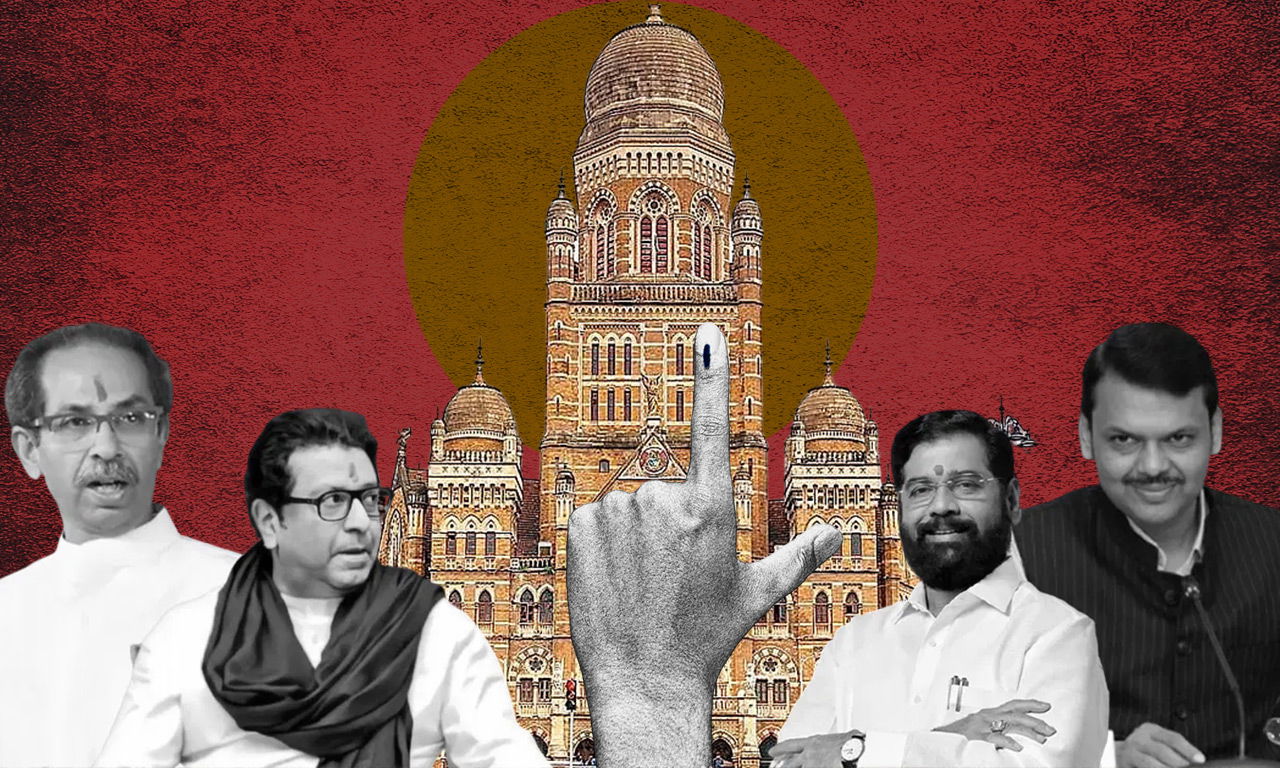
The long-stalled Brihanmumbai Municipal Corporation (BMC) elections, overdue since 2022, may finally see a breakthrough, with the court recently directing the State Election Commission (SEC) to issue a poll notification. If followed through, elections must be conducted within four months—potentially in the first or second week of October, once the monsoon subsides. Yet the question remains: why has the city—India’s financial capital—been denied elected civic governance for nearly half a decade?
At the heart of this delay lies a dense web of legal hurdles, administrative reshuffling, and blatant political maneuvering. Since 2017, the city has been governed by unelected administrators—a model that runs contrary to democratic principles and undermines public accountability. Over five years have passed without new civic mandates across Mumbai, Thane, Pune, and several other municipal bodies. What should have been routine electoral governance has instead turned into a high-stakes battleground for political control.
The official explanation for the delay includes the pending resolution of legal disputes over OBC reservation quotas, disputes over ward delimitation powers between the state government and the SEC, and decisions made under the former Maha Vikas Aghadi (MVA) government to increase the number of wards from 227 to 236. These changes—whether warranted or politically expedient—have created a bureaucratic deadlock.
Adding to the confusion, the current Mahayuti government recently reversed the MVA’s decision, bringing the number of wards back to 227, citing adherence to the 2011 Census. This is a controversial move, given the demographic transformations Mumbai has undergone in over a decade. Critics argue that relying on outdated census figures for ward formation not only distorts representation but serves narrow political interests.
The administrative roadmap is finally moving, albeit sluggishly. Draft ward boundaries are scheduled to be published from July 22–31, followed by a public window for suggestions and objections until August 11. The final proposals will be sent to the SEC between August 12–18, and after due approval, notifications for Mumbai, Thane, and Pune will be issued by September 4. However, this timeline is already compressed, and any bureaucratic hiccup or fresh litigation could derail it once again.
Meanwhile, political parties are in a state of flux. The BMC—governing a ₹52,000 crore budget—is not just any civic body; it is the richest municipal corporation in Asia and a power centre in its own right. All major parties—BJP, Shiv Sena (in its various avatars), Congress, and NCP factions—are jockeying for dominance. The absence of elections has only intensified this political anxiety, with each camp trying to manipulate the administrative process to safeguard its urban turf.
In a telling move, the SEC has introduced a regulation mandating all registered political parties to contest at least five seats in upcoming civic elections, failing which they face de-registration. While this seeks to curtail the proliferation of fly-by-night political outfits—418 registered parties at last count—the timing of the directive is suspect. Critics allege it could disproportionately affect smaller, regional, or emerging parties that may not yet be electorally strong but serve vital democratic functions.
Adding further layers of intrigue, the state government has implemented a four-member ward system across most municipalities, except the BMC. While the ruling coalition defends this as a means to bolster grassroots democracy, the exemption of Mumbai—India’s most politically strategic city—invites uncomfortable questions. Is the exception based on administrative rationale or electoral calculus?
What emerges from this murky political theatre is a concerning pattern: democratic processes are increasingly being treated as tools of convenience rather than as fundamental constitutional obligations. The repeated delays, arbitrary policy reversals, and top-down ward restructuring betray a political class more invested in controlling outcomes than enabling fair representation.
Mumbai’s citizens have effectively been disenfranchised for years, not due to war or emergency, but because political actors cannot agree on the rules of the game. At a time when urban governance faces unprecedented challenges—from housing shortages to climate resilience—the lack of an elected civic body in a global metropolis like Mumbai is not just a failure of administration, but a crisis of democracy.
The October election window now looms as a test of the state’s credibility and the resilience of its institutions. Will the political leadership across party lines rise above expediency and allow the people of Mumbai to reclaim their voice? Or will the city’s democratic fate continue to be held hostage to electoral arithmetic?
The answers, as always in Indian politics, lie not in declarations—but in delivery.
