


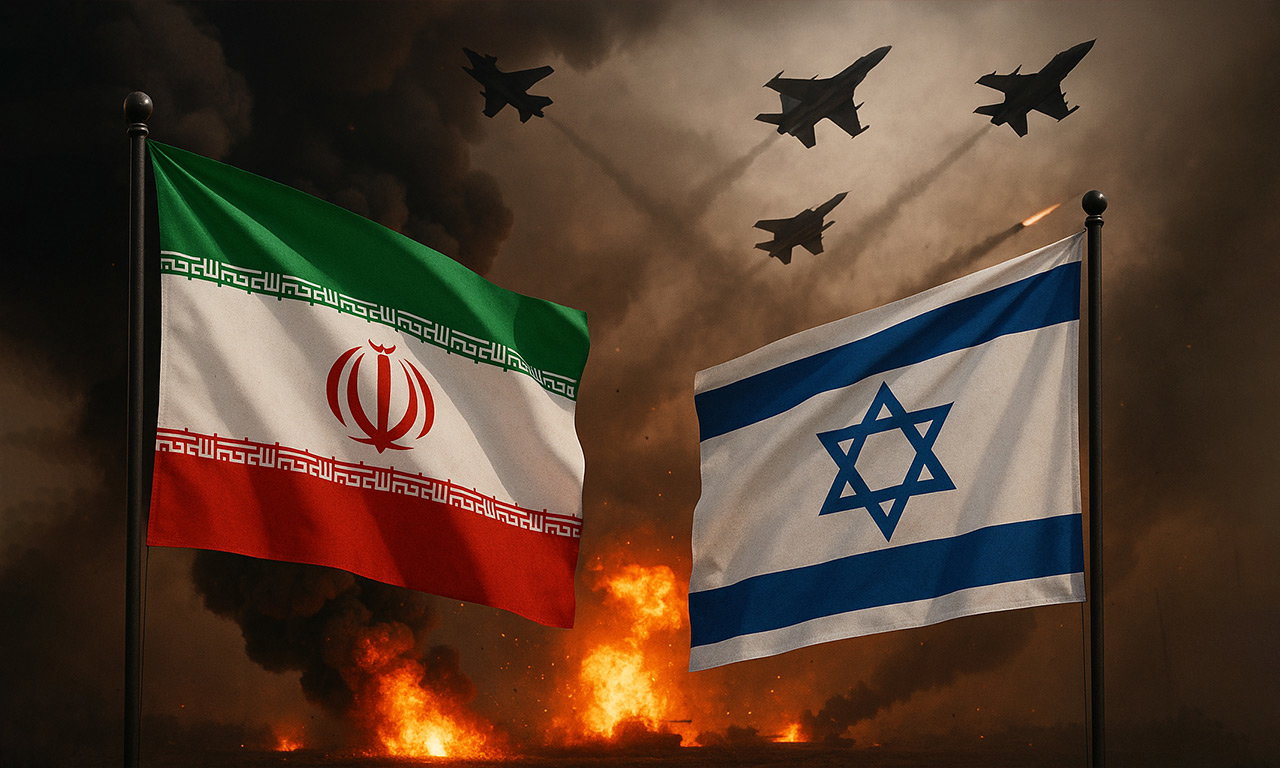
The volatile confrontation between Iran and Israel has now entered a dangerously escalatory phase, with the two regional powers trading their most intense military blows in decades. Israel’s largest-ever aerial offensive—reportedly designed to dismantle Iran’s nuclear capabilities—has triggered a predictable, yet deeply unsettling, retaliatory spiral. In the early hours, Tel Aviv and Jerusalem were rocked by air-raid sirens, sending millions scrambling for shelter as Iranian missiles cut through the skies. Prime Minister Benjamin Netanyahu’s warning that “more is on the way” is not mere rhetoric—it’s an affirmation of a geopolitical reality where restraint is no longer currency.
Iran’s Supreme Leader Ayatollah Khamenei, as expected, accused Israel of provoking war. But to present this as a recent flare-up is to insult history. Since the 1979 Islamic Revolution, Iran has positioned itself not merely as Israel’s adversary, but as the vanguard of an anti-Zionist resistance—albeit one largely performative and self-serving in nature. Theocratic Iran, under its clerical elite, has weaponised the Palestinian cause not out of solidarity, but utility. The Ayatollahs care little for the Palestinian people; they care for regional legitimacy and ideological leverage.
The true nature of this enmity is strategic, not moral. Iran has codified the destruction of Israel into its foreign policy doctrine—not merely as a slogan, but through material commitments: arming Hezbollah, bankrolling Hamas and PIJ, building forward-operating bases in Syria, and attempting to encircle Israel with a ring of fire. These are not rogue operations; they are state-sponsored, sanctioned acts of asymmetric warfare executed via proxies, insulated from direct accountability. No other country—none—has institutionalized antisemitism into statecraft like the Islamic Republic.
Meanwhile, Israel, a Western-facing state born out of the ashes of European Jewry, now finds itself in perpetual siege mode. Its transformation from an Eastern Semitic civilization into a Western military-technological powerhouse has placed it on the opposite end of Iran’s historical spectrum. Where Persia once embraced Jews as allies against the Hellenistic and Roman empires, it now sees Zionism as a Western colonial implant and, therefore, as the enemy.
The antagonism, however, runs deeper than mere ideology—it is about regional supremacy. The modern Iranian state, emboldened by its Revolutionary Guard Corps and its expanding arc of influence—from Tehran to Beirut via Baghdad and Damascus—has arguably become more powerful today than at any point in the last three centuries. This resurgence, ironically, is a byproduct of U.S. miscalculations. The fall of Saddam Hussein handed Iraq to Iran on a silver platter, turning it into a proxy and buffer zone. In Iraq, Iran found not just geopolitical depth but also religious-cultural hegemony. Its control over militias, political parties, and religious institutions has made it the shadow government of Baghdad.
This dominance allows Iran to project power westward—to Syria, to Lebanon, and to the Mediterranean. It’s not Israel, but strategic access to the Mediterranean and the Strait of Hormuz, that remains Tehran’s ultimate objective. Israel is simply a convenient boogeyman to justify that expansion and galvanize pan-Islamic legitimacy.
The U.S., for its part, remains shackled to the region’s hydrocarbon calculus. Washington’s strategic doctrine hinges on controlling three nodes of global power: Europe, East Asia, and the Persian Gulf. The Gulf, flush with energy resources, cannot be surrendered to a China-aligned Tehran. Hence, American foreign policy oscillates between containment and coercion when it comes to Iran. Sanctions have failed. Cyber-sabotage campaigns like Stuxnet, while tactically brilliant, are strategically limited. The JCPOA, while heralded as diplomacy’s high-water mark, was ultimately a Band-Aid on a bullet wound.
But a military solution is fraught with peril. Iran is not Iraq. It has a battle-hardened, Russia- and China-aligned military-industrial complex. Any large-scale confrontation risks dragging Washington into a catastrophic multi-front war, potentially handing Beijing the Gulf through the backdoor. The price of bombing Iran is not measured in missiles but in geopolitics—specifically, in ceding influence over Eurasia to a rising China.
Thus, Israel’s aggressive posture isn’t just about neutralizing a nuclear threat. It is about pre-empting a regional shift where Iran, backed by China and Russia, redefines the balance of power in the Middle East. If Iran acquires a nuclear weapon, it’s not just Israel’s security that is compromised—it’s America’s strategic footprint that is rendered obsolete.
The Palestinian question, meanwhile, is tragically peripheral. Palestinians are pawns in this regional chessboard. For Iran, they are a tool to rally Arab street sentiments and discredit Sunni monarchies that have normalized relations with Israel. For Israel, they are a demographic and security dilemma, increasingly irrelevant in its broader strategic calculus.
Since the 1960s, Palestinians have aligned themselves not based on ideology, but on opposition to American imperialism. Their support for Iran post-1979 was less about Shia revolutionary zeal and more about shared antipathy toward U.S.-backed regimes. But Iran is no liberator. Its record in Syria, where it aided Assad’s mass slaughter, or in Iraq, where it props up sectarian militias, makes a mockery of its claims to moral leadership.
What we are witnessing today is not just another regional squabble—it is the crumbling of a post-Cold War order, the emergence of a new axis of resistance and revanchism, and the recalibration of power in a multipolar world. Iran and Israel are not just enemies. They are symbols of two clashing worldviews—one theocratic, messianic and revisionist; the other nationalist, democratic (albeit imperfect), and Western-aligned.
In this zero-sum game, peace is not an outcome—it is a pause. The battleground may be Syria, Lebanon, Iraq or Gaza, but the war is existential. For Israel, survival. For Iran, supremacy. For the rest of the world—especially the U.S.—the challenge is preventing this regional fire from becoming a global conflagration.
The clock is ticking. Diplomacy is gasping. And history, it seems, is repeating—only this time, with nuclear stakes.
