


In 2025, a defining moment unfolded in the heart of Madhya Pradesh when Union Minister of Agriculture, Shri Shivraj Singh Chouhan, stood before a gathering of over 50,000 farmers at Harda and made a commitment that may well change the destiny of Indian agriculture. His words were not a routine assurance—they carried the weight of a promise to replicate a living, breathing model of transformation across the nation. The model he referred to was born in Harda, nurtured by the Gram Vikas Trust (GVT), and matured into a vision now known as HAPPYHarda — Healthy Agriculture by Progressive & Prosperous Youth of Harda. It represents not just a district’s dream, but the possibility of reviving the soul of Bharat — the soil, the farmer, and the village that have long formed its backbone.
To understand what makes HAPPYHarda revolutionary, one must look back to 2016, when GVT dared to begin an experiment in some of India’s most neglected rural belts. Rather than chasing superficial development, the Trust aimed to build a proof of concept — to demonstrate what is possible when traditional wisdom is merged with modern management, community participation, and sustainable planning. The results between 2017 and 2024 shattered every assumption about rural stagnation. In 5,000 villages, farmer incomes rose by ten times; 6.5 crore trees were planted; 800 crore litres of water were harvested through community-based watershed structures; and social harmony, once frayed by migration and poverty, was rebuilt through shared success.
This was not charity. It was design. A self-reliant ecosystem where the farmer became the entrepreneur, the soil regained its fertility, and the village rediscovered its purpose. This is what drew the attention of the nation. In 2025, when the Agriculture Minister promised to scale this model nationally, it was an acknowledgment that the future of Bharat depends on learning from its roots.
India’s tragedy lies not in its lack of potential, but in its neglect of the very foundation that sustains it — the farmer. Despite being the largest employer in the country, contributing nearly 18% to the GDP and feeding 1.4 billion people, Indian farmers continue to be treated as a vote bank rather than a national asset. Fragmented landholdings, rising input costs, erratic weather, and the stranglehold of middlemen have crippled rural livelihoods. What India has missed for decades is a cohesive, holistic model — one that connects the farm to the market, the farmer to finance, and agriculture to dignity. HAPPYHarda has stepped into that vacuum with the clarity of science and the soul of service.
Harda’s geography is symbolic of its destiny. Nestled on the banks of the sacred Narmada River, with a lineage rich in farming and education, Harda has always embodied the rhythm of Bharat. The HAPPYHarda initiative was designed not merely to revive the district’s prosperity but to turn it into a demonstration site for national regeneration. Its ethos is built around collaboration — bringing together farmers, scientists, industrial partners, and local governance into a single ecosystem that rewards productivity, responsibility, and innovation.
At the Mumbai University’s “Purv Rang” event in November 2025, HAPPYHarda’s vision reached a new milestone when the Mumbai Chapter, led by AISECT, announced its entry into Maharashtra. The event wasn’t ceremonial—it was a convergence of thought leaders, policymakers, academics, and entrepreneurs. An exclusive strategy meeting with Dr. Santosh Chaubey, Chancellor of AISECT University, defined the roadmap for fund allocation and nationwide implementation. The agenda revolved around social asset creation, soil health revival, water management, and industrial collaboration for value addition in agriculture. With corporate partners like Buldhana Urban Cooperative, Jain Irrigation, Sahyadri Farms, Reliance Retail, and RR Kabel coming on board, HAPPYHarda has become a bridge between India’s rural strength and urban resources.
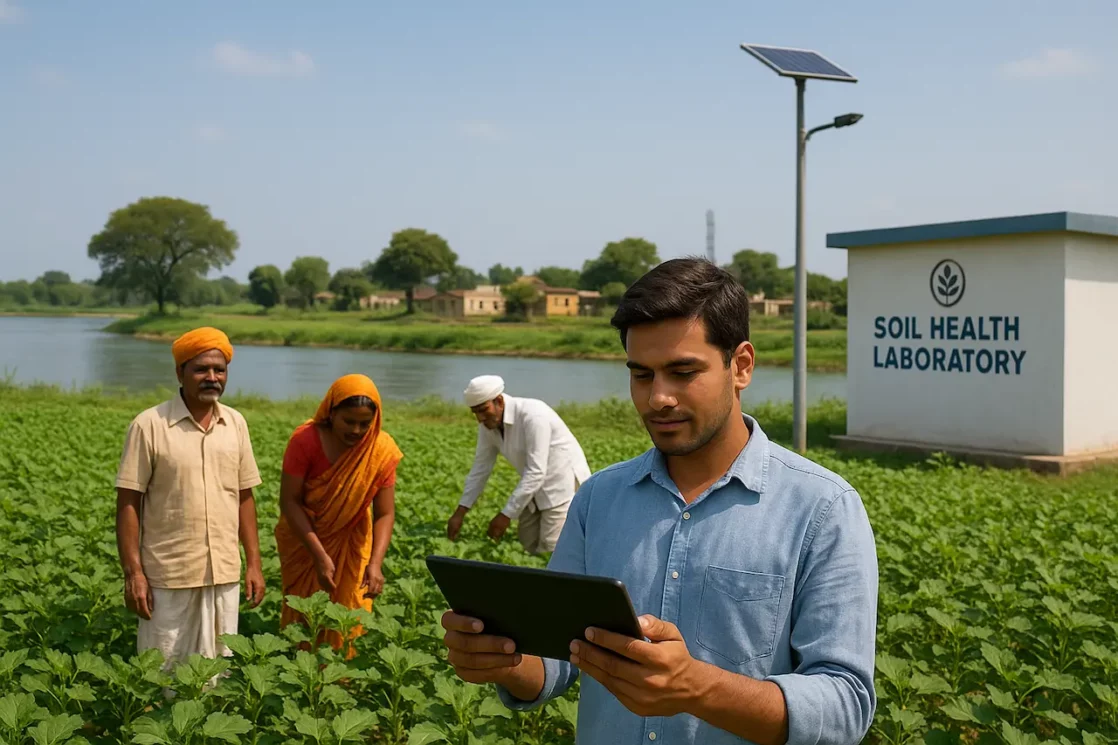
What makes this initiative truly futuristic is its focus on the ecosystem, not isolated reforms. For decades, India has thrown subsidies and schemes at farmers without addressing the systemic rot beneath. The HAPPYHarda model begins with the soil. Years of chemical abuse have stripped Indian farmlands of their vitality. The Trust’s next major investment is in soil health laboratories, designed to analyze, restore, and maintain long-term fertility. It’s a scientific revolution rooted in simplicity: if the soil lives, the nation thrives. Parallel efforts are being made to develop micro-irrigation systems, precision farming, and renewable energy integration, reducing the cost burden while enhancing sustainability.
Yet, technology alone is not enough. The movement also takes aim at one of the darkest realities of Indian agriculture—the agro mafia. Across states, unregulated trader networks, hoarders, and lobbying cartels control prices, dictate supply chains, and exploit farmers who have no access to fair markets. HAPPYHarda is building an alternative ecosystem where farmers are stakeholders, not dependents. Through cooperative ownership, transparent pricing, and blockchain-backed traceability, this model promises to dismantle the exploitative middle layer that has haunted the sector for decades. By connecting farmers directly to industries and consumers, it transforms them into value creators, not raw material suppliers.
The inclusion of local factories for value addition—be it juice, sugar, or food processing units—is not a supplementary idea; it’s central to the model. Every crop must have a second life, and every farmer must earn from every stage of that life cycle. This approach also ensures employment generation in rural areas, slowing down the urban migration that has hollowed out India’s villages.
But the story doesn’t end with economic gain. HAPPYHarda is about restoring dignity. For too long, agriculture has been seen as the profession of those who couldn’t make it elsewhere. The youth of Harda are rewriting that perception. Armed with digital tools, IoT devices, and market intelligence, they are creating an image of the modern Indian farmer—educated, empowered, and enterprising. Through initiatives in horticulture, dairy farming, and eco-tourism, they are diversifying income sources while preserving the cultural soul of Bhuana heritage. “Know your Farmer, Know your Food” is not just a slogan here—it’s a philosophy that reestablishes trust between the producer and the consumer, between Bharat’s heartland and its cities.
If scaled across India, the potential impact of HAPPYHarda is staggering. A tenfold income increase across the farming population could lift nearly 200 million people out of poverty. Improved water conservation could reduce the dependency on erratic monsoons by over 30%. Value-addition industries could create millions of jobs, particularly for women and rural youth. With agriculture accounting for 60% of India’s employment, this model could fundamentally reshape the nation’s economic architecture.
The larger question is: can India afford not to adopt such models? Climate change is tightening its grip, groundwater levels are depleting, and food security risks are mounting. The agrarian crisis is no longer a rural problem—it’s a national emergency. Models like HAPPYHarda offer not just solutions but survival strategies for the decades to come. They embody the Gandhian idea of Gram Swaraj, updated for the 21st century—villages that are self-sufficient yet globally connected, traditional yet technologically advanced.
By 2030, HAPPYHarda envisions a network of Smart Villages — clusters where every farmer has access to soil data, water analytics, renewable power, and a digital marketplace. Education and entrepreneurship will go hand in hand, making rural youth the custodians of a new economic revolution. With support from the Ministry of Agriculture, the roadmap includes soil labs in every district, integrated agro-industrial zones, and partnerships with universities like AISECT and Mumbai University for research and training.
India’s growth cannot be measured by skyscrapers or stock markets alone—it must be reflected in the fertility of its soil and the prosperity of its farmers. The future belongs not to the cities that consume, but to the villages that produce. HAPPYHarda reminds us that progress is not about abandoning the past but about reinterpreting it with purpose. The river Narmada that flows through Harda has always been a symbol of renewal, and now it nourishes not just the fields but a national vision.
Shri Shivraj Singh Chouhan’s endorsement of this model signals more than a policy shift—it marks a philosophical transformation. India’s next revolution will not come from political corridors but from the soil. From the self-respect of the farmer who no longer waits for subsidy but demands value. From the unity of partnerships that see the village not as a relic, but as a powerhouse.
HAPPYHarda stands today as a testimony to what Bharat can become when it believes in its own roots. It is a reminder that in the farmer’s cracked palms lies the map to the nation’s future. A future where prosperity grows with sustainability, where progress walks hand in hand with purity, and where Bharat once again learns to bloom from its soil outward.
As one farmer from Harda said with quiet conviction, “We no longer wait for rain or relief — we have learned to make our own season.” That is the spirit of HAPPYHarda — a spirit that must now flow through the veins of a new, self-reliant, and truly Pragat Bharat.
