


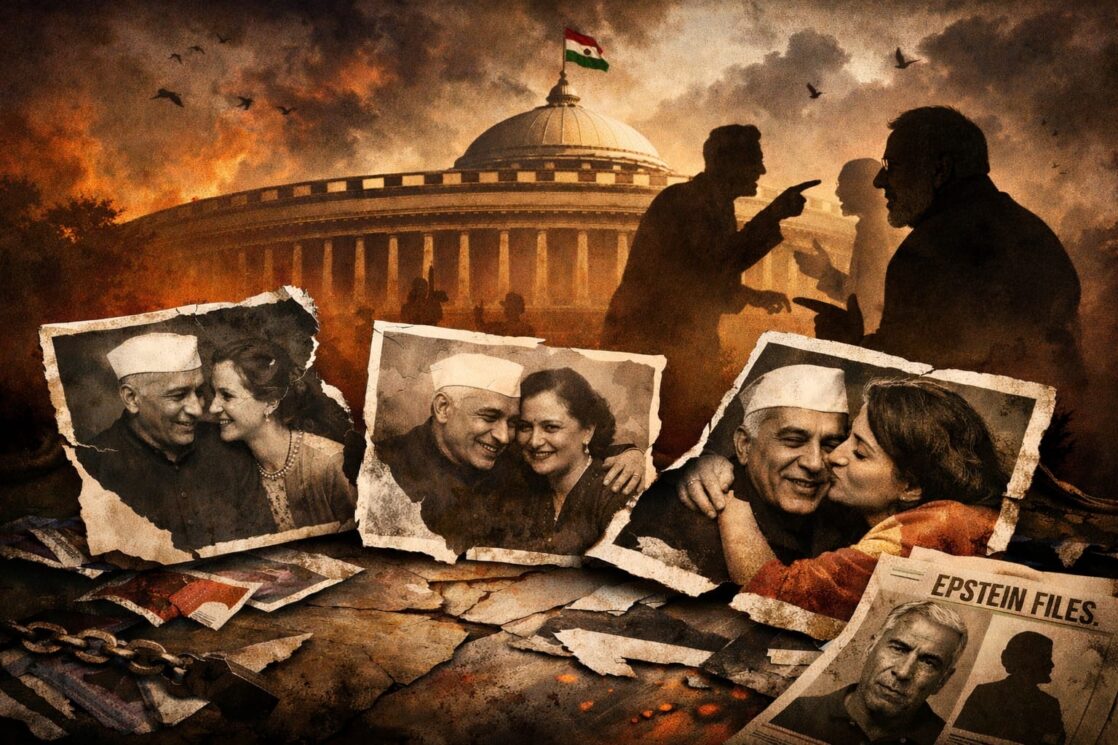
The scenes that unfolded outside Parliament yesterday were not just another episode in India’s noisy political theatre. They were a revealing moment — one that exposed how fragile, reactionary and intellectually hollow public discourse can become when political desperation takes precedence over dignity.
A senior leader of the Bharatiya Janata Party, while responding to allegations circulating about so-called “Epstein files” and an alleged connection being whispered around Prime Minister Narendra Modi, chose not to confront the matter with evidence, clarity, or reason. Instead, he stood before the media with a handful of photographs of India’s first Prime Minister, Jawaharlal Nehru. One photograph showed Nehru alongside Edwina Mountbatten. Another featured his sister, Vijaya Lakshmi Pandit. The third showed a tender family moment — his niece, Nayantara Sahgal, affectionately hugging and kissing her uncle on the cheek.
It was, by all reasonable standards, a loving family photograph. Anyone with basic emotional intelligence can recognise affection within a family without descending into cheap insinuations.
And yet, what appeared to be the subtext of this spectacle? A crude attempt to imply: “Even if Modi’s name appears in certain speculative files, Nehru was no saint either.” This is not argument. This is intellectual bankruptcy dressed up as outrage.
Let us examine the absurdity.
First, the relationship between Nehru and Vijaya Lakshmi Pandit was that of brother and sister. Pandit was a distinguished diplomat who later became President of the United Nations General Assembly. To weaponise photographs of siblings standing together is not political debate — it is moral decay.
Second, the photograph with Nayantara Sahgal depicted familial affection between an uncle and niece. Sahgal herself has written extensively about growing up in Anand Bhavan surrounded by intense political discussions and nationalist fervour. To twist such images into something unsavoury is not only shameful; it reflects a disturbing willingness to defile even family bonds for political convenience.
Third, and most sensationalised over decades — Nehru’s friendship with Edwina Mountbatten. Yes, the two shared a deep bond. It has been documented, analysed, romanticised, and scrutinised. But it has also been clarified by Edwina’s daughter in her memoir Daughter of Empire, where she emphasised the respect, emotional kinship and platonic nature of their relationship. Both Nehru and Edwina belonged to elite political circles. They interacted frequently in public, amidst officials and dignitaries. Their correspondence, when released, revealed warmth — not scandal.
History records human relationships in shades of complexity. It does not validate sensational gossip engineered decades later for political mud-slinging.
Now let us turn to the deeper issue — the practice of dragging freedom fighters into contemporary controversies. Nehru was not merely India’s first Prime Minister. He was a central architect of independent India. He spent nine long years in British prisons. He helped lay down the foundations of democratic institutions — from IITs and scientific research centres to a secular constitutional framework. He navigated a shattered nation through Partition’s horrors without social media, without propaganda machinery, and without an IT cell narrating his glory day and night.
Disagree with his policies. Critique his economic model. Debate his Kashmir approach. That is legitimate in a democracy. But equating affectionate family photographs with modern allegations tied to entirely unrelated global scandals crosses into intellectual delinquency.
As for the mention of “Epstein files” — allegations and insinuations are not convictions. The global controversy surrounding Jeffrey Epstein has engulfed politicians, businessmen, celebrities and royals worldwide, often on the basis of association rather than proof. Dragging such speculative matters into India’s internal politics without verified evidence is reckless. If credible facts exist, they should be investigated transparently. If not, weaponising whispers is nothing but character assassination.
Equally troubling is the use of allegedly AI-generated or digitally manipulated images in political attacks. In an age where artificial intelligence can fabricate convincing visuals, deploying altered historical imagery to score points is deeply unethical. Once truth becomes optional, democracy becomes ornamental.
The larger question is this: Is there even a valid comparison between Modi and Nehru?
Nehru governed a fragile newborn republic emerging from colonial ruin. Literacy was abysmal. Infrastructure was skeletal. Industrial capacity was marginal. He was building from ashes. Today’s India, for all its challenges, stands on the institutional scaffolding erected in those first years. To deny his role in shaping modern India is historical illiteracy.
Prime Minister Narendra Modi governs a rising economic power with digital governance, global connectivity, expansive media networks and unparalleled communication tools. His political era operates in a completely different landscape. He benefits from decades of institutional continuity.
Every leader must be judged within their context.
But what unfolded yesterday was not contextual criticism. It was deflection. Instead of directly addressing questions raised by the Opposition — including Rahul Gandhi’s recent parliamentary demands for accountability over tariff policies — the ruling party appeared more interested in rewriting old narratives. Gandhi’s recent speech, questioning economic policy and accountability, deserved rebuttal with data. Instead, what the public witnessed was distraction, diversion, and personal denigration.
This pattern reflects a broader concern: the shrinking space for reasoned discourse. Dissent is increasingly labelled as disloyalty. Questions are treated as conspiracies. Historical figures are selectively vilified while contemporary leaders are elevated beyond criticism.
Democracy does not function on personality cults. It functions on accountability.
Nehru did not silence critics by projecting doctored imagery of his predecessors. He debated them inside Parliament. His speeches remain on record — articulated, reasoned, and often self-critical. Today, Parliament sessions are frequently disrupted, Opposition voices curtailed, and media narratives polarised into camps.
One may strongly support or oppose any leader — Modi included. But lowering standards of debate to insinuations about family affection photographs sets a dangerous precedent. It tells younger generations that nothing is sacred — not freedom fighters, not familial bonds, not historical truth.
Criticise policies. Scrutinise decisions. Demand transparency over tariffs, economic partnerships, diplomatic positions — absolutely. That is the lifeblood of democracy. But attempting to obscure contemporary allegations by dredging up distorted historical photographs insults the intelligence of the nation.
India is not a playground of propaganda. It is a civilisation-state with memory.
You can disagree with Nehru’s vision, but you cannot erase his sacrifices. You can defend Modi robustly, but you cannot shield him through historical mud. The strength of a government lies not in silencing debate but in winning it through argument.
Yesterday’s episode was not merely poor optics. It was a moral low. And if political parties continue racing toward theatrical sensationalism rather than substantive governance debates, the casualty will not be one leader’s image — it will be public trust itself.
In a mature democracy, truth does not need manipulated images. It needs courage.
