


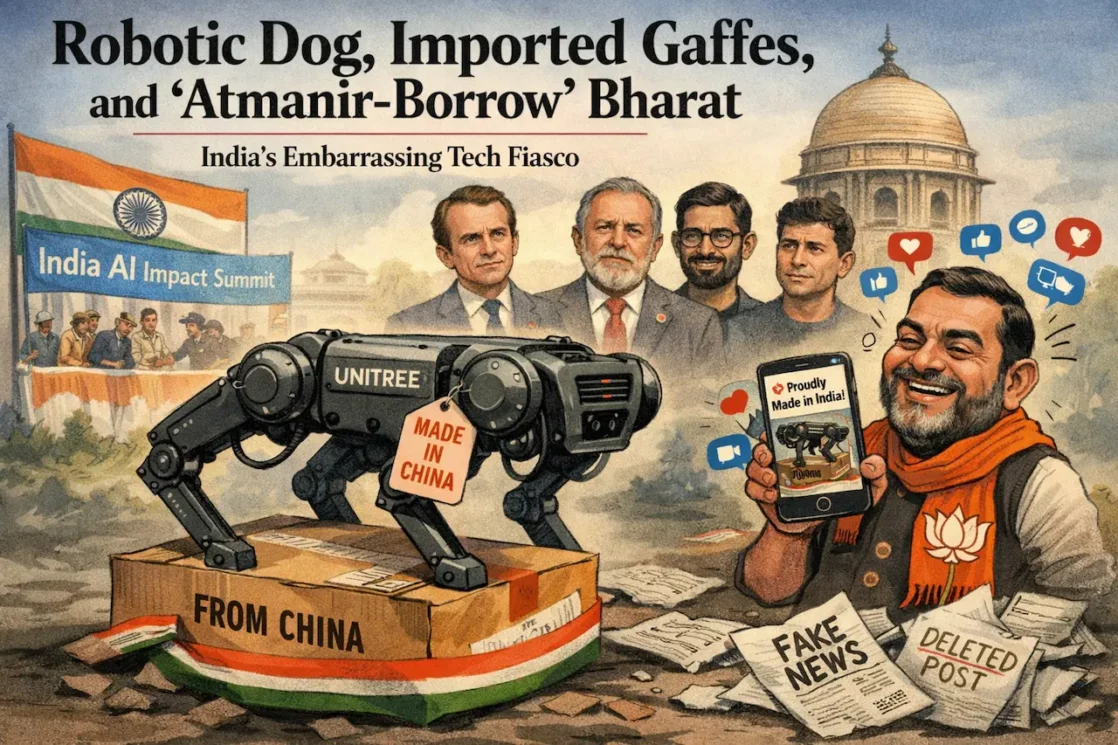
India hosted the India AI Impact Summit with all the pomp and ambition of a nation ready to proclaim itself a technological powerhouse. The stage was global, the audience formidable. Leaders like Emmanuel Macron and Luiz Inácio Lula da Silva were in attendance, global tech heavyweights such as Sundar Pichai, Sam Altman and Cristiano Amon were expected to participate, and Prime Minister Narendra Modi was set to address the gathering. This was supposed to be India’s moment — a confident announcement to the Global South that we are not just consuming artificial intelligence, we are building it. Instead, what stole the spotlight was not a breakthrough algorithm or a groundbreaking chip, but a robotic dog that could be ordered online.
The controversy exploded when videos from the summit circulated widely on social media. Representatives from Galgotias University showcased a sleek four-legged robot named “Orion,” describing it as a product of the university’s Centre of Excellence. The optics were powerful: a made-in-India quadruped symbolizing indigenous innovation. The applause, however, did not last long. Internet users quickly identified the machine as the Unitree Go2, a commercially available robotic dog manufactured by China-based Unitree Robotics. Available for purchase in India for roughly ₹2–3 lakh, and globally at modest price points, it is widely used in labs and classrooms around the world. There was nothing mysterious about it, and certainly nothing indigenous.
What followed was a textbook case of narrative outrunning facts. Critics accused the university of passing off imported technology as homegrown innovation. Under pressure, Galgotias University clarified on social media that the robot had indeed been procured from Unitree and was being used merely as a teaching aid. Yet the explanation came too late. Government sources indicated that the university was asked to vacate its exhibition space at Bharat Mandapam during the summit. Professor Neha Singh later stated she never explicitly claimed the robot was built from scratch but had only presented it as an exhibit. Still, the perception of misrepresentation had already hardened.
The embarrassment did not stop there. Reports soon highlighted another product displayed by the university — a drone soccer device allegedly developed on campus. Observers pointed out striking similarities between the showcased drone and commercially available models associated with South Korea’s Helsel, the pioneer of drone soccer technology since 2015. Once again, what was suggested to be domestic innovation appeared suspiciously like imported hardware. Two incidents in quick succession turned what should have been a triumphant AI gathering into an uncomfortable international talking point.
The real damage lies not in buying foreign technology. Universities across the world procure international tools for research. There is no shame in importing a robot for educational purposes. The humiliation arises when optics blur into exaggeration. At a summit attended by heads of state and CEOs evaluating India’s AI ecosystem, the line between showcasing research capability and implying product ownership must be crystal clear. Investors and global partners do not measure technological leadership by viral videos; they examine patents, supply chains, intellectual property, and research depth.
Equally troubling was the rush by several political figures and supporters to amplify the robotic dog as a symbol of India’s success without basic verification. Posts celebrating the “indigenous breakthrough” spread quickly. Images were circulated proudly. When online users exposed the truth, those celebratory posts quietly disappeared. Deleting a tweet may remove it from a timeline, but it does not erase the digital trail or the credibility lost in the process. In the age of screenshots, enthusiasm without due diligence is not harmless; it is reckless.
This episode has wider implications. The India AI Impact Summit was marketed as a flagship initiative projecting India as a serious AI leader for the Global South. When an internationally visible event becomes associated with questions of authenticity, it risks overshadowing the genuine achievements of Indian scientists and startups. The country has brilliant engineers building large language models, robotics solutions, semiconductor designs, and AI applications across sectors. Their painstaking work does not deserve to be diluted by careless showmanship.
There is also a question of institutional responsibility. How did a private university’s exhibit pass through vetting processes at such a high-profile international summit without clearer disclosures? Large-scale events require rigorous screening, not just elaborate staging. Transparency should not depend on social media detectives correcting public claims after the fact. The credibility of national platforms rests on strong institutional filters long before exhibition booths are opened.
The broader irony cuts deeper. The government has consistently championed the vision of “Atmanirbhar Bharat,” emphasizing self-reliance in manufacturing and technology. The aspiration is legitimate and necessary. But self-reliance cannot be retroactively stamped onto imported machines. It is built through sustained research investment, academic integrity, and honest representation of progress. Branding cannot substitute for building. A slogan becomes hollow the moment presentation outpaces substance.
International observers are not easily swayed by spectacle. When leaders like Macron or Lula attend an AI summit in New Delhi, and global executives such as Pichai or Altman share the stage, they are evaluating whether India offers credible partnerships, robust innovation ecosystems, and trustworthy institutions. An episode involving misrepresented hardware risks feeding skepticism that India is better at packaging than producing. Whether fair or not, perceptions matter on the global stage.
The government now faces a choice. It can treat this episode as a minor embarrassment and move on, or it can use it as a catalyst for stricter standards. Clear guidelines must define how institutions present imported technologies at official forums. Claims of indigenous development must be backed by documentation. Political endorsements should follow verification, not precede it. A developed nation does not rely on viral validation; it relies on verifiable achievement.
It is tempting in moments like this to demand punitive action out of anger — cancellation of accreditation, arrests, sweeping punishments. Yet durable solutions require systemic reform rather than symbolic fury. The objective should be to restore credibility and prevent recurrence, not merely to produce scapegoats. Transparency, accountability, and procedural rigor are stronger correctives than outrage alone.
India stands at an important technological crossroads. The ambition to become a developed nation by the coming decades is not fantasy; it is achievable. But development is not a marketing campaign. It is discipline sustained over years. When we celebrate prematurely, we invite scrutiny. When scrutiny reveals exaggeration, we invite ridicule. When ridicule becomes international, we undermine the very institutions tasked with carrying the national vision forward.
The robotic dog saga may fade from daily headlines, but its lesson should not. If we want the world to take India’s AI aspirations seriously, we must first take our own standards seriously. Celebrate what is real. Build what does not yet exist. And above all, remember that credibility, once dented on a global stage, costs far more to repair than any robotic dog ever will.
