


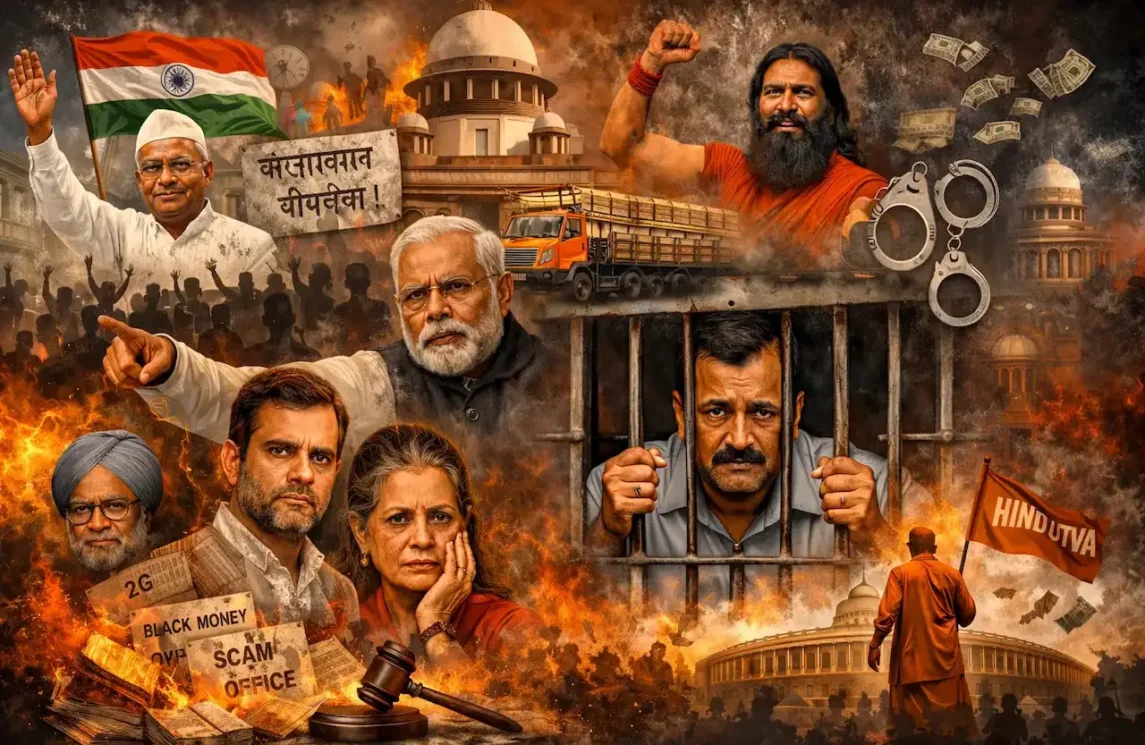
Indian politics has perfected a brutal art — the art of manufacturing morality, weaponizing outrage, and then pretending innocence when the same weapons are turned inward. What we are witnessing over the past decade is not just a contest of ideologies or governance models. It is the exposure of a cruel, cyclical system where power is pursued through public humiliation, narrative manipulation, and institutional combat. Every party that ascends the throne does so on the shoulders of accusation, and every party that falls cries vendetta. This is not ideology; this is a revolving door of political karma.
When the UPA government led by Manmohan Singh was in power, a nationwide moral spectacle was staged in the name of anti-corruption. Anna Hazare was projected as a modern-day Gandhi — fasting, speaking softly, wrapped in moral symbolism. The message was simple and emotionally explosive: the country had been looted. Television channels amplified every slogan. Social media, then a growing political weapon, converted suspicion into certainty.
Behind that moral theatre stood sharp political operators, most notably Arvind Kejriwal. Files were displayed before cameras. Complex policy decisions were reduced to punchlines. Allegations became prime-time verdicts. The target was clear: discredit the Congress ecosystem entirely. Sheila Dikshit was relentlessly attacked. Sonia Gandhi and Rahul Gandhi were dragged into a daily cycle of ridicule and suspicion. The branding of Rahul Gandhi as “Pappu” was not spontaneous mockery; it was a calculated erosion of legitimacy, repeated until it entered public vocabulary.
Simultaneously, Baba Ramdev entered the stage promising to bring back black money. Then came Narendra Modi with electrifying rallies and sweeping assurances that illicit wealth would return to citizens. The emotional pitch worked. Anger was consolidated. In 2014, the Bharatiya Janata Party secured a historic mandate. The anti-corruption movement had achieved its political outcome.
But this is where the cruelty of Indian politics reveals itself most starkly. Allegations that dominate headlines do not always translate into convictions in courtrooms. Legal processes move differently from television debates. Over time, several high-profile cases that were projected as decisive scandals did not end with dramatic punishments. Yet reputations had already been damaged. Elections had already been won. Narratives had already reshaped public opinion. In politics, accusation often achieves what evidence later cannot undo.
The anti-corruption agitation also gave birth to the Aam Aadmi Party. Arvind Kejriwal, once the accuser, became the establishment in Delhi. The outsider became Chief Minister. The system he condemned became the system he governed. And then the wheel began to turn again.
Investigative agencies became central to political battles. Cases were registered. Arrests were made. AAP leaders described it as vendetta; the BJP described it as accountability. The script felt familiar because it was familiar. The language once used against Congress was now being used against AAP. The same moral intensity. The same media framing. The same public shaming.
By 2025, the BJP reclaimed power in Delhi. By 2026, AAP leaders secured bail in major cases and began portraying themselves as victims of political persecution. Demands for apology surfaced. Appeals to democratic fairness were made. But a haunting question lingered: when Congress leaders were relentlessly targeted, who apologized when courts did not deliver the apocalyptic conclusions that were predicted? When reputations were dragged through mud for years, who restored them?
The cruelty of Indian politics lies not merely in competition, but in the normalization of character assassination as a legitimate electoral strategy. Allegations are amplified beyond proportion. Social media ecosystems are mobilized to create permanent perceptions. Institutions are drawn into political narratives. The public is conditioned to see every opponent not as a rival, but as a criminal-in-waiting.
Today, even the BJP faces rising discomfort among sections of voters over economic strain, centralization of authority, and governance challenges. Its ideological plank of Hindutva continues to energize a committed base, but fatigue and skepticism are visible in other quarters. The irony is unmistakable: the very strategy of relentless narrative control that once dismantled Congress is now scrutinized by a more digitally aware electorate. Political permanence is an illusion; dominance is temporary.
This is not about declaring any party innocent or guilty. Courts exist for that purpose. This is about recognizing the pattern: outrage is weaponized to win power; once in power, the same instruments are justified as governance tools; when out of power, they are condemned as authoritarian misuse. Every party claims moral superiority in opposition and procedural legitimacy in government. Every party speaks of democracy when cornered and strength when dominant.
And the voter? The voter watches this cycle unfold with growing exhaustion. There is anger, yes — but also disgust. Not because politics is adversarial, but because it often feels performative and vindictive. The language is extreme, the accusations dramatic, the promises grand. Yet accountability rarely matches rhetoric.
The cruel face of Indian politics is not a single party. It is the system of mutual destruction that all major players have, at different times, embraced. Congress once enjoyed near-unchallenged authority. It declined. The BJP rose with unprecedented dominance. It now faces its own tests. AAP emerged as a moral alternative. It too became entangled in the very structures it criticized. The wheel turns without sentiment.
Karma in politics is not mystical revenge; it is structural inevitability. If you normalize public humiliation as strategy, you will one day be humiliated. If you reduce governance debates to criminal insinuations, you will one day defend yourself against insinuations. If you build power through anger, you will eventually confront anger.
The deeper tragedy is institutional erosion. When investigative agencies, courts, media, and digital platforms become intertwined with political narratives, public trust weakens. Democracy survives not merely through elections but through credibility. And credibility is fragile.
So the final question is not whether one party deserves sympathy or another deserves criticism. The real question is whether Indian politics can move beyond this cycle of accusation and retaliation. Can it mature into a system where evidence precedes outrage, where dissent is not equated with criminality, where victory does not require annihilation of the opponent’s dignity?
Or will we continue watching leaders bite at each other’s heels while citizens oscillate between hope and cynicism?
The cruel face of Indian politics is not hidden. It is visible in every rally, every televised debate, every trending hashtag. Power is pursued with moral fervor and defended with institutional force. But the electorate remembers. And in democracy, memory is the most unpredictable force of all.
