


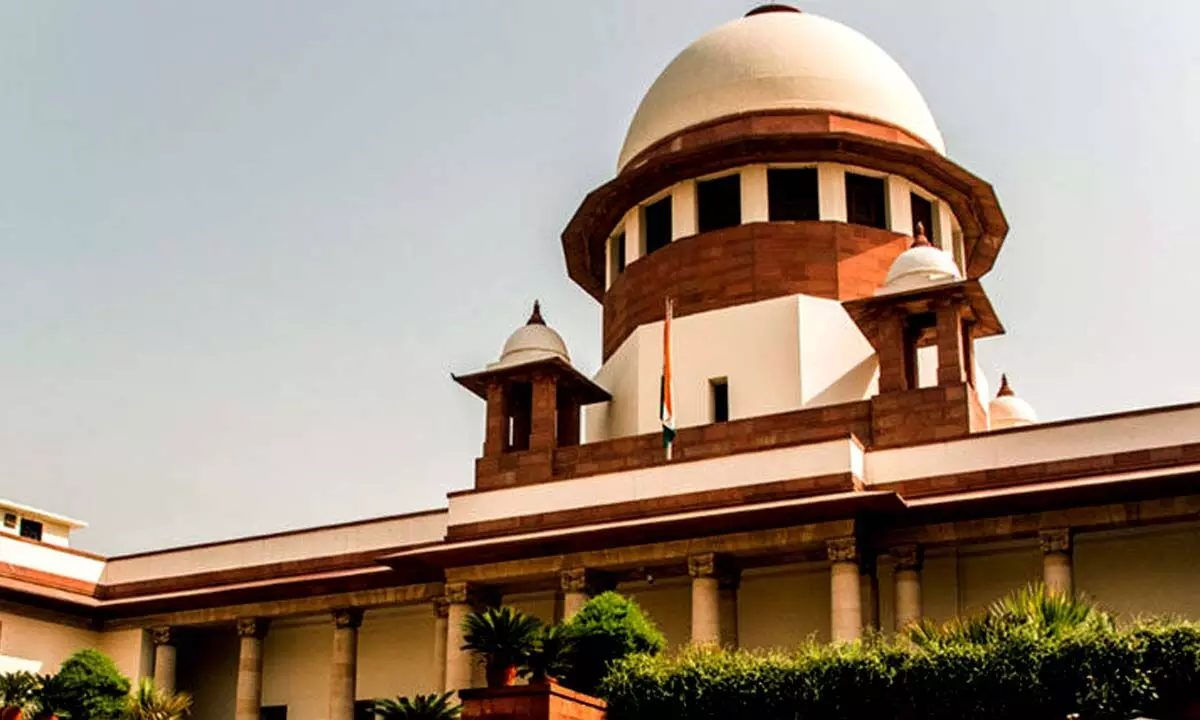
Reinforcing the principle that personal liberty remains central even under stringent anti-terror laws, the Supreme Court on Monday observed that “bail is the rule and jail is an exception” and granted bail to an accused in a high-profile narco-terror case linked to Jammu and Kashmir.
A bench comprising Justices B V Nagarathna and Ujjal Bhuyan granted bail to Syed Iftikhar Andrabi, a resident of Handwara, who is facing trial over his alleged involvement in a cross-border network accused of drug trafficking and terror financing in Jammu and Kashmir.
The court directed Andrabi to surrender his passport and report to the local police station once every 15 days as part of the bail conditions.
The National Investigation Agency (NIA) is probing the case, which was registered in 2020 under provisions of the Unlawful Activities (Prevention) Act (UAPA) and the Indian Penal Code (IPC).
In a significant observation, the apex court held that Section 43D(5) of the UAPA, which imposes strict conditions for granting bail, cannot be used to justify prolonged or indefinite imprisonment and must operate within the constitutional framework of Articles 21 and 22.
“Bail is the rule and jail the exception is a constitutional principle flowing from Articles 21 and 22, and the presumption of innocence is the cornerstone of any civilised society governed by the rule of law,” the bench observed.
The Supreme Court also stressed that its landmark 2021 judgment in the K A Najeeb case remains binding law and cannot be diluted, bypassed or ignored by trial courts, high courts, or benches of lesser strength.
The K A Najeeb ruling had established important safeguards regarding bail under the UAPA, especially in cases involving prolonged incarceration without trial.
Andrabi had moved the Supreme Court challenging an order of the Jammu & Kashmir and Ladakh High Court, which had earlier denied him bail after citing scrutiny of cellphone records that allegedly showed his contact with terror operatives across the border.

