


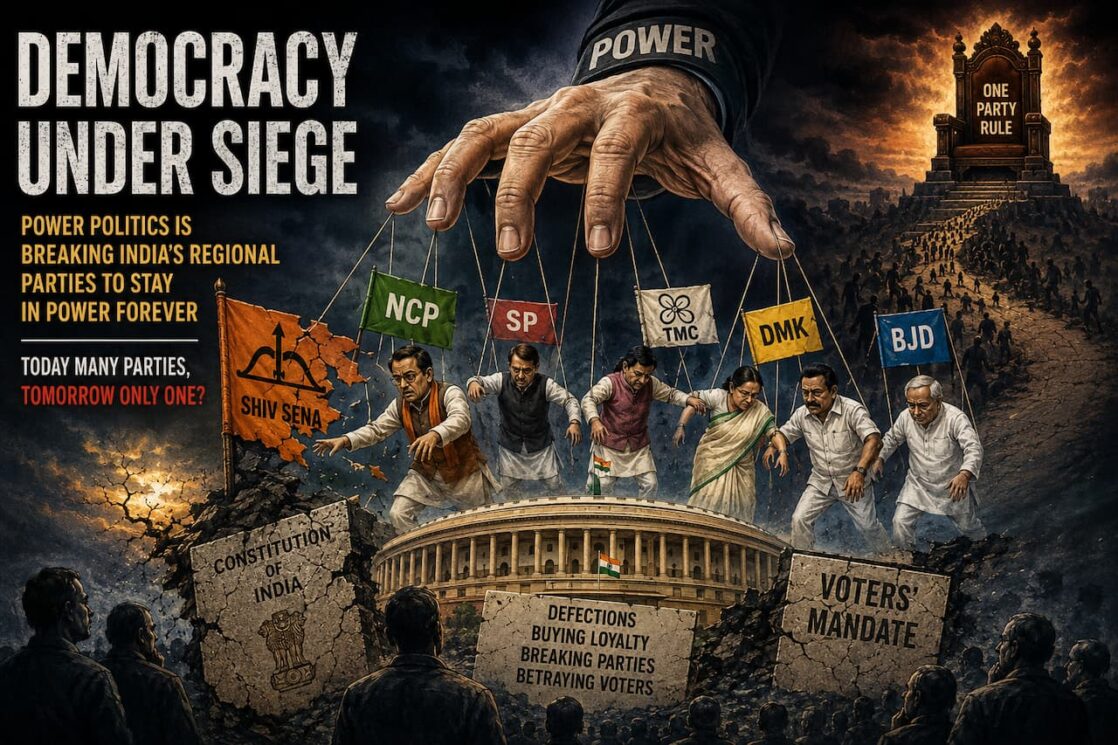
India proudly calls itself the world’s largest democracy. Elections are held regularly, governments change, political rallies draw millions, and voters continue to participate with remarkable enthusiasm. Yet beneath this democratic spectacle lies an uncomfortable reality: the systematic weakening of political opposition and the steady erosion of regional parties that once gave India’s federal structure its strength.
The unfolding crisis within Shiv Sena is not merely a story about one political party. It is a reflection of a deeper illness that has infected Indian politics. As Shiv Sena approaches its 60th foundation day, it finds itself once again staring at the possibility of another split. What was once a powerful regional force shaped by the vision and charisma of Bal Thackeray is today struggling for survival amidst defections, factionalism, and relentless political pressure.
The scenes witnessed over the past few days are telling. Uddhav Thackeray publicly challenged disloyal leaders to leave the party. Senior leader Sanjay Raut launched emotional attacks on those he considers traitors. Allegations of massive financial inducements to lure elected representatives have surfaced. MPs have gone incommunicado. Rumours, denials, counterclaims, and backroom negotiations dominate headlines. Regardless of which faction one supports, the larger question remains: Is this how democracy is supposed to function?
The tragedy extends beyond Shiv Sena. Across India, regional parties that once represented unique linguistic, cultural, and local aspirations are finding themselves under immense pressure. Leaders are being persuaded, tempted, threatened, or politically isolated until they eventually cross over to larger power centres. Governments are toppled not through public mandate but through engineered defections. Political loyalty has increasingly become a commodity that can be negotiated rather than a commitment to ideology or voters.
This trend strikes at the very heart of democratic values.
A healthy democracy requires strong opposition. It requires competing ideas, vibrant debate, and multiple centres of political influence. When regional parties weaken, it is not merely their leadership that suffers. Entire communities lose their voice. Local issues are pushed aside. The diversity that defines India’s political landscape begins to disappear.
India’s Constitution envisioned a federal structure precisely because the country is too vast, too diverse, and too complex to be represented by a single political narrative. Regional parties emerged because national parties could not always understand or articulate local aspirations. From Tamil Nadu to Punjab, from Maharashtra to West Bengal, regional movements became powerful because they reflected genuine public sentiment.
Today, however, politics appears increasingly driven by the pursuit of permanent power.
The message being sent is unmistakable: if a party cannot be defeated electorally, it can be weakened from within. If voters choose an opposition government, elected representatives can be encouraged to switch loyalties. If a regional force becomes influential, its leaders can be divided until the organisation collapses under its own weight.
Such victories may be politically effective, but they come at a heavy democratic cost.The repeated fragmentation of Shiv Sena illustrates this transformation. The party has witnessed internal rebellions before, but the 2022 split led by Eknath Shinde fundamentally altered Maharashtra’s political landscape. What followed was not merely a battle for leadership but a struggle over identity, legacy, symbols, and public mandate. Now, reports of another possible exodus suggest that the cycle is far from over.
One must ask a simple question: when voters cast their ballots, whom are they electing? The individual candidate, the party symbol, the ideology, or the alliance presented before them? If elected representatives can repeatedly abandon the platform on which they sought votes, then the sanctity of the electoral mandate itself becomes questionable.
The growing normalisation of political defections has created a dangerous precedent. Politicians increasingly behave as free agents rather than representatives of public trust. Ideological differences that once defined parties have become blurred. Former enemies become allies overnight, while former allies become bitter rivals. Principles are sacrificed at the altar of convenience.
For ordinary citizens, this breeds cynicism.Voters begin to wonder whether their mandate truly matters. They see governments formed not in public squares but in luxury hotels and closed-door meetings. They witness political dramas where loyalty appears temporary and power appears permanent. The result is declining faith in democratic institutions.Perhaps the greatest danger lies in what this trend could ultimately produce.
If regional parties continue to weaken, if opposition voices continue to shrink, and if political power continues to concentrate in fewer hands, India risks moving toward a system where electoral competition exists in form but not in substance. Democracy does not die only through dictatorships or military coups. Sometimes it is weakened gradually through the systematic elimination of meaningful alternatives.A nation as diverse as India cannot thrive under political uniformity. Its strength lies in pluralism, disagreement, debate, and decentralisation. Regional parties are not obstacles to democracy; they are essential components of it. They ensure that local voices are heard and that power remains distributed rather than concentrated.The crisis unfolding within Shiv Sena should therefore concern every citizen, irrespective of political affiliation. This is not simply about Uddhav Thackeray, Eknath Shinde, or any individual leader. It is about the future of democratic competition in India.
The world’s largest democracy must decide whether it wishes to remain genuinely competitive or gradually evolve into a political system where one dominant force overshadows all others. History shows that democracies flourish when power changes hands through public consent. They weaken when power becomes an end in itself.
The question before India is no longer who will win the next election.The question is whether enough political space will remain for others to compete.
