


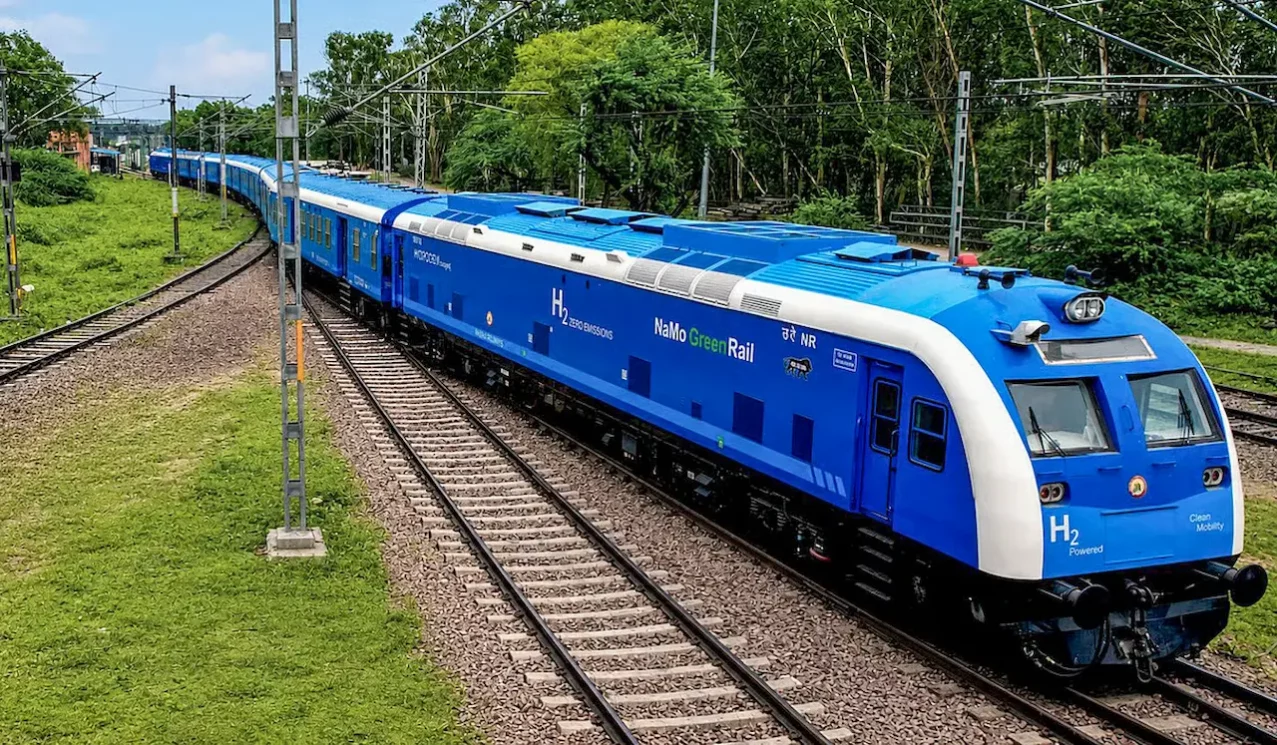
India’s first hydrogen-powered passenger train, set to be inaugurated by Prime Minister Narendra Modi on Friday, marks a significant step towards cleaner rail transport. However, experts believe hydrogen-powered trains are likely to play only a niche role in the country’s railway network, as more than 95 per cent of India’s broad-gauge routes are already electrified.
The inaugural service will operate between Jind and Sonipat in Haryana, covering the 89-km route in approximately two hours with 12 intermediate stops.
According to the Ministry of Railways, the 10-coach train will be powered by a 1,200-kilowatt hydrogen fuel-cell propulsion system and will run at a maximum speed of 75 kmph.
Calling it a milestone in the evolution of Indian Railways, the ministry said the project reflects India’s transition from coal and diesel-powered locomotives to cleaner and more sustainable sources of energy.
Harpreet Singh Arora, Professor at Shiv Nadar University’s School of Engineering, explained that hydrogen fuel-cell trains are essentially electric trains that generate electricity onboard by combining hydrogen with oxygen from the air inside a fuel cell.
Moushumi Mohanty, Senior Programme Manager for Electric Mobility at the Centre for Science and Environment (CSE), said the only direct emission from a hydrogen fuel cell is water vapour, making it a cleaner alternative to fossil fuels.
Hydrogen fuel for the train is produced separately, compressed, transported to a refuelling station and then stored in high-pressure tanks installed on the train. An indigenous hydrogen storage and refuelling facility has been established at Jind to support the project.
The ministry said both the train and the refuelling infrastructure are equipped with advanced safety systems, including hydrogen leak detectors, heat sensors and automatic shut-off mechanisms. The driver’s cabin has also been specially designed to enhance safety during emergencies.
With the launch, India joins a select group of countries, including Germany, France, Japan, China and the United States, that have either introduced hydrogen-powered trains or are exploring the technology for cleaner rail transport.
Experts, however, cautioned that hydrogen’s long-term contribution to India’s clean energy transition depends largely on the availability of affordable green hydrogen, which is produced using renewable electricity.
Mainak Mukherjee, Product Analyst at global technology firm SLB, said hydrogen can significantly reduce emissions only if green hydrogen production is expanded and supported by robust infrastructure.
Mohanty noted that hydrogen deployment should prioritise green hydrogen, minimise leakage across the supply chain and focus on sectors where direct electrification is difficult.
She pointed out that since over 95 per cent of India’s broad-gauge railway network is already electrified, hydrogen trains are unlikely to replace conventional electric trains and will instead be better suited for non-electrified regional routes where overhead electrification is technically challenging or economically unviable.
A 2024 study by researchers at the University of Michigan found that while green hydrogen could be useful for heavy-duty transport such as railways, aviation and shipping, battery-electric systems remain three to eight times more energy-efficient wherever direct electrification is feasible.
Experts also highlighted that railways offer an ideal testing ground for hydrogen technology because of their fixed routes, predictable schedules and easier establishment of refuelling infrastructure.
Hydrogen fuel cells typically convert hydrogen into electricity with an efficiency of around 50-60 per cent, while hydrogen production through electrolysis generally achieves efficiencies of 60-70 per cent, depending on the technology used.
Although hydrogen trains represent an important technological milestone for Indian Railways, experts believe their long-term role will depend on falling green hydrogen costs, improvements in fuel-cell technology and the economics of operating services on non-electrified routes.
