


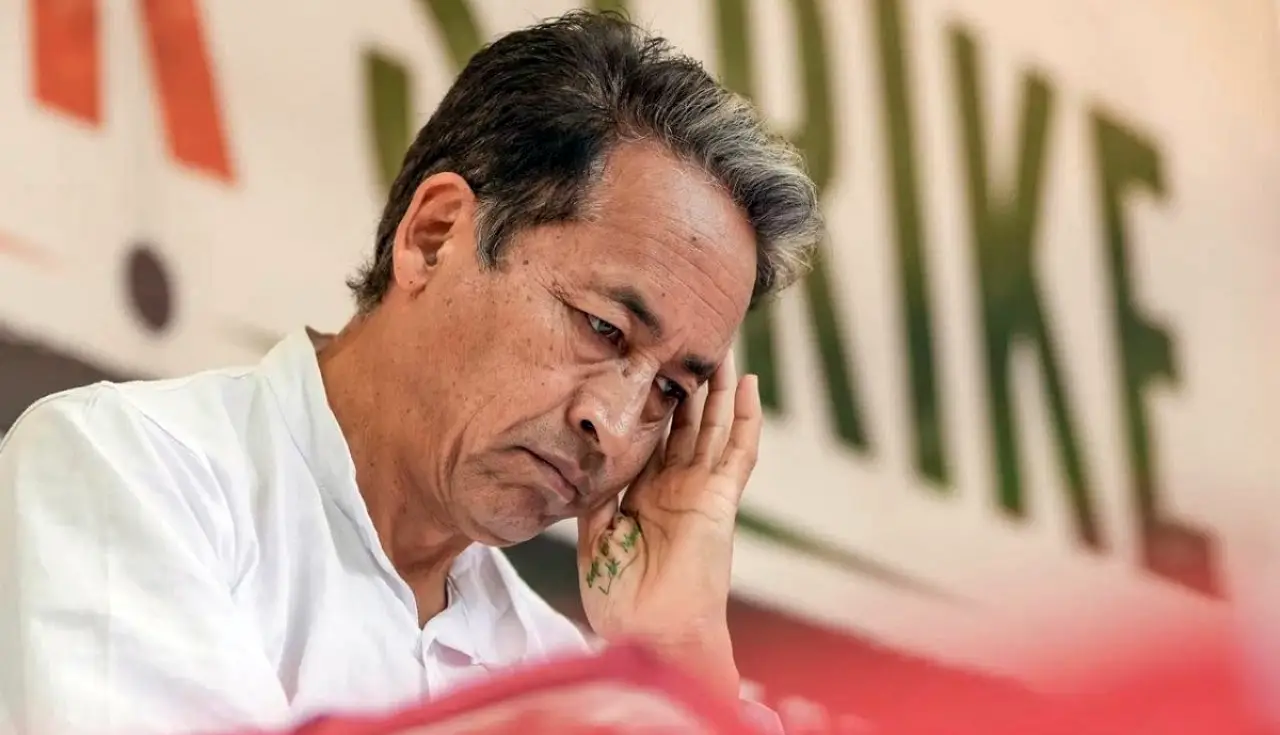
There is something profoundly unsettling about the way modern public movements unfold. They begin with a wave of emotion, dominate headlines, flood social media timelines, attract celebrities, politicians, influencers, and commentators, and then, almost as suddenly, fade into silence. The cameras move elsewhere, hashtags lose momentum, public attention shifts to the next controversy, and those who stood in the spotlight are left to continue their struggle alone.
The ongoing satyagraha led by Sonam Wangchuk appears to reflect this familiar pattern.
At the heart of every satyagraha lies a simple but powerful idea: one individual willingly accepts hardship in pursuit of a larger public cause. It is a tradition deeply rooted in India’s democratic and moral history. From Mahatma Gandhi to countless lesser-known social reformers, the strength of satyagraha has never come from numbers alone; it has come from conviction. Yet conviction also comes with a price. When the initial excitement fades, the satyagrahi is often left carrying that burden almost entirely by himself.
Looking at the present situation, one cannot help but notice a growing contrast between digital solidarity and physical participation.
Social media has made it easier than ever to express support. A tweet, an Instagram story, a carefully worded post, or a short video can instantly reach millions of people. Celebrities, public figures, and influencers routinely use these platforms to express concern about national issues. While such expressions can help generate awareness, awareness alone is not the same as participation. A message of support from a distance is not equivalent to standing beside someone who is enduring a prolonged public protest.
This is perhaps one of the defining characteristics of modern activism. The digital world rewards visibility, while real movements demand sacrifice.
The difference between clicking “share” and sharing someone’s hardship is enormous.
Political responses have followed a similarly predictable pattern. Leaders from opposition parties have visited the protest, expressed solidarity, and spoken before television cameras. Such visits are a normal part of democratic politics, and opposition parties naturally seek to amplify issues that challenge the government of the day. However, critics often question whether these visits represent sustained engagement or merely symbolic political messaging. A photograph with a protester may generate headlines for a day, but the true measure of commitment lies in continued support long after media attention has diminished.
The government, on the other hand, has maintained its own approach. Supporters of the government may argue that public policy cannot be shaped solely by protest and that every demand must be evaluated within broader constitutional, administrative, and national considerations. Critics, however, contend that prolonged silence from those in authority can deepen public frustration and create an impression that genuine concerns are not being addressed with sufficient urgency.
Whether one agrees with Sonam Wangchuk’s demands or not, the larger democratic question remains relevant: how should a constitutional democracy respond when a peaceful protest continues over an extended period?
Silence is itself interpreted in different ways. For supporters, it may appear as neglect. For governments, it may represent strategic restraint. Between these competing interpretations lies the challenge of democratic governance.
Another striking feature of this episode is the rapidly changing cycle of public attention.
Today’s media environment moves at extraordinary speed. Yesterday’s breaking news becomes today’s forgotten headline. Public outrage has a remarkably short lifespan. Every week brings a new controversy, a new debate, and another event demanding national attention. As a result, sustained public engagement has become increasingly difficult.
Many political observers believe that governments across the world—regardless of ideology—benefit when public discourse shifts from one issue to another. This is not unique to any single administration or country; it is a characteristic of modern politics itself. When multiple controversies compete for public attention, each individual issue inevitably receives less sustained scrutiny.
Some commentators have suggested that the emergence of other high-profile controversies has overshadowed the continuing focus on Wangchuk’s satyagraha. Whether this shift occurred naturally through the news cycle or as a consequence of broader political dynamics is open to public interpretation. What is undeniable, however, is that public attention is finite, and once it moves elsewhere, movements often struggle to maintain visibility.
This is where the role of civil society becomes particularly important.
Democracy cannot rely solely on governments or opposition parties. Nor can it depend entirely on celebrities or social media influencers. The true strength of democracy lies in citizens who remain engaged even after television crews leave.
History repeatedly reminds us that transformative movements were rarely sustained by moments of viral popularity. They survived because ordinary people continued to stand beside extraordinary individuals despite uncertainty, criticism, and inconvenience.
One must also reflect on the growing culture of performative activism.
There is an increasing tendency to treat public causes as temporary trends. A profile picture changes. A hashtag is posted. A statement is issued. Then attention quietly moves elsewhere. This phenomenon is not limited to any ideological group. It cuts across political affiliations, professions, and generations.
Real activism demands consistency.
It demands showing up when there are no cameras.
It demands standing beside someone when public applause has disappeared.
That is a far more difficult commitment than posting online.
The conversation surrounding Sonam Wangchuk therefore extends beyond one individual or one movement. It raises broader questions about the nature of citizenship, political responsibility, and public memory. How long are citizens willing to remain engaged with an issue? Do we support causes only while they are trending? Have we gradually replaced participation with performance?
These questions deserve reflection irrespective of one’s political beliefs.
Governments change. Opposition parties change. News cycles change. Public narratives change. But the credibility of a democracy ultimately depends upon its ability to hear peaceful voices, even when those voices become inconvenient or unpopular.
Likewise, citizens must recognize that democracy cannot function through spectatorship alone. If every movement is left solely to the individual who initiated it, then collective responsibility slowly gives way to collective indifference.
As events continue to unfold, it remains to be seen how this chapter will conclude. Whether the government engages more directly, whether political parties continue their involvement, or whether public attention returns in greater numbers are questions that only time can answer.
For now, however, one image stands above all political calculations: a solitary satyagrahi continuing his struggle while much of the surrounding noise gradually fades away.
History has a curious way of judging such moments. It rarely remembers those who merely observed events from a comfortable distance. It remembers those who stood firm when standing firm carried a personal cost.
The measure of any democratic society is not simply how loudly it celebrates peaceful protest at its beginning, but how consistently it respects those who continue that protest long after the applause has ended.
