


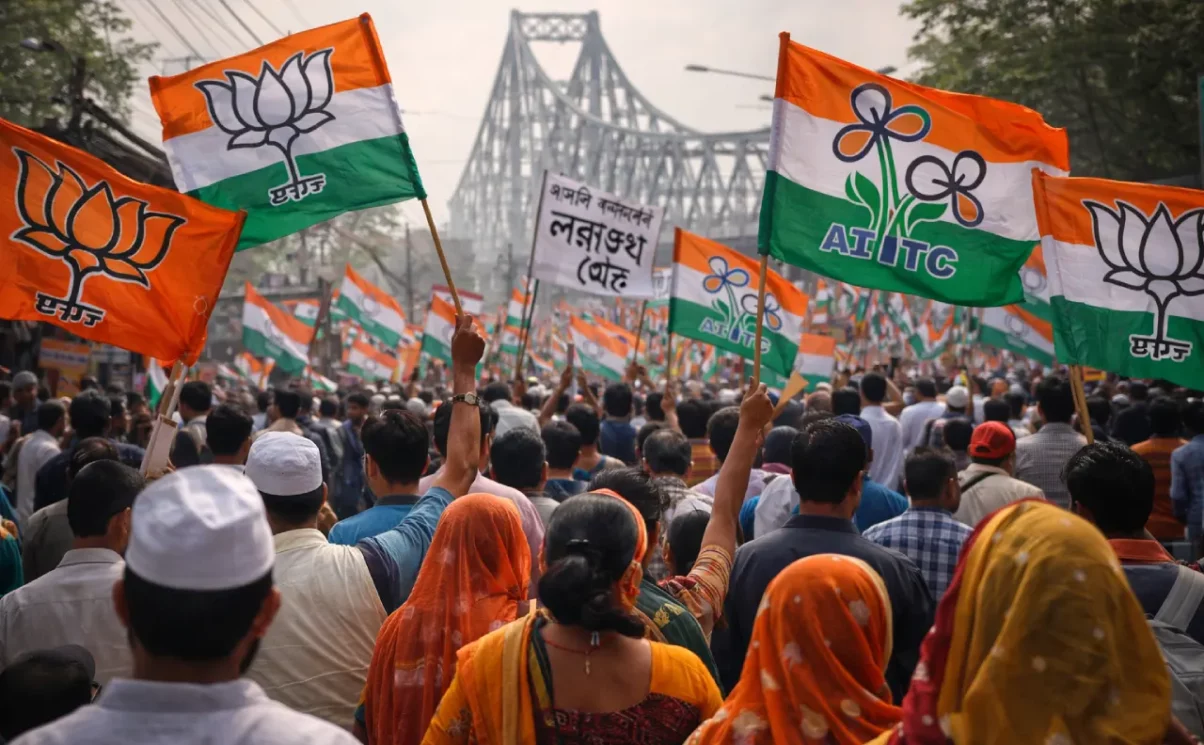
West Bengal has never been a state that votes in straight lines or predictable patterns. It listens, absorbs, debates, and then delivers a verdict that often surprises those who try to fit it into neat political frameworks. The 2026 electoral mood reflects this very character. What appears on the surface as a clash between the BJP’s aggressive religious mobilization and Mamata Banerjee’s governance-driven narrative is, in reality, a far more layered contest—one that is testing the limits of identity politics and the endurance of credibility.
The BJP entered Bengal with a clear and familiar strategy: consolidate the Hindu vote by invoking cultural identity, highlighting religious grievances, and projecting itself as the defender of a larger civilizational ethos. For a while, this approach yielded results. The surge in the 2019 Lok Sabha elections and the strong showing in 2021 were not accidental; they were built on a carefully crafted narrative that resonated with sections of voters who felt politically sidelined. But Bengal is not a political vacuum waiting to be filled. It carries a civilizational temperament shaped by thinkers like Swami Vivekananda and Rabindranath Tagore—a temperament that engages deeply with religion, yet resists its reduction into a blunt political instrument. The BJP’s challenge has not been in introducing the religious narrative, but in sustaining it without overplaying it. What was once a sharp and disruptive message has gradually become repetitive. Bengal’s voter, politically aware and culturally nuanced, quickly recognizes when a narrative is being stretched beyond its natural limit. When repetition replaces innovation, even the strongest messaging begins to lose its force.
There is also a deeper miscalculation embedded in the BJP’s approach—the assumption that religious identity, once activated, will override all other considerations. Bengal does not operate on such linear logic. Identity matters, but it competes with governance, welfare delivery, economic stability, and leadership credibility. It is a layered decision-making process, not a single-axis reaction. By leaning too heavily on religious polarization, the BJP risks appearing one-dimensional in a state that prides itself on intellectual and political complexity. Moreover, every attempt at polarization triggers an equal and opposite consolidation. Minority voters, sensing vulnerability, tend to rally more decisively behind the strongest opposing force, thereby creating a natural ceiling for the BJP’s expansion. What begins as a strategy to consolidate one side often ends up strengthening the other.
In contrast, Mamata Banerjee has executed a far more grounded and instinctive political maneuver. Her slogan “Mamata’r Kshamata” is not just a piece of campaign rhetoric—it is a carefully calibrated shift in the electoral conversation. It does not challenge identity; it bypasses it. It asks the voter not who they are, but what they have experienced. This distinction is crucial. Welfare schemes like Lakshmir Bhandar, Kanyashree, and Duare Sarkar are not abstract promises; they are tangible interventions that have entered households and shaped daily lives. For many voters, especially women, these schemes translate into financial support, accessibility, and a sense of state presence. This creates a relationship that is not ideological but experiential. And in politics, lived experience often outweighs theoretical alignment.
The brilliance of “Mamata’r Kshamata” lies in its simplicity and emotional resonance. It does not provoke; it reassures. It does not divide; it consolidates. It subtly reminds the voter that governance is not about grand narratives but about consistent delivery. In an environment saturated with high-pitched rhetoric, this calm assertion of capability stands out. It shifts the electoral battlefield from confrontation to comparison, from identity to performance. And in doing so, it places the BJP in a reactive position, forcing it to counter not just a slogan, but an accumulated record of governance.
To fully grasp the dynamics at play, one must understand Bengal’s electoral ambiance. This is a state where politics is woven into everyday life. Conversations around governance, ideology, and leadership are not confined to elite spaces; they unfold in tea stalls, local trains, college campuses, and neighborhood gatherings. The average voter here is not passive. They engage, question, and evaluate. There is also a strong undercurrent of regional pride, a subtle but powerful resistance to narratives perceived as externally imposed. The BJP, despite its organizational strength, often struggles with this perception. Its leadership and messaging can appear disconnected from Bengal’s socio-cultural rhythm. Mamata Banerjee, on the other hand, is deeply embedded in that rhythm. She is not just a political leader; she is seen as an extension of Bengal’s own identity—flawed, combative, but unmistakably local.
Another factor shaping the current mood is fatigue. Years of relentless campaigning, aggressive rhetoric, and continuous political confrontation have created a sense of saturation among voters. The dramatic no longer shocks; the loud no longer persuades. In such an environment, stability begins to carry weight. Familiarity becomes an asset. The voter starts to prioritize continuity over disruption, especially when that continuity is backed by visible delivery. This is where Mamata’s narrative gains strength. It does not demand attention—it earns acceptance through repetition of experience rather than repetition of slogans.
At the same time, Mamata Banerjee has demonstrated a keen understanding of balance. She has not entirely ceded the space of cultural identity to the BJP. Through selective engagement—be it participation in religious festivals or symbolic gestures—she has ensured that she remains culturally relevant without allowing religion to dominate her political identity. This dual approach enables her to occupy the center ground, a space that is often the most electorally advantageous. While the BJP attempts to pull the discourse toward polarization, Mamata anchors it in governance and emotional connect, preventing the narrative from drifting too far in either direction.
As the election approaches, the contest is no longer about who can mobilize louder crowds or craft sharper slogans. It is about which narrative resonates deeper with Bengal’s layered consciousness. The BJP offers a vision rooted in identity and disruption, seeking to redefine the state’s political trajectory. Mamata offers a narrative of continuity and capability, grounded in lived experience and administrative recall. The choice before the voter is not simplistic; it is a careful weighing of aspiration against assurance.
West Bengal, true to its nature, will not be hurried into a decision. It will deliberate, absorb competing narratives, and then respond in a manner that reflects its unique political temperament. The BJP’s religious card remains significant, but it is no longer decisive on its own. Mamata’s “Kshamata” narrative, while not without challenges, taps into a quieter but more enduring sentiment—the desire for stability, familiarity, and functional governance. In the end, Bengal will not choose between identity and governance in isolation. It will choose a balance that aligns with its own sense of self.
And that is the one constant in Bengal politics—it refuses to be reduced, refuses to be dictated to, and ultimately, refuses to behave like any other state.
