


Standing at the threshold of its centenary, the Rashtriya Swayamsevak Sangh is not merely an organizational experiment—it is a civilizational journey of India’s social, cultural, and national resurgence. For nearly a hundred years, without noise or craving recognition, it has worked with discipline and quiet determination to strengthen the nation’s very spine. In an era obsessed with visibility and instant success, the Sangh represents something rare—where work speaks louder than applause.
The Sangh’s true strength lies in its Swayamsevaks. They are not just young men gathering in daily drills; they are embodiments of discipline, sacrifice, cultural rootedness, and national commitment. From education to rural upliftment, disaster response to women’s empowerment, environmental preservation to social harmony—their contribution spans all sectors. Much of this work remains unseen, yet its impact is deeply embedded in society.
India today faces complex challenges—preserving cultural identity, ensuring social cohesion, and addressing sensitive issues like religious conversions. The Sangh has taken a firm and unapologetic stand. It asserts that faith must remain a matter of free will, not a consequence of coercion, inducement, or exploitation. This is not merely ideological resistance; it is a call for ethical responsibility.
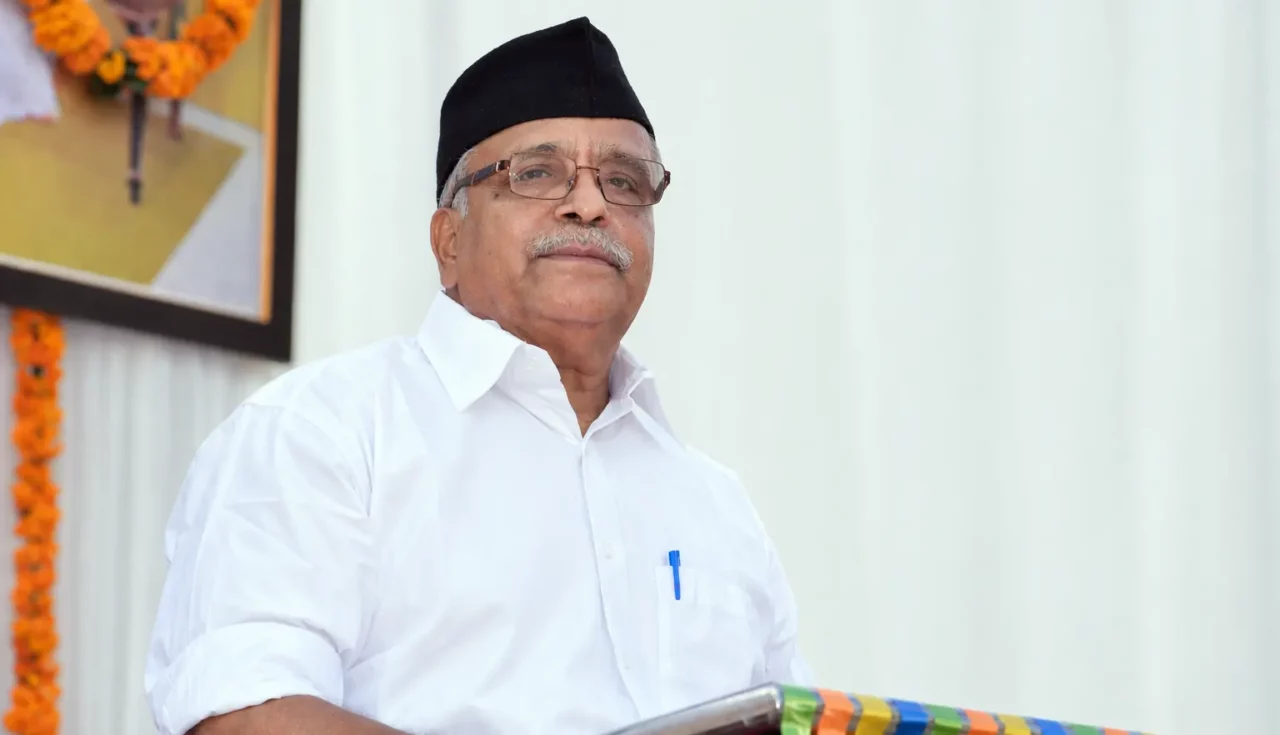
Among the many individuals who have shaped the Sangh’s direction, Suresh “Bhaiyyaji” Joshi stands out as a figure of remarkable clarity and conviction. Known for his simplicity, humility, and deep connection to Bharat’s roots, Bhaiyyaji represents the living spirit of the Sangh. Beginning his journey as a Pracharak in 1975, he rose through the ranks and served as Sarkaryavah from 2009 to 2021, guiding the organization during a crucial phase of expansion and influence.
What defines Bhaiyyaji is his fearless clarity. He has consistently emphasized that the Hindu community is not synonymous with any political entity, and political opposition must not be misinterpreted as opposition to Hindus. In an age of polarization, this distinction reflects both courage and intellectual honesty.
On the issue of religious conversions, his position has been both balanced and firm. While he respects individual freedom of faith, he strongly opposes conversions driven by exploitation of poverty, ignorance, or inducement. He has openly questioned activities carried out under the guise of social service when they conceal deeper agendas—raising uncomfortable but necessary truths.
He has also emphasized cultural rootedness in practical terms. In a diverse city like Mumbai, he has stressed that learning the local language is not optional—it is a responsibility. Language is not merely a tool of communication; it is a bridge to belonging and respect for the land one inhabits.
As the Sangh approaches its centenary, this is not merely a celebration—it is a moment of reflection and renewed commitment. What has been built over decades is now visible in the form of disciplined youth, aware citizens, and a society increasingly conscious of its cultural identity.
Yet the journey is far from over. The challenges ahead—technological disruption, cultural erosion, and the pressures of globalization—demand stronger resolve. In such times, institutions like the Sangh become indispensable.
Simply put, the Sangh is not just an organization; it is an idea, a way of life. And the Swayamsevaks who carry it forward are not merely participants—they are the architects of the nation’s future. Everything else may fade with time… but such individuals are the ones who shape history.
