


Bihar never disappoints. Elections there are less of a democratic exercise and more of a full-blown entertainment festival—equal parts political theatre, emotional drama, and unexpected plot twists. The 2025 assembly election was no different. In fact, it was one of those rare sequels where everyone already knew the ending, yet people still showed up with popcorn. Because let’s be honest: nobody with even half an eye on Bihar’s political pulse was surprised when the NDA sprinted ahead. If anything, the surprise would’ve been if they didn’t win.
Right from the start, this election was a clash of two completely different emotional universes. On one side stood the NDA—calm, predictable, almost boring in its discipline. On the other side, the opposition was busy staging a political version of a daily soap, complete with exaggerated melodrama, moral victories, tear-soaked press conferences, and the infamous Jyoti Singh episode that made even the most patient voters roll their eyes. Bihar is used to drama, but this year the opposition over-invested in theatrics and under-invested in strategy.
Meanwhile, the NDA treated the election less like a festival and more like an engineering project—precise planning, joint measurements, and zero ego leaks. The seat-sharing formula was stitched together months in advance. BJP and JD(U) calmly divided the turf: 101 seats each, a perfectly balanced arrangement that said, “We’re grown-ups now.” Smaller partners like LJP (Ram Vilas) and HAM(S) fell in line with disciplined efficiency. The message was clear: this family may bicker internally, but when stepping onto the battlefield, everyone marches in formation.
The opposition alliance, in contrast, felt like a baraat where the groom had run away. Congress looked confused about what it was doing in Bihar, the RJD carried the burden of Lalu’s fading charisma, and Tejashwi Yadav—pitched again as the youth face—clearly hadn’t figured out why voters still weren’t buying the product. Add to this the bizarre campaign cameos, like Khesari Lal Yadav trying to mix Bhojpuri stardom with electoral chemistry, and you had an opposition bloc that resembled a talent show more than a political force.
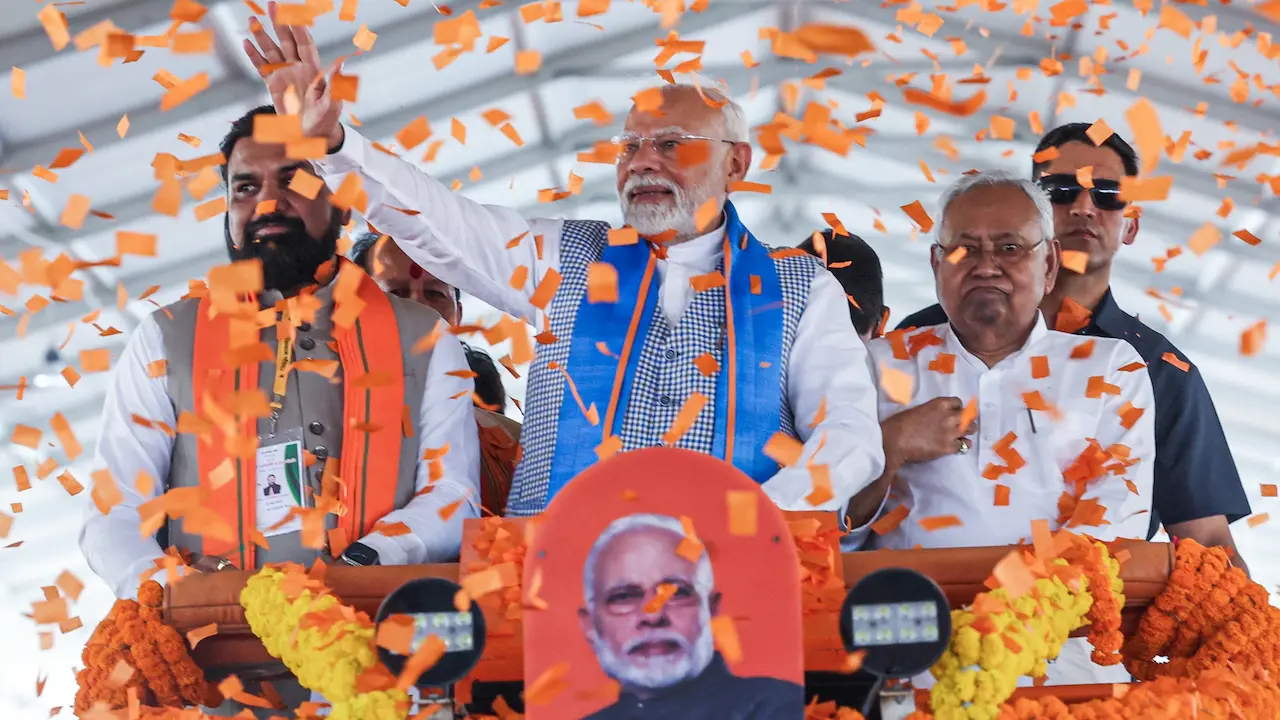
The NDA didn’t need to do much heavy lifting in such a setup, but they didn’t relax either. They went all out. Narendra Modi’s rallies were thunderous, Amit Shah’s speeches were strategic promises delivered with a salesman’s precision, and the local cadre worked with silent but ruthless consistency. Every rally looked like a blockbuster premiere. The opposition tried to counter this with emotion—but voters in Bihar have heard enough emotional speeches in the last 40 years. This time they wanted predictability, not passion.
And the voters responded in historic numbers. Bihar recorded a 66.91% turnout—the highest since the very first elections in 1951. When people stand in line in such massive numbers, it’s a sign they aren’t just voting; they’re voting with intention. They knew exactly what they wanted—and more importantly, what they didn’t.
One of the most talked-about outcomes was the rise of Maithili, the youngest MLA in Bihar now, symbolising a generational shift the state has been quietly preparing for. On the other side of the spectrum, seasoned names like Prashant Bhushan faced humiliating defeats—proof that Bihar’s voters don’t care about Delhi’s intellectual credentials. They vote for what touches their daily life. And Tejashwi? Bihar’s youth seemed increasingly unconvinced by his “new-age leader” packaging. They wanted stability, not experiments.
This election wasn’t just about campaigns—it was about memories. Bihar has a long political memory, much longer than politicians assume. The NDA invoked fears of the old Jungle Raj with a masterstroke. For younger voters who didn’t live through it, the stories alone were enough. For older voters who had lived through those chaotic years, no amount of new promises from the RJD could compete with the comfort of stability they had experienced under the Modi-Nitish tag team. NDA asked voters one simple question: “Do you really want to go back?” The answer was a loud, resounding no.
Nitish Kumar—despite his oscillating political journey—remained a decisive factor. Two decades in power have given him a reputation that’s hard to shake off. He might not be the most charismatic leader, but Bihar trusts him like one trusts an old scooter—maybe not glamorous, maybe not smooth, but deeply reliable. His alliance with the BJP ensured the “double-engine government” message landed perfectly. Voters believed this duo delivered progress, welfare schemes, better law and order, and a sense of continuity.
And when women came out in huge numbers, the NDA practically sealed the deal. Nitish Kumar’s welfare schemes for women, from self-help groups to education incentives, paid political dividends once again. Young voters too tilted heavily towards the NDA, attracted by Modi’s appeal, development rhetoric, and the promise of stability in jobs and governance.
The opposition tried to counter these forces, but their messaging felt disconnected. Congress appeared as a reluctant participant, the RJD seemed trapped between nostalgia and reinvention, and the smaller parties were running their own parallel ambitions. Unity existed on paper; on stage, it evaporated.
The NDA, on the other hand, offered a clean, jargon-free narrative: development, safety, stability, consistent leadership. Whether one agrees with their politics or not, they sold their story better—far better.
As the results poured in, the ruling alliance was projected to cross the 200-seat mark—an extraordinary feat in Bihar’s fractured political history. The BJP registered its best performance since 2010. This wasn’t merely a win; it was a referendum. A message from Bihar’s 74 million voters — “We know what works for us.” For a state that has historically been labelled as backward, volatile, or governed by caste equations, this election broke stereotypes. People voted not by caste alone but by aspiration, by memory, and by fear of returning to instability.
Bihar’s political veterans—Nitish Kumar and Lalu Prasad Yadav—both in their twilight years, watched this election unfold from a distance. Nitish held his ground, steering the ship steadily. Lalu, weakened by age and convictions, could only watch his legacy slowly dissolve. Tejashwi, despite his energy and earnestness, couldn’t overcome the baggage of the past. Bihar isn’t willing to hand over its future to nostalgia; it wants leaders who can work in the present.
This election was more than a victory for the NDA; it was a mirror held up to Bihar’s evolving political consciousness. Voters showed they want efficiency, not emotion. They want development, not dynastic sagas. They want leadership, not limelight seekers. In a state where millions still migrate for jobs, where poverty remains a haunting reality, and where political instability has historically stalled growth, the NDA’s pitch of reliability resonated strongly.
The opposition will analyse what went wrong. They should—but they’ll find the answer staring them in the face. Elections are not won by viral videos, melodramatic speeches, or celebrity candidates. They’re won by organisation, messaging, and ground work. The NDA had all three. The opposition had none.
When future historians study the 2025 Bihar elections, they’ll likely describe it as the moment Bihar voters matured past their political stereotypes. The election wasn’t an ideological battle; it was a choice between chaos and control. Bihar chose control.
And behind the grand narratives, the high-pitched rallies, and the election-day tension, Bihar delivered a simple, almost old-fashioned lesson: if you show up consistently, stay disciplined, and treat politics like serious business instead of a travelling circus, voters reward you.
In the end, the NDA didn’t win because the opposition failed. They won because they did everything a winning side is supposed to do—prepare early, campaign hard, send the right message, and keep the house in order. There was no twist in the story. No shock ending. No cliffhanger.
Just Bihar doing what Bihar does best: turning politics into a riveting show, and then voting with cold, clear logic.
And that’s why the NDA win wasn’t a surprise—it was the most predictable, most entertaining, and most telling chapter in Bihar’s never-ending political saga.
