


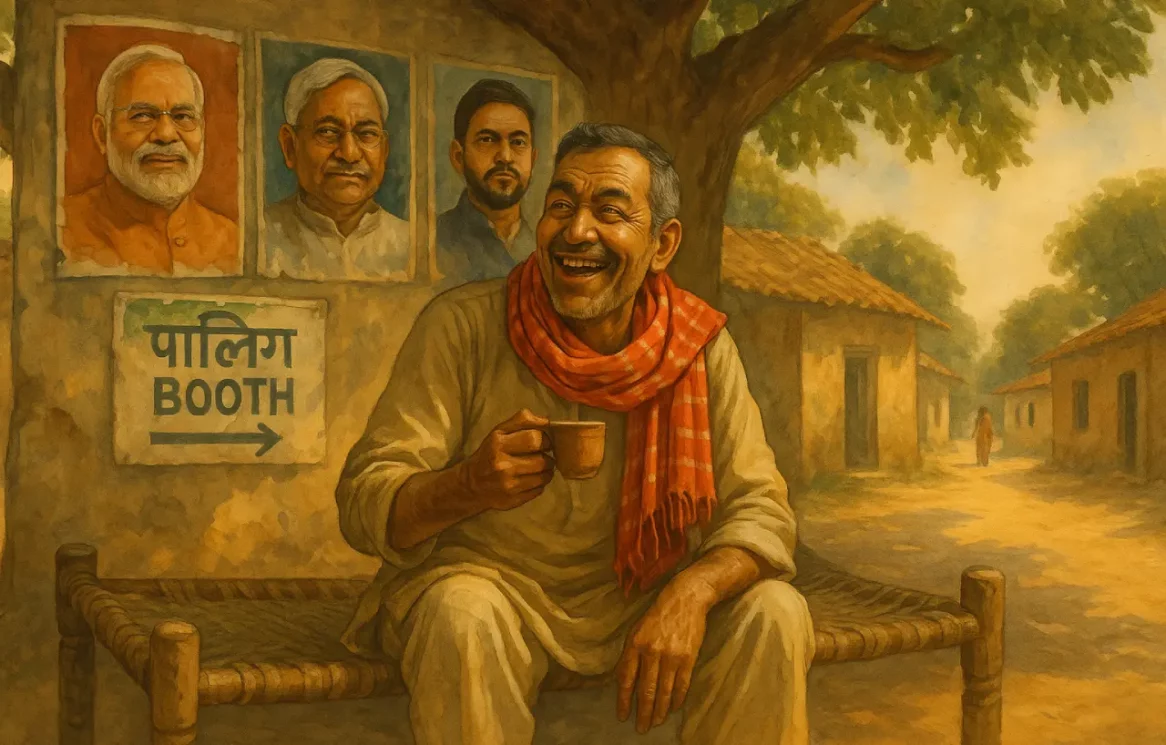
Ah, Bihar — the land where politics isn’t just an event, it’s theatre. And this election season, the stage is set bigger, louder, and a whole lot more unpredictable than ever before. The first phase of voting on November 6 saw history being made — or at least rewritten with a more enthusiastic pen. A record voter turnout of around 65% showed that Biharis have decided not just to sit back and watch the drama unfold; they’re now writing the script themselves. Considering this is the state that once gave India Chanakya, it’s only fair that strategy and street-smartness run in the DNA.
With 121 constituencies spread across 18 districts, the voters of Bihar braved the November dust, chaos, and political promises that could put a Bollywood script writer to shame. The Election Commission, for once, deserves a round of applause — the SIR (Special Intensive Revision) of electoral rolls had zero appeals, and this time, they claim, the voter list is as pure as Ganga jal (though we’ll let you decide which part of Ganga). For a state where politics and caste have been lifelong companions, the idea of a clean roll is almost revolutionary — like finding punctuality in Indian Railways.
Let’s talk about the ruling alliance — the BJP and JD(U), that long and occasionally awkward marriage of convenience between Narendra Modi’s juggernaut and Nitish Kumar’s ever-evolving political conscience. It’s like watching a couple who’ve been together so long, they don’t even bother pretending anymore. The chemistry’s gone, but the compulsion remains — for power, for survival, and for that one last round of governance glory.
And yet, Bihar’s electorate, those 74 million souls — more than the entire population of France — have never been easy to fool. They’ve heard it all: development, employment, women’s safety, youth empowerment, even free Wi-Fi. But they’ve also seen their young migrate to other states in droves, their rivers flood every year, and their infrastructure swings between potholes and election promises. Bihar’s biggest export continues to be manpower, not manufacturing. Every Bihari family has at least one son or daughter working in Delhi, Mumbai, or Dubai — while home remains a place of nostalgia, and unkept political promises.
Meanwhile, the Election Commission’s attempts at modernization — colored candidate photos on EVMs, phone deposit facilities, and even wheelchairs and e-rickshaws for elderly voters — deserve some credit. For once, voting didn’t feel like an endurance test. It was an event. There were Jeevika women volunteers ensuring order, and queues that actually moved. Miracles do happen — in Bihar, they just need polling day to occur.
Now, on to the circus — sorry, the campaign trail. Prime Minister Modi’s rallies, as usual, are less about Bihar and more about reaffirming his connection with the masses — the charisma still works, the crowd still cheers, and the opposition still fumes. On the other hand, Rahul Gandhi, the eternal underdog of Indian politics, promised to “prove to Gen Z” that Modi’s rise was based on “election manipulation.” Ah, the irony — if elections are manipulated, one wonders how Rahul still finds the courage to contest them every time.
Then there’s Prashant Kishor — Bihar’s very own political scientist turned political sage. Once the architect of others’ victories, he now plays the critic, taunting BJP’s Samrat Chaudhary for boasting too much and doing too little. Kishor’s advice to Samrat was sharp: win your own seat before counting the NDA’s chickens. Fair point. After all, Bihar’s politics is not about what Delhi thinks, it’s about who controls Tarapur and how many crowds you can actually gather without free biryani.
The Lok Janshakti Party’s Arun Bharti, meanwhile, dusted off some history books to remind everyone that Bihar was once an economic powerhouse — producing 60% of India’s coal, 40% of its sugar, and a fair amount of intellectuals. “Congress ruined it all,” he thundered, blaming the infamous Freight Equalisation Policy that stripped Bihar of its industrial advantage. Hard to argue there — Bihar’s decline was less an accident and more a long bureaucratic murder, carried out slowly, file by file.
And in this theatre of the absurd, we have Mukesh Sahani, VIP chief and Mahagathbandhan’s Deputy CM candidate, cracking one-liners after an attack on Deputy CM Vijay Sinha’s convoy. “They’re suffering from the Bihar they created,” he said, proving that in Bihar politics, sarcasm is the new diplomacy. For a man nicknamed “Son of Mallah,” Sahani knows how to steer a boat through political storms — and he’s smelling a wave of change. Or at least he hopes the wave doesn’t capsize halfway through.
Bihar’s voters, however, are playing it close to the chest. Women, especially, have emerged as the quiet game-changers. Their turnout has been consistently higher than men’s, their concerns more practical — safety, education, employment, dignity. Every party now chants the “nari shakti” mantra, but Bihar’s women have seen more slogans than solutions. Congress promises monthly allowances, BJP talks of empowerment schemes, and Nitish Kumar reminds them of prohibition — though everyone knows liquor still flows, just with better delivery options.
The larger story, however, goes beyond local seats and alliances. This election is a referendum on political will. Bihar is the test lab of Indian democracy — if governance can work here, it can work anywhere. And yet, decades later, the state still oscillates between hope and heartbreak. Infrastructure crawls, jobs vanish, and crime remains an uninvited guest at every political celebration. The young Bihari, educated but unemployed, looks at politics with the same mix of faith and frustration that one reserves for Indian customer service — “maybe this time, they’ll actually do something.”
Nitish Kumar, now a veteran of every political permutation possible, finds himself fighting fatigue — not of age, but of credibility. The once-iconic “Sushasan Babu” image has faded into bureaucratic beige. Even his allies struggle to defend him with enthusiasm. The opposition, led by Tejashwi Yadav, capitalizes on youth and nostalgia — a strange mix that somehow resonates in the land of contradictions. Tejashwi talks about jobs and development, but the shadow of Lalu-era chaos still lingers. Bihar has long memories — and longer scars.
As for the voters — they’re not naïve. They’ve learned to separate drama from delivery, speeches from substance. They know that whoever wins will promise the moon and deliver maybe a lamp post. But still, they show up, vote, and hope. Because Bihar, for all its struggles, never gives up on democracy. It still believes that change can come — if not through leaders, then through sheer stubbornness.
So yes, Bihar’s elections are interesting. Not because of Modi’s rallies or Rahul’s accusations or Kishor’s sarcasm — but because of the quiet determination of its people. The farmers who still slow despite floods. The youth who still prepare for exams despite power cuts. The women who still vote despite indifference. That’s Bihar’s real story — resilience dressed in humour, patience wrapped in irony.
And as November 14 approaches, when the results roll in, one thing is certain: no matter who wins, Bihar will continue doing what it’s always done best — survive, laugh at its politicians, and wait for the next election, where hope will once again wear a fresh coat of paint.
Because in Bihar, politics isn’t a choice — it’s heritage.
