


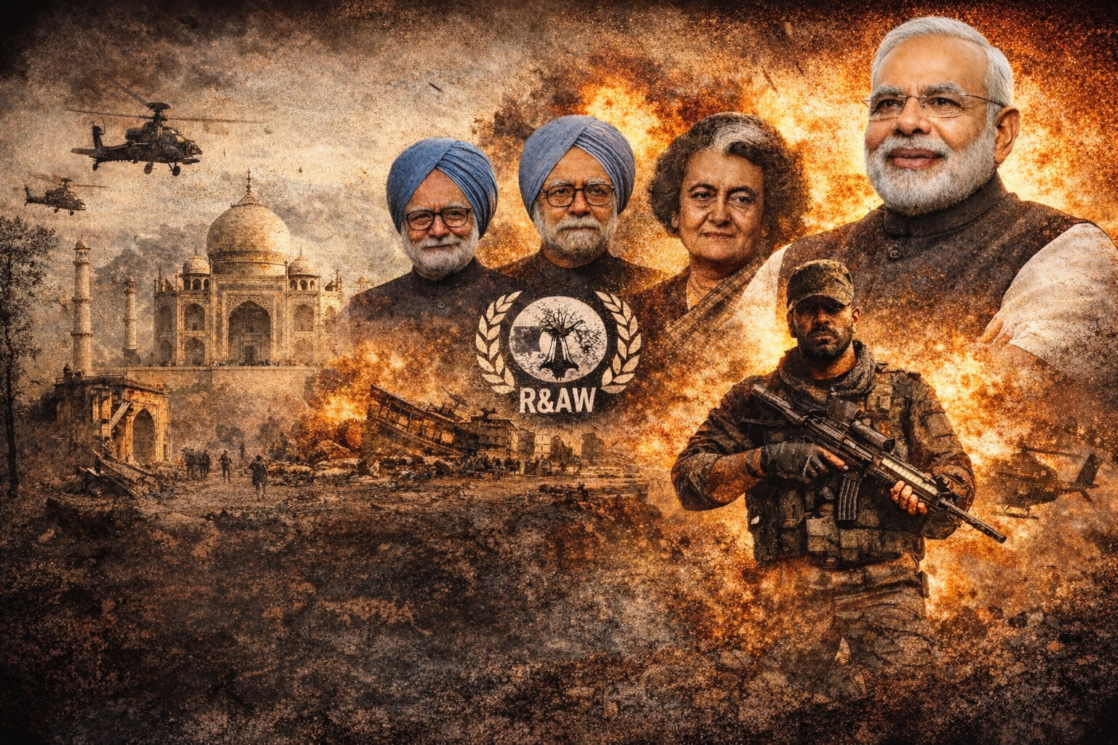
There was a time when cinema reflected society. Today, it engineers perception. What we are witnessing now is not filmmaking—it is narrative manufacturing. And Dhurandar stands as a glaring example of how history is not just being retold, but selectively edited, repackaged, and politically reassigned.
Let’s call it what it is: propaganda with a cinematic budget.
Because when a film takes real intelligence operations, real sacrifices, real blood spilled in silence—and then conveniently rewrites the credit line to suit a present-day political narrative, it stops being art. It becomes an agenda.
The entire storyline of Dhurandhar is drawn from events that occurred between 2004 and 2014. That is not my opinion. That is a record. And during this entire period, India was governed by the Indian National Congress under Prime Minister Manmohan Singh.
Not Narendra Modi. Not the BJP.
Yet somehow, by the time the credits roll, the audience is nudged—subtly, cleverly, repeatedly—into associating these operations with a leadership that had nothing to do with their execution.
That’s not storytelling. That’s intellectual dishonesty.
Let’s strip this down to bare facts—the kind that don’t bend to screenplay demands.
Hamza’s infiltration into Pakistan took place in 2004. Rehman Daiket was neutralized in 2009. Arshan Pappu was eliminated in 2013. Aslam Khan was killed on 9 January 2014. Every single one of these operations falls squarely within the Congress-led era.
And yet, the film behaves as if these were part of some post-2014 strategic doctrine.
Why?
Because perception today matters more than truth yesterday.
Even more telling is the case of long-term operations. Jamal Jamili was sent to Pakistan nearly four decades ago, during the time of Indira Gandhi. The intelligence groundwork that India benefits from today was not built overnight—it was laid brick by brick across decades, across governments, across ideologies.
But Dhurandar doesn’t have the patience for historical continuity. It has a political point to make.
Let’s talk about institutions.
The Research and Analysis Wing—India’s premier external intelligence agency—was established in 1968 under Indira Gandhi’s leadership. It was strengthened, structured, and strategically empowered during Congress regimes. The rank of Secretary (Research) was placed on par with the highest bureaucratic offices in the country, reflecting its importance.
Then came 1977.
The Janata Party government under Morarji Desaidowngraded this status, reducing its institutional weight. It took another Congress government under Rajiv Gandhi in 1986 to restore that stature.
This is not ideology. This is documented administrative history.
But does the film acknowledge any of this?
Of course not.
Because acknowledging it would complicate the narrative—and propaganda thrives on simplicity.
Now let’s address another convenient illusion: the idea that bold economic or strategic decisions began in recent years.
Demonetisation, often portrayed as a groundbreaking modern strike against black money, had already been implemented twice before—once in 1946 and again in 1978. The 1978 move, ironically, was carried out by the same Janata Party regime that weakened R&AW’s institutional standing.
History, it seems, is only remembered when it suits the script.
And then comes perhaps the most uncomfortable truth of all—the elimination of Ilyas Kashmiri in 2011. A high-value target, neutralized during a period when India’s intelligence cooperation and groundwork were at their peak under the Congress-led government.
But watch how such events are absorbed into a broader narrative that subtly shifts credit elsewhere.
It’s not accidental. It’s designed.
What Dhurandar does is take a decade of sustained intelligence effort, built on institutional continuity and strategic patience, and compress it into a single political personality. It erases the timeline, blurs accountability, and hands over a neatly wrapped narrative to the audience.
And the audience, unaware or unconcerned, consumes it.
Because cinema has one advantage over history—it doesn’t need footnotes.
But here’s the problem.
When films start rewriting recent history—history that is still within living memory—they don’t just distort facts, they distort public understanding. They create a generation that believes complex national security operations are the result of one leader, one ideology, one moment.
That is not just false. It is dangerous.
Because institutions matter more than individuals.
Governments change. Officers retire. Political narratives shift. But institutions like R&AW operate in the shadows, across decades, beyond headlines. Their successes are cumulative, not episodic.
And when you reduce that legacy to fit a political storyline, you don’t just disrespect history—you undermine the very idea of institutional integrity.
Let’s be blunt.
If Dhurandhar 2 wanted to be honest, it would have acknowledged that the operations it glorifies were conceived, executed, and completed during a time when the BJP was not even in power at the Centre. That Narendra Modi had no administrative role in these missions. That the credit, if it must be given politically, belongs to the Congress-led governments of that era.
But honesty doesn’t sell as well as hero worship.
So instead, we get a carefully curated illusion—one that aligns with current political sentiments, one that reinforces a pre-existing narrative, one that replaces complexity with convenience.
And that is the real tragedy.
Not that a film took creative liberties—but that it chose to do so at the cost of truth.
Because once cinema becomes a tool to rewrite recent history, it stops being entertainment. It becomes indoctrination.
And a society that consumes such narratives without questioning them slowly loses its ability to distinguish between fact and fiction.
The past deserves better.
The institutions deserve better.
And above all, the truth deserves better.
