


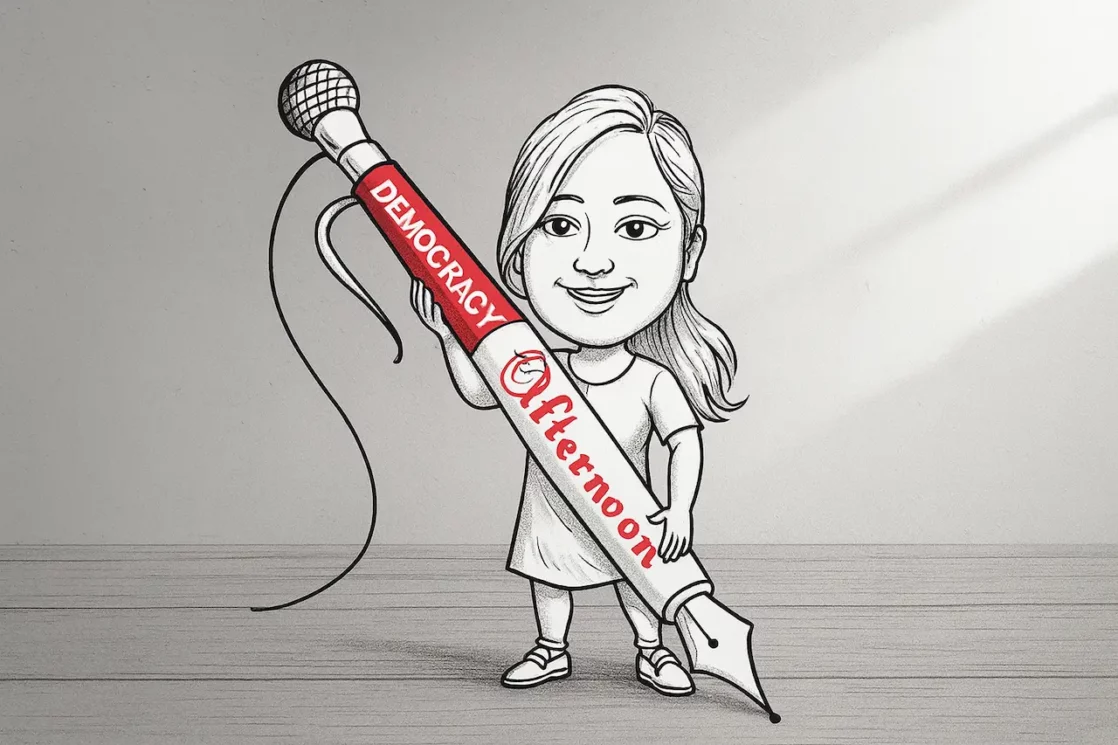
I lived through three generations of journalism, and there was a time when journalism was not a profession — it was a sacred pursuit. It demanded discipline, patience, and devotion. Words weren’t written to impress; they were chosen to express. Every sentence carried weight, every editorial was born from contemplation. Journalism was not about breaking news first — it was about telling it right.
When I began my journey, writing an editorial was a test of the mind and the heart. One had to think deeply, question constantly, and write with a sense of moral duty. A newsroom was not a factory of words; it was a temple of ideas. Each story went through several hands — reporters, sub-editors, proofreaders — all dedicated to one purpose: perfection.
I still remember my early years at ADC. There was a man named Suresh Baliga — a magician with words — who could craft headlines that made readers pause and think. Our editor, Late Mobin Pandit, would make us rewrite the same article ten times until it reached the standard he believed the readers deserved. There was no room for mediocrity; every word had to earn its place on the page.
Later, at FPJ and other publications, I witnessed the same rigor. Journalism, then, was not about visibility — it was about integrity. We wrote not for algorithms, but for conscience.
And then came a new age — an age of convenience.
I was fortunate enough to have computers when I started. Before me, senior journalists had typewriters; before them, printing was done by manually fixing metal letters, one by one. I have even seen, as a child, veterans like Khadilkar, Navakalkar, and Khebudkar writing by hand — long, passionate pieces flowing from their pens like poetry. The smell of ink, the shuffle of paper, the clack of the typewriter — these were the rhythms of real journalism.
But somewhere between the pen and the processor, something shifted.
Technology promised speed — and it delivered. Research became easier. Google came along, offering a universe of information at a keystroke. I remember secretly using it, then rewriting everything in my own words, worried that my curiosity might look like dependency. Editors, back then, could tell instantly whether your writing had “soul” or it was borrowed thought. They would circle paragraphs, question your logic, and ask — “Why did you write this? What do you really want to say?”
That questioning — that intellectual push — shaped us. It built journalists, not content creators.
Then, the digital tide came in. Blogs replaced columns. Clicks replaced credibility. The printing press bowed to the algorithm. And now, in what feels like the blink of an eye, we’ve arrived at the era of Artificial Intelligence.
Today, a writer no longer needs to struggle with words. A headline can be generated in seconds. An editorial can be written by a machine — emotionless, flawless, and disturbingly efficient. AI has become the hand that writes, but not the mind that thinks. It can produce content — but not conviction.
Journalism has always been a dialogue between truth and expression. But AI is a monologue — it tells you what you want to hear, faster and smoother than ever before. It doesn’t question power; it mimics it. It doesn’t understand irony, pain, or rebellion — the lifeblood of real journalism.
The young generation finds this exciting. They are fascinated by the ease, the instant gratification. And I do not blame them — they were born into this speed. But I often wonder — will they ever know the joy of reworking a story till dawn, the pride of finding the perfect word after hours of searching, the silence that follows the moment your editorial goes to print — knowing it might move minds, maybe even change something?
I started my own newspaper at a very young age — seventeen years ago. It was back-breaking work. Gathering content, editing, designing, proofreading, finalizing layouts — every task required heart and sweat. Giving a headline that both informed and inspired was an art that could not be learned by code. Each edition felt alive — like a child you raised and sent into the world. There was exhaustion, but also immense satisfaction. You earned your byline.
Today, you can “generate” one.
It’s not that technology is evil — it’s just indifferent. It doesn’t feel the heat of the printing press, the anxiety of a deadline, or the moral weight of a truth that might offend someone powerful. It only feels prompts and patterns.
And this is where journalism has begun to lose its essence.
We are no longer chroniclers of truth; we are curators of convenience. Words are optimized for engagement, not enlightenment. Facts are shaped for speed, not sincerity. Opinion is crafted for virality, not value.
There was a time when journalists were the conscience of the nation. Today, they are often the reflection of its noise. The editorial pages that once echoed thought-provoking ideas now compete for relevance against trending hashtags and viral videos.
In my early days, an editorial was an event. Readers waited for it, discussed it, and argued over it. It had the power to stir debate, to shift public opinion. Today, most editorials are just scrollable content. The era of “slow journalism” — when truth was earned, not extracted — is dying quietly, pixel by pixel.
And yet, there is something within me that refuses to give up hope.
Because journalism is not merely about medium — it’s about meaning. It’s not about how fast you write, but why you write. Machines may produce words, but they cannot produce wisdom. They may predict emotions, but they cannot feel them.
I have seen three generations of journalism.
The first wrote with hands — slow but soulful.
The second typed with passion — fast but thoughtful.
The third commands machines — faster, smarter, but often empty.
Progress has its price. And perhaps this — the loss of human touch in storytelling — is journalism’s heaviest cost.
When we wrote editorials years ago, one question always lingered in our minds: “Am I saying something that matters to society?”
Today, the question has changed: “Will this go viral?”
And that shift — from responsibility to reach — marks the slow death of the very spirit of journalism.
The pen that once spoke truth to power now seeks validation from algorithms. The editorial that once aimed to awaken conscience now aims to please audiences. The journalist who once chased authenticity now chases analytics.
So yes, technology has advanced. Tremendously. We have tools that our predecessors could never have imagined. But in gaining speed, we lost sincerity. In finding shortcuts, we lost substance.
And in this rush for relevance, somewhere along the way — journalism lost its soul.
Yet, I still believe — deep down — that there will come a moment when someone, somewhere, will stop and ask again:
“What do I really want to say?”
And maybe, just maybe, that question will bring journalism back home — to its heart, to its humanity, and to its purpose.
Because journalism, at its purest, was never about technology.
It was — and will always be — about truth.

Respected Vaidehi Taman Ma’am,
Your editorial is not merely a reflection — it is a resurrection. Each word carries the pulse of a conscience that refuses to be silenced. In an age where journalism often chases noise, your voice reminds us of its original vow: to awaken, not entertain; to illuminate, not merely inform.
When humanity began to chase wealth and forgot the quiet strength of wisdom, the shift toward technology — and now artificial intelligence — became inevitable. But as you so beautifully expressed, machines may generate words, yet they cannot generate soul.
From my own journey, I have witnessed the silent power of pure-hearted guidance. In my early days, only one teacher truly saw me — not as a slow learner, but as a soul worth nurturing. She taught with devotion, never once showing frustration at my pace. Her love became the reason I continued my education.
Later, I left my graduation midway and turned to the soil — where nature became my Guru, teaching me without judgment, without expectation. And then, in a moment that still feels like destiny, I met former Prime Minister V.P. Singh in Delhi around 1999. He welcomed me into his home with an open heart. From that year until his final breath in 2008, we spent countless hours in his garden, discussing politics, world thinkers, and the language of conscience. He never raised his voice, never dismissed my questions. His presence was a living editorial — thoughtful, patient, and profound.
Pure hearts still exist, Ma’am — though they often remain unspoken. Your words come from such a place. They do not merely inform; they transform. They remind us that journalism, at its best, is not about reach but about responsibility. Not about algorithms, but about authenticity.
Time is quietly shaping a new dawn — one where wisdom and love may again guide our collective conscience. Your editorial is a beacon in that journey. May your pen continue to stir the soul of society, and may your truth remain untouched by trends.
With deep respect and heartfelt gratitude,
A R PATIL