Bareilly on High Alert: Tight Security and Internet Ban Ahead of Friday Prayers 2
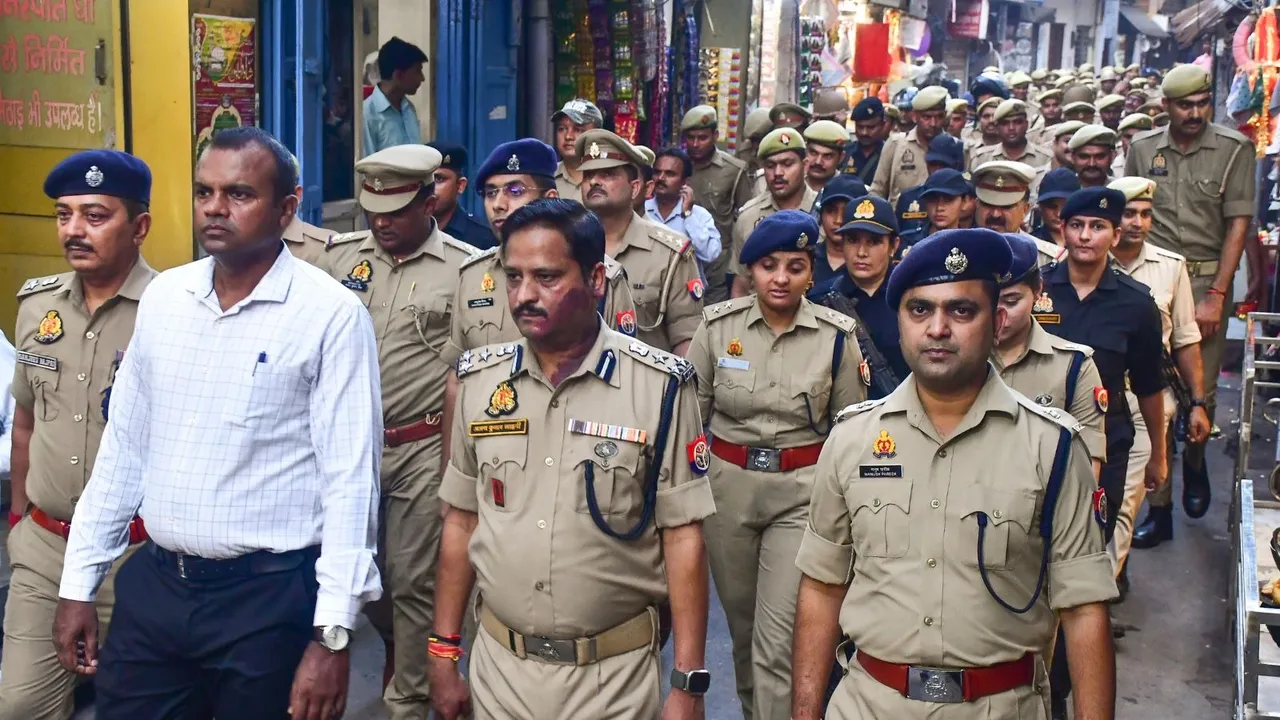
Bareilly turned into a fortress on Friday as security was tightened across sensitive areas ahead of congregational prayers, just a week after the city was rocked by violent clashes.
District Magistrate Avnish Singh and Senior Superintendent of Police Anurag Arya patrolled the city with heavy force since morning, while clerics from the Ala Hazrat Dargah appealed to residents to maintain peace. Internet services remained suspended, and only a few people were seen in the markets.
The unrest began on September 26 when locals clashed with police following Friday prayers after a proposed protest over the “I Love Muhammad” posters was cancelled. Several people were injured in the violence. Police have so far registered 10 FIRs, booked hundreds of mostly unidentified suspects, and arrested over 70 people, including cleric Tauqeer Raza Khan, his aides, and relatives.
Authorities said they have divided the city into four super zones and eight zones for tighter monitoring, with additional IPS officers deployed. Heavy police and paramilitary forces were stationed outside key mosques including Nau Mahal Masjid, Ala Hazrat Dargah, Azam Nagar Masjid, and Baradari mosque. Drone cameras were also deployed for surveillance.
Markets in Roadways Bazaar, Kutubkhana, Shivaji Marg, Alamgirganj, Sarafa, Sahmatganj, and Qila Bazaar opened but lacked the usual hustle, with shopkeepers prepared to shut down at the first sign of unrest.
Clerics appealed for calm, with Sajjadanashin of Ala Hazrat Dargah, Mufti Ahsan Miyan, urging people not to believe in rumours and to return home peacefully after prayers. In light of the tense situation, the annual ‘Julus-e-Gausia’ procession has been cancelled this year and replaced by a small programme with prayers and langar at Sailani Raza Chowk on Saturday. Organisers clarified that the traditional procession will resume next year.
India Condemns Manchester Synagogue Terror Attack That Killed Two 4
India on Thursday strongly condemned the deadly Islamist terror attack on a synagogue in Manchester, United Kingdom, that left two people dead. The attack occurred when an assailant drove a car into people outside the Heaton Park Synagogue and later stabbed them.
New Delhi expressed solidarity with the people of the UK, terming the incident a grim reminder of the ongoing threat posed by terrorism worldwide.
“We condemn the terror attack on the Heaton Park Synagogue in Manchester, during Yom Kippur services today,” External Affairs Ministry spokesperson Randhir Jaiswal said. He noted that the tragedy was particularly saddening as it took place on the International Day of Non-Violence.
“This attack is yet another grim reminder of the challenge we face from the evil forces of terrorism, which the global community must combat and defeat through united and concerted action,” Jaiswal said.
India extended its condolences to the victims’ families and the people of Manchester, stressing the need for collective global action against terrorism.
Putin Hails PM Modi as 'Balanced and Wise,' Backs India's Oil Purchases 6
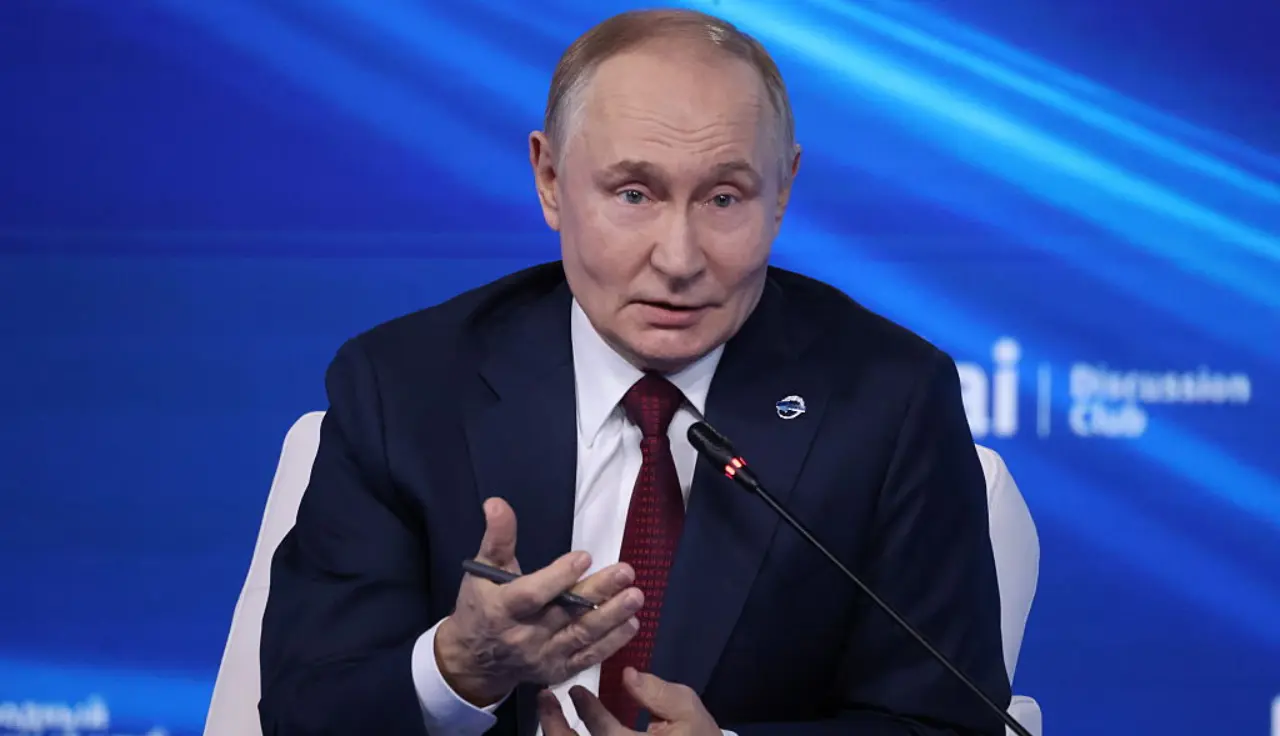
Russian President Vladimir Putin has strongly backed India’s decision to continue purchasing oil from Moscow, asserting that New Delhi’s choices are guided by economic pragmatism rather than political pressure. Speaking at the Valdai Discussion Club in Sochi, Putin said India would face losses of $9–10 billion if it stopped importing Russian energy, with sanctions carrying equal costs.
He praised India’s leadership, stressing that the country would not compromise under external pressure. “The people of India will never allow humiliation in front of anyone. I know Prime Minister Modi; he himself would never take such steps,” Putin said, describing Modi as a “balanced, wise, and nationally oriented leader.”
The remarks came shortly after US President Donald Trump accused India and China of funding the Ukraine war by continuing Russian oil imports. In August, Trump imposed an additional 25 per cent tariff on Indian goods, raising total duty to 50 per cent in response to New Delhi’s stance.
Highlighting the deep-rooted diplomatic relationship between Russia and India, Putin said the two nations have shared trust since India’s independence. “We have never had any problems or interstate tensions with India. Never,” he emphasised.
Calling Modi a friend, Putin underlined their close and comfortable relationship while acknowledging the need to address trade imbalances. He suggested expanding imports of Indian agricultural goods, pharmaceuticals, and other products while tackling financing, logistics, and payment challenges.
With the special strategic partnership between India and Russia approaching its 15th anniversary, Putin reaffirmed the importance of strengthening bilateral cooperation and unlocking new opportunities.
Climate activist Sonam Wangchuk’s wife, Gitanjali Angmo, has approached the Supreme Court seeking his immediate release, challenging his detention under the stringent National Security Act (NSA).
Wangchuk was detained on September 26, just two days after large-scale protests demanding statehood and Sixth Schedule status for Ladakh turned violent, leaving four people dead and around 90 injured. He is currently lodged in Jodhpur jail, Rajasthan.
The plea, filed through advocate Sarvam Ritam Khare, not only contests the grounds of detention but also questions the decision to invoke the NSA against Wangchuk. Angmo alleged she has not received a copy of the detention order, terming it a violation of rules, and added that she has had no contact with her husband since his detention.
The Ladakh administration has meanwhile rejected allegations of a “witch-hunt” or a “smokescreen” operation against the activist, maintaining that due process has been followed.
RSS: The Unsung Backbone of India’s Freedom and Nationhood 10
The criticism that the Rashtriya Swayamsevak Sangh (RSS) did not participate in India’s freedom struggle is one of the most frequently repeated, yet least understood, accusations hurled against it. It is a charge that reveals less about the RSS itself and more about the shallow understanding and ideological prejudice of those who make it. To understand the role of the RSS in India’s independence movement and nation-building, one has to go beyond the simplistic binaries of “marching in protests” or “not marching” and instead examine the deeper questions of what truly constitutes a freedom struggle. If one limits the definition of patriotism merely to holding placards, shouting slogans, and courting arrest in mass movements, then perhaps the RSS’s contribution might seem minimal. But if one understands freedom as something larger — a struggle to resurrect a nation’s selfhood, restore its civilizational confidence, reforge its fragmented society, and prepare its people to sustain sovereignty once political freedom is achieved — then the RSS’s role is not only significant but indispensable.
The RSS was founded in 1925 by Dr. Keshav Baliram Hedgewar, not as a political outfit but as a cultural and social movement with a clear mission: to build the nation from within. Hedgewar, himself a participant in the revolutionary underground against the British and a member of the Indian National Congress before founding the RSS, had come to a crucial realization. He saw that political independence, while necessary, was not sufficient. A colonized nation could overthrow foreign rulers, but if its people remained divided, weak, and ashamed of their own heritage, then their “freedom” would be hollow. The centuries of Islamic invasions and British colonialism had not only enslaved India politically but had also broken its civilizational backbone. The social fabric was fragmented, the sense of national unity was almost non-existent, and the intellectual confidence of the people had been eroded by colonial education and cultural imperialism. Hedgewar believed that before India could truly be free, it had to rediscover its identity and rebuild its inner strength.
Thus, the RSS did not emerge as a party seeking to capture political power. It emerged as a movement seeking to regenerate the soul of a broken nation. Its method was not protests and petitions but silent, disciplined, grassroots-level social work. It established daily shakhas (branches) across towns and villages, where young boys and men were trained in physical fitness, character building, discipline, and above all, a deep sense of devotion to Bharat Mata. The RSS aimed to create a cadre of selfless, service-oriented, and patriotic citizens who would think of the nation before themselves — something that India desperately needed if it was to sustain independence once achieved.
Critics often point out that the RSS did not officially participate in major movements such as Gandhi’s Civil Disobedience Movement of 1930 or the Quit India Movement of 1942. But this argument is both simplistic and dishonest. Firstly, the RSS leadership did not forbid individuals from participating. Hedgewar himself resigned from his post as Sarsanghchalak in 1930 and joined the Satyagraha, for which he was imprisoned. Many swayamsevaks also participated in these movements in their individual capacities. However, Hedgewar consciously kept the organization itself away from formal involvement. Why? Because he believed the RSS had a larger mission than immediate political confrontation. If the RSS had become just another political group chasing British withdrawal, it would have diluted its deeper mission of national reconstruction. Moreover, the Congress and other movements already had plenty of political mobilization. What India lacked was an organization working systematically to unite Hindus, instill pride in their civilization, and build the social foundation on which a free nation could stand.
It is also worth questioning the assumption that political confrontation is the only valid form of resistance. While Congress leaders led protests, others fought with arms (like the revolutionaries of Bengal), and still others like the Arya Samaj and Ramakrishna Mission focused on cultural awakening. Each played a role. The RSS’s approach was no less significant — it fought the psychological and social battles that were essential to India’s eventual success. It worked to end caste prejudices within Hindu society, to remove the inferiority complex planted by colonial rule, and to prepare the ground for national unity. Independence would mean nothing if Indians remained ashamed of their own civilization, divided by sectarian conflicts, and vulnerable to external manipulation.
The criticism that RSS ideology was not explicitly “anti-British” is another misunderstanding — or rather, a deliberate distortion. The RSS’s ideology was not “anti” anything in a narrow political sense; it was “pro-Bharat.” Its focus was not on hatred for the British but on love for India — her culture, her dharma, her unity, and her destiny. Critics love to quote M.S. Golwalkar’s statement calling British rule “an act of providence” out of context. Golwalkar did not mean that British rule was good or desirable; he meant that its historical role had forced Indians to confront their weaknesses and unite as a nation — a painful but necessary awakening. The RSS never collaborated with the British. It did not take British money, nor did it spy on nationalists. It simply chose to fight the battle on a different plane — the civilizational one.
The accusation that the RSS tried to divert Hindu anger away from the British and toward Muslims is equally hollow. The organization did emphasize the historical reality of Islamic invasions and the civilizational struggle that had been waged for centuries. But this was not a distraction from the independence struggle — it was a part of the larger project of national revival. The British were temporary rulers; the deeper wounds to Indian society had been inflicted over centuries of cultural subjugation. The RSS sought to heal those wounds by reviving the consciousness of a shared Hindu identity — not to promote hatred, but to restore self-respect and cohesion. Only a united Hindu society could stand up to colonial rule and chart its own destiny.
Moreover, the RSS’s influence and contribution extended beyond the pre-1947 period. During the Partition, it played an extraordinary role in maintaining peace, rescuing refugees, and providing relief to those displaced by one of the greatest human tragedies in history. Even leaders who had been hostile to the RSS, such as Sardar Vallabhbhai Patel, acknowledged its discipline and service. In a letter written in 1948, Patel praised the RSS for its “patriotic efforts” and recognized that its members were “devoted workers” who had served the nation in its hour of need. This is not the language one uses for an “unpatriotic” organization.
It is also important to note that many individuals associated with the RSS made immense sacrifices for the nation. Hedgewar’s own revolutionary past is often erased from mainstream history. M.S. Golwalkar worked tirelessly to expand the organization under colonial surveillance. Countless swayamsevaks were imprisoned, harassed, and persecuted — both by the British and later by the post-independence state — precisely because they were seen as a threat to the established order. The British knew that while political parties might win independence, an organization like the RSS had the potential to create a society that could resist imperialism in all its forms — political, cultural, and intellectual.
Another frequent criticism is that the RSS refused to meet Subhas Chandra Bose or collaborate with revolutionaries. This is historically false. Hedgewar and Bose did attempt to meet, and even though one such meeting did not happen due to Hedgewar’s ill health, there was mutual respect between them. Bose himself recognized the need for a disciplined, nationalist force within the country — a role the RSS was fulfilling. Hedgewar’s interactions with leaders like Veer Savarkar further underscore the fact that the RSS was not isolated from the broader nationalist movement. It shared intellectual and ideological space with many who were fighting the same battle in different ways.
To judge the RSS by whether it shouted slogans in the streets is to fundamentally misunderstand what the freedom struggle was about. Freedom is not only about the exit of foreign rulers; it is about the revival of national selfhood. It is about preparing a people to govern themselves, defend their civilization, and chart their future. The RSS’s work in this regard was monumental. It reconnected Indians with their civilizational roots, taught them pride in their identity, fostered unity among Hindus across caste and region, and built an organizational discipline that would later become the backbone of numerous national movements.
After independence, the RSS’s relevance only grew. The challenges India faced — from Partition and refugee crises to internal disunity and external aggression — required precisely the kind of character, discipline, and selflessness that the RSS had been cultivating. Its volunteers were on the frontlines of relief efforts during Partition, in the 1962 and 1971 wars, and during natural disasters. Its ideological influence shaped a new generation of leaders and thinkers who would guide India’s political and cultural renaissance in the decades to come.
Those who sneer at the RSS today do so often from ideological bias rather than historical understanding. They hold up a one-dimensional definition of nationalism — one that equates patriotism solely with political agitation — and use it as a stick to beat the RSS with. But history is far richer than that. Revolutions are not made by protests alone. They are made by transforming the consciousness of a people, by rebuilding the moral and cultural foundations of a nation, and by forging a collective will that can sustain sovereignty long after the oppressor is gone. In that deeper, broader, and more enduring struggle, the RSS was not absent — it was essential.
It is time we shed the shallow narratives and ideological blinkers that have distorted our understanding of India’s freedom struggle. The RSS was not a bystander to history. It was a silent architect of India’s rebirth — a movement that worked not for headlines or political power, but for the soul of the nation. Its contribution cannot be measured by the number of arrests its members faced or the speeches they gave. It must be measured by the strength of the society it helped build, the character it forged, and the civilizational confidence it restored. And by those measures, the RSS stands as one of the most patriotic, selfless, and consequential organizations in modern Indian history.
To deny the RSS its place in the story of India’s independence is not just historically dishonest — it is an injustice to the very idea of freedom. Because political independence without cultural self-awareness is incomplete, and it is precisely that deeper dimension of freedom that the RSS fought for, tirelessly and selflessly, for over a century. It is easy to wave a flag once the battle is won. It is far harder to build the spirit that makes a people worthy of that flag. That is what the RSS did. And that is why it deserves not contempt, but gratitude.
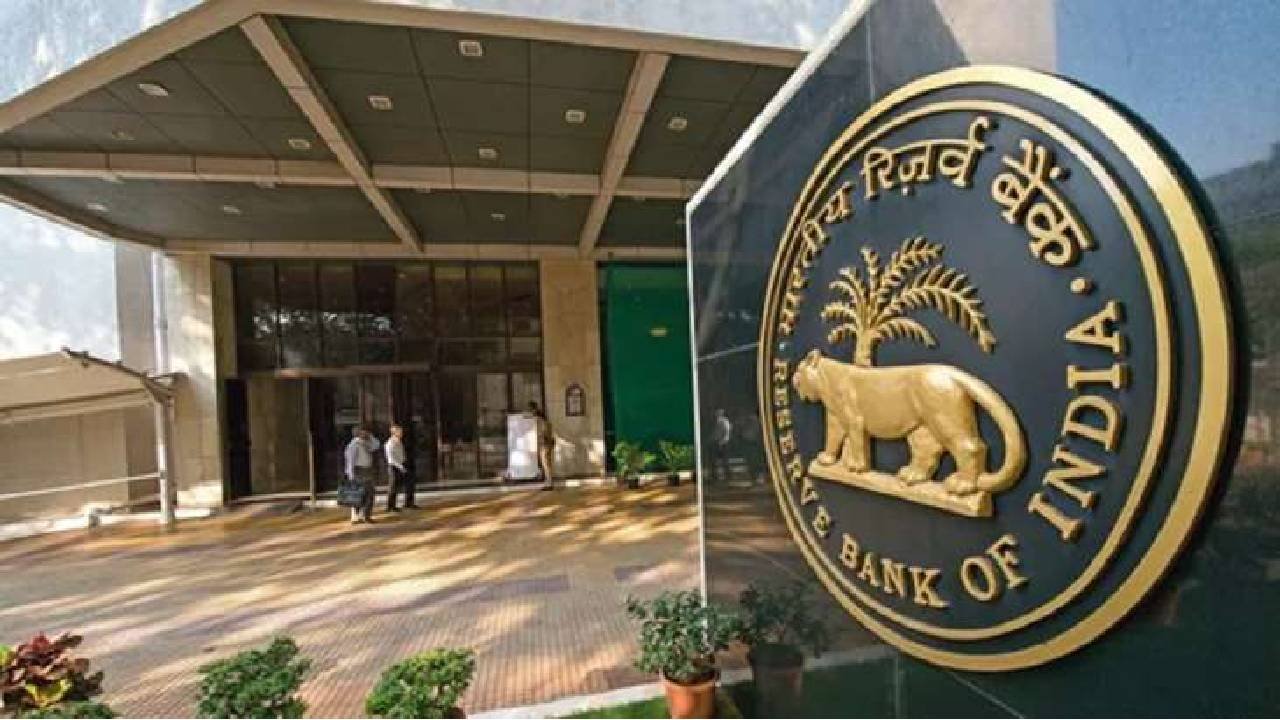
The Reserve Bank of India (RBI) on Wednesday decided to keep the repo rate unchanged at 5.5 per cent, with the monetary policy committee (MPC) maintaining a “neutral” policy stance.
A neutral stance implies that the central bank neither seeks to stimulate the economy nor tighten liquidity, balancing efforts to control inflation without impeding growth.
RBI Governor Sanjay Malhotra said the inflation outlook has become more benign due to a sharp decline in food prices and recent GST rate cuts. The RBI has revised its average inflation projection for 2025-26 to 2.6 per cent from the 3.1 per cent projected in August.
On growth, the MPC has raised its GDP forecast to 6.8 per cent from 6.5 per cent earlier, citing robust domestic demand, a good monsoon, the impact of earlier monetary easing, and GST rate reductions.
The Governor noted that the central bank is waiting for the effects of previous policy measures to fully play out and for trade-related implications to unfold. “It would be prudent to wait for the policy actions to play out before charting out the next round of monetary policy actions,” he said.
Since February this year, the RBI has reduced the repo rate by 100 basis points. Lower rates, combined with increased liquidity, are expected to reduce borrowing costs for consumers and businesses, encouraging consumption and investment. The effectiveness of these cuts, however, depends on how efficiently commercial banks transmit the benefits to borrowers.
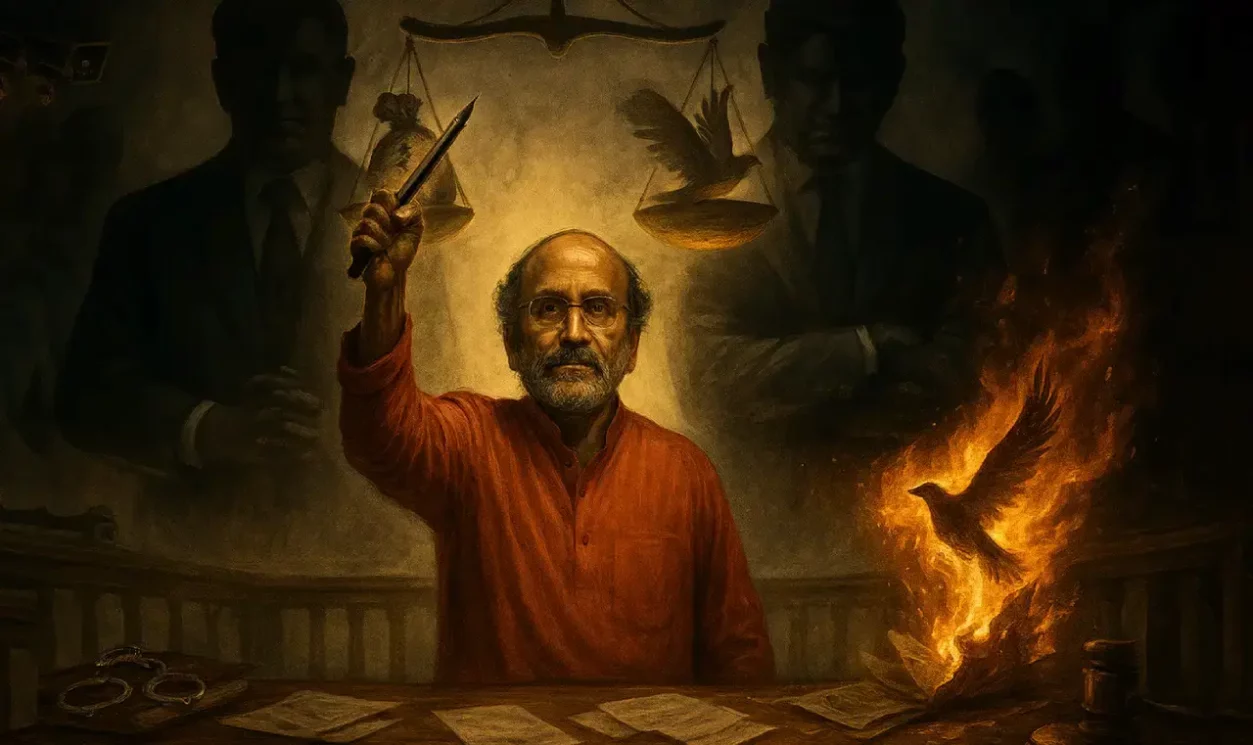
In a democracy, journalism is meant to be the conscience of the nation — a watchdog that questions authority, exposes wrongdoing, and speaks truth to power. But in India, successive governments, irrespective of ideology, have treated that conscience as a threat. The Congress mastered the art of controlling the narrative through state machinery, but the BJP has elevated it into a fine science, deploying lawsuits, surveillance, regulatory crackdowns, and character assassinations to muzzle those who dare to question. In this environment of fear and intimidation, Paranjoy Guha Thakurta stands as a rare, unflinching voice — a journalist who has refused to bend or bow, even as the weight of political power and corporate muscle bore down on him.
The recent developments in his legal battle with the Adani Group could set a precedent and offer a glimmer of hope to independent journalists like Abhisar Sharma and Raju Parulekar, who now face similar persecution. Both were summoned by a magistrate’s court in Gandhinagar after criminal defamation complaints were filed by Adani. This legal harassment is not about justice — it’s about deterrence. It’s about sending a chilling message to every journalist in the country: toe the line or be dragged into courtrooms for years. What both the government and corporate giants like Adani need to understand is simple — journalists are not criminals; they are performing their constitutional duty. And the law applies to them just as it does to the powerful they expose.
The Rohini Court’s ex-parte injunction in Adani Enterprises Ltd. v. Paranjoy Guha Thakurta & Ors. — ordering alleged “unverified” content to be “expunged” within 36 hours under the IT Rules, 2021 — is emblematic of how vague and overbroad legal tools are now used to silence dissent. Within days, the Ministry of Information and Broadcasting issued a sweeping directive to remove over 140 links across Instagram and YouTube. This wasn’t about protecting reputations; it was about erasing inconvenient facts from public memory. And who was at the center of it all? Paranjoy Guha Thakurta — the only Indian journalist cited in the global Hindenburg Report on Adani, the whistleblower who dared to pull back the curtain on one of India’s most powerful conglomerates. Until he spoke, there was no watchdog watching Adani’s meteoric rise. He made the unthinkable thinkable — that the empire might be built on sand.
This is not the first time Paranjoy has been targeted. In 2016, as Editor of Economic and Political Weekly, he published a bombshell investigation exposing how government policies were tweaked to benefit an Adani Group company by ₹500 crore. The Ministries of Finance and Commerce were contacted for clarification — none came. As the story gained traction, Adani’s legal team struck back with a defamation notice. The Sameeksha Trust, fearing an expensive courtroom battle with one of India’s wealthiest corporations, pulled down the article. Paranjoy resigned in protest. That resignation wasn’t just about an article — it symbolized a deeper rot in Indian media: when truth becomes too expensive to print, democracy begins to die.
This wasn’t Paranjoy’s first battle with power. In 2014, his book Gas Wars: Crony Capitalism and the Ambanis, co-authored with Subir Ghosh and Jyotirmoy Chaudhuri, exposed irregularities in natural gas pricing. Reliance Industries promptly hit him with a defamation notice. Since the BJP came to power, Adani and Ambani have not just dominated headlines — they’ve become synonymous with a political-business ecosystem that feeds off each other. They bankroll policies, elections, and propaganda — and in return, enjoy unprecedented regulatory leniency. Journalists who try to trace the money trail are treated as enemies of the state.
The release of the Hindenburg Research report in January 2023 marked another turning point. It alleged opaque accounting, bribery, and environmental violations — wiping billions off Adani’s market value and sparking calls for a probe. Once again, Paranjoy’s work was vindicated: he was the only Indian journalist cited in the report. That should have earned him accolades. Instead, he was targeted by Pegasus spyware between April and July 2018. Amnesty International confirmed his phone had been compromised — another glaring example of how far the state will go to punish inconvenient journalism.
Paranjoy’s battles extend beyond corporate boardrooms. He was one of the first to expose the phenomenon of “paid news” — when media houses sold editorial space to the highest bidder. That exposé, during the UPA era, caused a storm. But instead of reforming, the disease metastasized. Today, the mainstream media is no longer just compromised — it’s largely bought and paid for. Prime-time anchors serve as megaphones for the ruling party. Questions are replaced by cheerleading. Investigations are replaced by propaganda. In 2010, Paranjoy had the courage to call out Congress; in 2025, he still calls out BJP. The governments change; the price of truth remains the same — harassment, lawsuits, and isolation.
His integrity is further underscored by his role in the public interest litigation over the 2G spectrum scam — a landmark case that shook the UPA government. That’s the point critics often miss: Paranjoy isn’t partisan. He is not anti-Modi or anti-BJP. He is anti-corruption, anti-cronyism, and pro-accountability. He has spent decades exposing the rot, regardless of who occupies Raisina Hill. And that is precisely why he’s so dangerous to those in power — because he cannot be bought, bullied, or co-opted.
The plight of journalists like Paranjoy reflects a broader crisis in Indian democracy. Reporters Without Borders has consistently downgraded India’s press freedom ranking, citing violence against journalists, political control of media, and abuse of defamation and sedition laws. Investigative reporters are routinely slapped with FIRs, raided by tax authorities, or dragged into court for years. Their families are harassed. Their phones are tapped. Their livelihoods are destroyed. The message is clear: speak softly, or don’t speak at all. It’s a far cry from the role envisioned for the press by the framers of our Constitution — a fearless institution holding power accountable.
In this hostile landscape, journalists like Paranjoy Guha Thakurta, Abhisar Sharma, and Raju Parulekar are not just reporters — they are resistance. They represent the last bastion of democratic accountability in a system that wants none. Their courage is not just professional; it’s deeply personal. It means accepting financial ruin, social isolation, and even physical danger as the cost of telling the truth. It means being labelled “anti-national” by those who confuse patriotism with sycophancy. It means being vilified by troll armies paid to protect billionaires and ministers.
The judiciary, too, must shoulder blame. Courts have often issued sweeping gag orders or entertained frivolous defamation suits that serve no purpose but to intimidate. The ex-parte injunction against Paranjoy’s reporting is a case in point — a legal tool turned into a weapon of censorship. If the judiciary does not stand as a bulwark for free expression, if it does not protect those who risk everything to expose the truth, then it becomes complicit in the erosion of democracy.
The verdict in Paranjoy Guha Thakurta’s case could be more than just a legal outcome — it could be a moment of reckoning for Indian journalism. If the courts affirm that investigative reporting is not defamation, that criticism is not a crime, and that public interest cannot be censored, it might embolden a new generation of journalists to stand their ground. It could remind corporations and governments alike that the press is not their enemy — it is their mirror. And if they don’t like what they see, the solution is not to break the mirror but to change the reflection.
India desperately needs more journalists like Paranjoy — spines of steel in a profession increasingly spineless. His career is a lesson in integrity: call out corruption, no matter who commits it; expose cronyism, no matter who benefits; speak truth, no matter who trembles. That is the essence of journalism. And in an era when truth is under siege, such journalism is not just necessary — it is revolutionary. Without it, democracy will wither into dictatorship wrapped in the cloak of electoral legitimacy.
The real test of a democracy is not how it treats those who agree with the government, but how it treats those who dissent. By that measure, India has a lot to answer for. But as long as journalists like Paranjoy Guha Thakurta refuse to be silenced, there remains a glimmer of hope — that the pen, even battered and bruised, is still mightier than the billionaire and the politician combined.
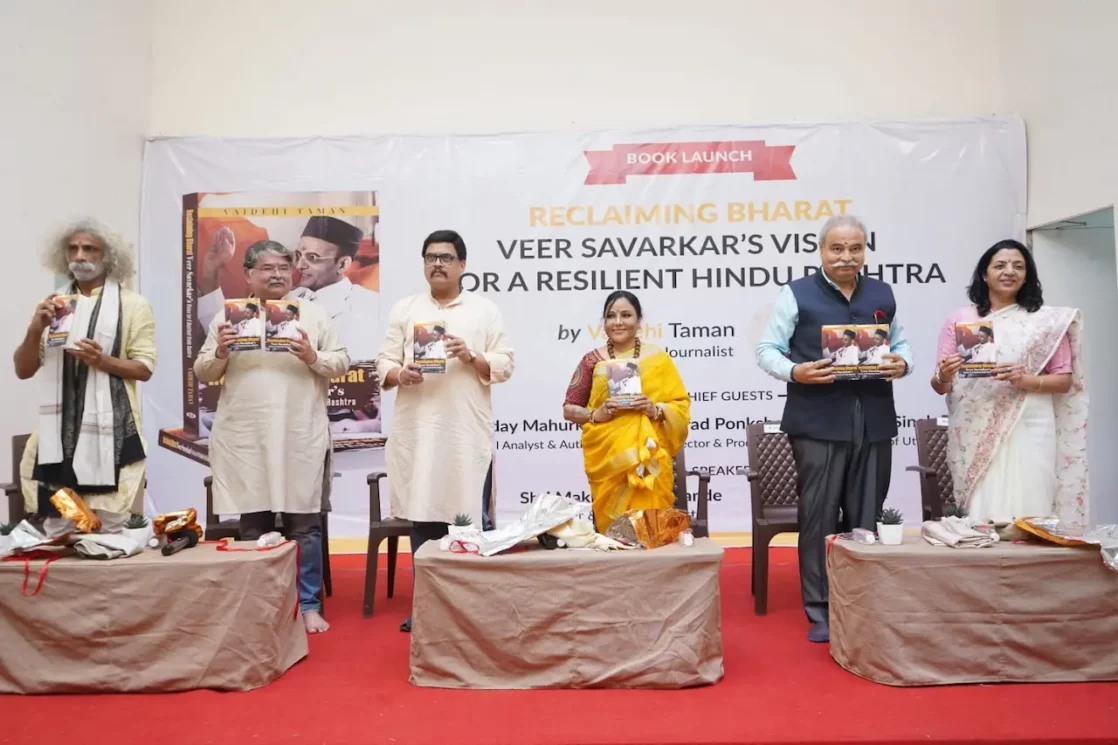
'Veer Savarkar's Vision for a Resilient Hindu Rashtra' – New Book by Dr Vaidehi Taman Launched in Mumbai 15
A powerful new addition to contemporary nationalist literature was unveiled today as “Veer Savarkar’s Vision for a Resilient Hindu Rashtra”, authored by senior journalist and editor Dr. Vaidehi Taman, was officially launched at the Mumbai Marathi Patrakar Sangh. The book, published simultaneously in Marathi, Hindi, and English, seeks to bring Vinayak Damodar Savarkar’s revolutionary ideas into sharper focus for a new generation of Indians.
The launch event witnessed the presence of several distinguished personalities from politics, media, and the arts. Among the guests were former Central Information Commissioner Dr Uday Mahurkar, Shiv Sena MLC Dr. Manisha Kayande, Ranjit Savarkar, President of the Swatantryaveer Savarkar National Memorial, veteran actor Sharad Ponkshe, and acclaimed actor-director Makrand Deshpande. Former Chief Minister of Uttarakhand Tirath Singh Rawat also marked his presence, adding further stature to the occasion.
The book presents Savarkar not merely as a freedom fighter but as a visionary who understood India’s cultural essence and its geopolitical future with remarkable clarity. Dr. Taman has distilled Savarkar’s thoughts on nationalism, governance, economics, social reform, foreign policy, and security into concise chapters, making them accessible to today’s youth and readers eager to understand the deeper philosophy behind Hindutva.
In his remarks, veteran actor Sharad Ponkshe reminded the audience that Savarkar’s prolific writings remain a repository of answers to India’s most pressing issues. “When questioned about his decision to end his life despite the nation’s problems, Savarkar said he had already written everything the country would need. His works still guide us today,” Ponkshe said.
Actor and director Makrand Deshpande emphasized that true patriotism must go beyond words. “Savarkar was more than a man — he was an idea, a poet, and a force. Loving one’s country must be shown through action. This book captures that spirit beautifully,” he noted.
Shiv Sena MLC Dr. Manisha Kayande highlighted the importance of reclaiming Savarkar’s legacy from decades of deliberate distortion. “It is essential for the younger generation to study and write about Savarkar. We are now at a point where we can regain what we once lost,” she observed.
Former Information Commissioner Dr Uday Mahurkar hailed the timing of the book, calling it a crucial contribution to India’s civilizational conversation. “Savarkar’s concept of a Hindu Rashtra was inclusive and visionary. He foresaw Pakistan’s formation, China’s aggression, and the strategic necessity of India’s nuclear capabilities long before they occurred. His insights are as relevant today as they were then,” Mahurkar stated.
In “Veer Savarkar’s Vision for a Resilient Hindu Rashtra”, Dr. Vaidehi Taman brings together history, ideology, and contemporary relevance in a compelling narrative. The book is both a tribute to one of India’s most misunderstood thinkers and a call to action — urging readers to see Hindutva not as a political slogan, but as a timeless framework for building a strong, confident, and united nation.
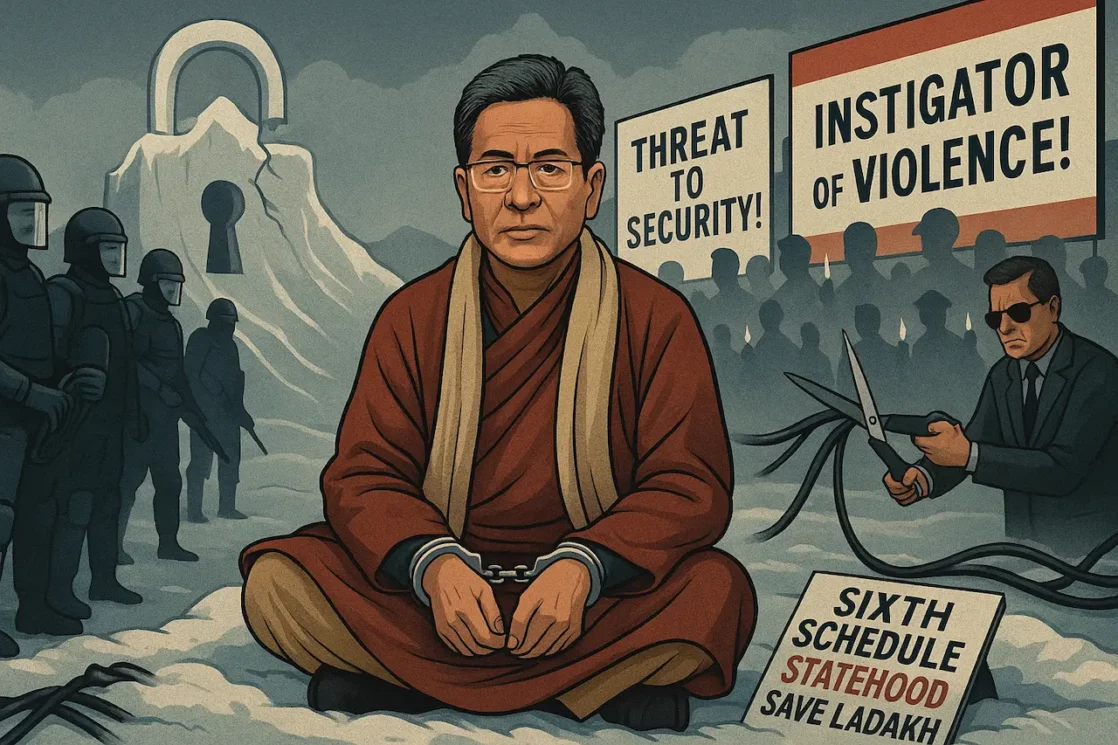
When Protest Terrifies Power: The Making of a False Narrative and the Arrest of Sonam Wangchuk 17
There are moments in a nation’s life when the relationship between rulers and citizens is laid bare, when all the rhetoric of democracy collapses under the weight of its own contradictions, and what remains visible is naked fear. The arrest of Sonam Wangchuk in Ladakh is one such moment. To anyone who has followed his life, his work, his ideas, the very notion that he could be branded a threat to national security would sound ludicrous, if it were not so dangerous. For decades he has been known as an innovator who made the barren land bloom, an educationist who reimagined what it means to learn in harmony with one’s environment, an environmentalist who turned melting glaciers into life-giving ice stupas, and above all a son of Ladakh who believed his people deserved dignity and a voice in their own future. Yet the Indian state has chosen to treat him not as a reformer but as an enemy, not as a partner in development but as a conspirator, and in that choice it has revealed its own weakness more clearly than he ever could have through protest.
The story of his arrest cannot be told without recalling the changes of 2019, when Ladakh was separated from Jammu and Kashmir and made a Union Territory. For many in the rest of India this seemed like an administrative reshuffling, a technical decision buried in legal language. But for Ladakhis it was a rupture, a sudden downgrading of political representation, a loss of agency, a new vulnerability to exploitation. Ladakh, with its fragile ecology and delicate cultural balance, had always required protections that recognized its uniqueness. The Sixth Schedule of the Constitution had been invoked in other tribal areas, giving them the right to safeguard their land, their resources, their identity. Why should Ladakh, even more vulnerable, be denied similar safeguards? That question haunted the region from 2019 onward, and it was Sonam Wangchuk, with his moral authority and his rare ability to translate complex concerns into clear language, who carried it to the nation’s conscience. He was not a politician with a party to build or elections to win; he was a reformer with credibility, and that made him infinitely more dangerous to those in power.
For years the government simply ignored him. His warnings about climate change, about the cultural erosion of Ladakh, about the risks of unfettered development, were tolerated as long as they did not become politically explosive. But patience in Ladakh was wearing thin. Jobs were scarce, migration was draining the young, land was being eyed by outside interests, and every delay from Delhi deepened the sense of betrayal. When Wangchuk finally sat on a hunger strike, it was not an act of drama but of desperation. He wanted to show, through his own body, the urgency of Ladakh’s demands. His fast was peaceful, his speeches calm, his appeal constitutional. Yet within days he drew thousands. The symbolism of a teacher, scientist, and activist starving in the snow while asking nothing more than constitutional justice captured the imagination of young Ladakhis, and it rattled the government in Delhi. They had dismissed him as an eccentric professor; now they saw him as a leader with mass support.
The government’s fear became visible when protests in Leh spilled over into violence. Some youth, frustrated, clashed with police. Vehicles were torched, even a BJP office attacked, and tragically lives were lost. Any government would be shaken by such events. But the response of a secure leadership would have been to ask: what produced such anger, and how do we address it? Instead, the Centre chose the easier, more cynical path: blame one man. The IT cell went into overdrive, scouring speeches, lifting lines out of context, painting Wangchuk as the architect of mayhem. References to the Arab Spring were twisted into a call for insurrection. His moral appeal to the youth was reframed as incitement. And the oldest trick in the book was dusted off: label him a puppet of foreign forces.
This charge was particularly hollow. Wangchuk has never hidden the fact that his innovations and products have found markets abroad. He created, he sold, he earned, and he paid taxes — even though under Article 10(26) of the Income Tax Act, as a member of a Scheduled Tribe living in Ladakh, he was entitled to exemption. He chose the harder road of paying, of standing above suspicion. And yet the IT cell, with its toxic talent for manufacturing suspicion, declared that this was foreign funding, that his institutions were channels of international conspiracy. It was a breathtaking act of projection, for the very party leveling this charge has long thrived on donations from abroad through legal and less-than-transparent means. They imagined everyone must be funded the way their own organizations are, and in that projection they revealed both their guilt and their desperation. For their loyal online army, no lie was too absurd to spread, no slander too low to post. Overnight, the man who had taught India how to harness ice and sunlight was cast as a danger to the nation itself.
Once the smear had been planted, the machinery followed. His NGO, SECMOL, saw its foreign contribution licence canceled. Investigations were announced, irregularities whispered into headlines, the CBI roped in. The idea was not just to tarnish his image but to cripple the institutions he had painstakingly built over decades. If you destroy a man’s work, you destroy his legacy, and perhaps his will. Alongside this, Ladakh itself was silenced: curfews imposed, mobile networks cut, internet suspended. The region was plunged into enforced quiet, as if the government believed that the absence of sound meant the absence of dissent. It was a classic authoritarian reflex: when you cannot control the message, you block the medium.
Wangchuk, however, refused to be cowed. He said openly that he was ready for arrest, that the government might invoke the Public Safety Act or the National Security Act, but that jailing him would create more problems for them than for him. It was a calm defiance, the kind that unnerves power more than any fiery slogan. Because he was right: in locking him away, they would confirm every suspicion about their intent, and they would make his voice echo louder than ever. Nevertheless, on September 26, the hammer fell. He was arrested under the NSA, bundled out of Ladakh, and taken to a jail far away, as if distance could dilute his influence. It was an act less of law than of fear, less of justice than of panic.
What does it say about a government when it must use its harshest national security law against a teacher, an innovator, a man whose only weapons are words and ideas? It says that the government is not as strong as it claims. It says that behind the facade of control lies the fear that one honest voice can undo the carefully constructed propaganda of power. It says that the rulers are more afraid of a peaceful hunger strike than of actual violence, because violence can be crushed with batons, but ideas cannot be crushed so easily. It says, finally, that the government values narrative control above truth, and will do whatever it takes — internet blackouts, arrests, agency raids, propaganda campaigns — to ensure its version of reality prevails.
But in doing all this, they have already lost. Sonam Wangchuk the activist was confined to Ladakh; Sonam Wangchuk the prisoner now belongs to the nation. His arrest has turned him into a symbol, not just of Ladakh’s fight but of the right to dissent itself. Students, environmentalists, civil society voices across India are watching, asking how a government that claims to champion democracy abroad can treat its own reformers as enemies at home. Every lie the IT cell spreads meets its counter in the facts of his life. Every attempt to delegitimize him only reminds people of his honesty. The very act of silencing him has ensured that his story will be told more widely than ever before.
The tragedy is that it did not need to come to this. The demands of Ladakh are not illegitimate. Statehood, Sixth Schedule protections, respect for ecology — these are constitutional questions, political issues that deserve debate and negotiation. By refusing dialogue and choosing suppression, the government has not solved the problem, it has deepened it. It has alienated Ladakhis further, radicalized moderates, and shown the rest of India that peaceful protest can be branded sedition at the flick of a switch. This is the road not of democracy but of authoritarianism. And history tells us authoritarianism always collapses under the weight of its contradictions, because you cannot imprison an idea forever.
What shook the government was not that a few youths set fire to vehicles in Leh. What shook it was the realization that a single man with integrity could inspire thousands without raising his voice, that his hunger strike was more threatening than any mob, because it spoke to the conscience of the people. Governments can control mobs with bullets and batons; they cannot so easily control the moral authority of a figure like Wangchuk. And so they panicked. They smeared, they silenced, they jailed. But in doing so they have confessed their own fear. A government that feels secure does not arrest a schoolteacher under the NSA. A government that trusts its people does not cut their internet. A government that believes in democracy does not treat dissent as treason.
And that is why Sonam Wangchuk’s arrest will be remembered not as the end of his movement but as the moment it broke through the walls of Ladakh and entered the national consciousness. It is the confession of a state that trembles before its own citizens, that fears questions more than violence, that prefers to destroy reputations rather than answer demands. They have locked him in a cell, but in doing so they have unlocked the truth about their own insecurities. And the truth, once seen, cannot be unseen.
Maharashtra's Governance Drowns While Farmers Sink 19
Maharashtra’s Marathwada is not just fighting nature’s fury — it is battling a far more dangerous disaster: the utter apathy and inefficiency of its own government. Unprecedented rains have ravaged the region, turning fertile farmlands into watery graveyards, sweeping away livestock, cutting off villages, and drowning months of hard labour in a matter of hours. Yet, the state machinery, led by Chief Minister Devendra Fadnavis and his two deputies Ajit Pawar and Eknath Shinde, has responded with a lethargy that borders on felonious negligence. Their delayed visits to flood-hit areas were not met with gratitude but with outrage, as angry farmers and villagers confronted them over the pathetic pace of relief distribution and the complete absence of proactive planning. Shinde’s tone-deaf remark, asking people to focus on the “intention” behind relief rather than the miserable execution, exposed just how detached and insensitive the government has become. People do not need empty intentions; they need immediate action, decisive governance, and leaders who stand with them when their lives and livelihoods are washed away.
This government, however, seems too busy saving its own seat belts to save its people. Most of its time has been squandered in the political circus of breaking alliances, forging new ones, and keeping the coalition intact. Governance has taken a backseat to power games. Corruption, irregularities, and bureaucratic red tape run deep within the system, while compassion — the most basic quality expected of leadership — is nowhere to be found. In just three days, more than ten people have died in flood-related incidents, yet the state’s response has been sluggish and directionless. It was not the chief minister or his deputies who initiated urgent rescue efforts — it was the local MP Omprakash Rajenimbalkar, who took the initiative to coordinate evacuations through the Collector’s office. The so-called leadership in Mumbai woke up from its deep political slumber only after Rajenimbalkar’s video went viral on social media, shaming them into action. Until then, they were content to issue hollow statements and stage-managed visits.
The disconnect between the rulers and the ruled was glaringly evident when a desperate farmer questioned Devendra Fadnavis about the insultingly low compensation per hectare. Instead of offering solutions or empathy, Fadnavis snapped, “Don’t politicise the issue.” Police then removed the farmer from the site, silencing the very voice they were supposed to hear. That single moment summed up everything wrong with this government — arrogant, intolerant of criticism, and allergic to accountability. In Solapur, where heavy rainfall has destroyed thousands of acres of soybean, cotton, and maize, Fadnavis’s big solution was to use drone footage for assessing crop loss. It is a classic bureaucratic band-aid — high on optics, low on substance. Farmers don’t need aerial surveys; they need swift compensation, interest waivers, and support to rebuild their lives. The reliance on drone footage only delays relief and adds another layer of red tape to a process already strangled by bureaucracy.
Ajit Pawar and Eknath Shinde, for their part, made their rounds in the flood-affected villages, instructing officials to provide food, shelter, and medicine — the kind of obvious instructions that should have been issued days earlier. Their words sounded rehearsed and robotic, a ritual performance rather than genuine leadership. Meanwhile, the region’s reality is brutal: rivers have overflowed, villages have been submerged, roads and bridges have collapsed, and farmlands — the very heart of rural Maharashtra — have been wiped out. To make matters worse, some areas are simultaneously battling drought, leaving farmers trapped between two extremes of climate disaster with no safety net.
The real tragedy is that the state’s farmers are already on the brink. Repeated crop failures, mounting debt, and rising input costs have pushed them into chronic distress. Many have not yet recovered from last season’s losses, and now, this year’s floods have erased whatever little hope remained. In such a situation, timely relief isn’t just desirable — it is a matter of survival. Yet, the government’s slow-motion response shows no urgency, no vision, and no empathy. It is telling that the most effective relief has come not from the state but from the Indian Army, whose personnel conducted high-risk helicopter rescues, evacuated stranded villagers, and distributed food in areas where the government had failed to reach. Their professionalism and speed only highlight the state administration’s incompetence.
This is not a natural calamity alone; it is a governance disaster, entirely man-made. Maharashtra’s disaster management is stuck in a bygone era — reactive instead of proactive, chaotic instead of coordinated, heartless instead of humane. A state that prides itself on being an industrial powerhouse cannot even ensure basic disaster preparedness for its farmers, the very people who feed its cities and sustain its economy. Eknath Shinde, Ajit Pawar, and Devendra Fadnavis have collectively failed the people of Maharashtra. Their priorities are clear: politics over people, power over performance, survival over service. And unless this attitude changes, the floods will not just wash away crops and homes — they will wash away what little trust the people still have left in their government.