


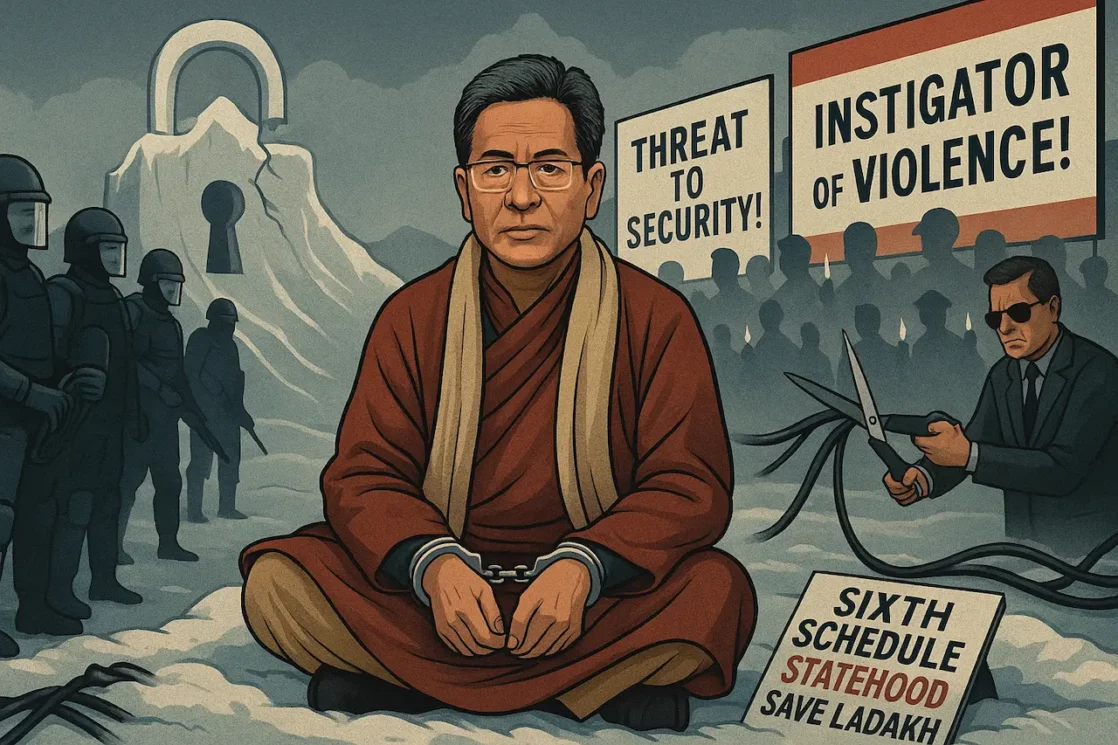
There are moments in a nation’s life when the relationship between rulers and citizens is laid bare, when all the rhetoric of democracy collapses under the weight of its own contradictions, and what remains visible is naked fear. The arrest of Sonam Wangchuk in Ladakh is one such moment. To anyone who has followed his life, his work, his ideas, the very notion that he could be branded a threat to national security would sound ludicrous, if it were not so dangerous. For decades he has been known as an innovator who made the barren land bloom, an educationist who reimagined what it means to learn in harmony with one’s environment, an environmentalist who turned melting glaciers into life-giving ice stupas, and above all a son of Ladakh who believed his people deserved dignity and a voice in their own future. Yet the Indian state has chosen to treat him not as a reformer but as an enemy, not as a partner in development but as a conspirator, and in that choice it has revealed its own weakness more clearly than he ever could have through protest.
The story of his arrest cannot be told without recalling the changes of 2019, when Ladakh was separated from Jammu and Kashmir and made a Union Territory. For many in the rest of India this seemed like an administrative reshuffling, a technical decision buried in legal language. But for Ladakhis it was a rupture, a sudden downgrading of political representation, a loss of agency, a new vulnerability to exploitation. Ladakh, with its fragile ecology and delicate cultural balance, had always required protections that recognized its uniqueness. The Sixth Schedule of the Constitution had been invoked in other tribal areas, giving them the right to safeguard their land, their resources, their identity. Why should Ladakh, even more vulnerable, be denied similar safeguards? That question haunted the region from 2019 onward, and it was Sonam Wangchuk, with his moral authority and his rare ability to translate complex concerns into clear language, who carried it to the nation’s conscience. He was not a politician with a party to build or elections to win; he was a reformer with credibility, and that made him infinitely more dangerous to those in power.
For years the government simply ignored him. His warnings about climate change, about the cultural erosion of Ladakh, about the risks of unfettered development, were tolerated as long as they did not become politically explosive. But patience in Ladakh was wearing thin. Jobs were scarce, migration was draining the young, land was being eyed by outside interests, and every delay from Delhi deepened the sense of betrayal. When Wangchuk finally sat on a hunger strike, it was not an act of drama but of desperation. He wanted to show, through his own body, the urgency of Ladakh’s demands. His fast was peaceful, his speeches calm, his appeal constitutional. Yet within days he drew thousands. The symbolism of a teacher, scientist, and activist starving in the snow while asking nothing more than constitutional justice captured the imagination of young Ladakhis, and it rattled the government in Delhi. They had dismissed him as an eccentric professor; now they saw him as a leader with mass support.
The government’s fear became visible when protests in Leh spilled over into violence. Some youth, frustrated, clashed with police. Vehicles were torched, even a BJP office attacked, and tragically lives were lost. Any government would be shaken by such events. But the response of a secure leadership would have been to ask: what produced such anger, and how do we address it? Instead, the Centre chose the easier, more cynical path: blame one man. The IT cell went into overdrive, scouring speeches, lifting lines out of context, painting Wangchuk as the architect of mayhem. References to the Arab Spring were twisted into a call for insurrection. His moral appeal to the youth was reframed as incitement. And the oldest trick in the book was dusted off: label him a puppet of foreign forces.
This charge was particularly hollow. Wangchuk has never hidden the fact that his innovations and products have found markets abroad. He created, he sold, he earned, and he paid taxes — even though under Article 10(26) of the Income Tax Act, as a member of a Scheduled Tribe living in Ladakh, he was entitled to exemption. He chose the harder road of paying, of standing above suspicion. And yet the IT cell, with its toxic talent for manufacturing suspicion, declared that this was foreign funding, that his institutions were channels of international conspiracy. It was a breathtaking act of projection, for the very party leveling this charge has long thrived on donations from abroad through legal and less-than-transparent means. They imagined everyone must be funded the way their own organizations are, and in that projection they revealed both their guilt and their desperation. For their loyal online army, no lie was too absurd to spread, no slander too low to post. Overnight, the man who had taught India how to harness ice and sunlight was cast as a danger to the nation itself.
Once the smear had been planted, the machinery followed. His NGO, SECMOL, saw its foreign contribution licence canceled. Investigations were announced, irregularities whispered into headlines, the CBI roped in. The idea was not just to tarnish his image but to cripple the institutions he had painstakingly built over decades. If you destroy a man’s work, you destroy his legacy, and perhaps his will. Alongside this, Ladakh itself was silenced: curfews imposed, mobile networks cut, internet suspended. The region was plunged into enforced quiet, as if the government believed that the absence of sound meant the absence of dissent. It was a classic authoritarian reflex: when you cannot control the message, you block the medium.
Wangchuk, however, refused to be cowed. He said openly that he was ready for arrest, that the government might invoke the Public Safety Act or the National Security Act, but that jailing him would create more problems for them than for him. It was a calm defiance, the kind that unnerves power more than any fiery slogan. Because he was right: in locking him away, they would confirm every suspicion about their intent, and they would make his voice echo louder than ever. Nevertheless, on September 26, the hammer fell. He was arrested under the NSA, bundled out of Ladakh, and taken to a jail far away, as if distance could dilute his influence. It was an act less of law than of fear, less of justice than of panic.
What does it say about a government when it must use its harshest national security law against a teacher, an innovator, a man whose only weapons are words and ideas? It says that the government is not as strong as it claims. It says that behind the facade of control lies the fear that one honest voice can undo the carefully constructed propaganda of power. It says that the rulers are more afraid of a peaceful hunger strike than of actual violence, because violence can be crushed with batons, but ideas cannot be crushed so easily. It says, finally, that the government values narrative control above truth, and will do whatever it takes — internet blackouts, arrests, agency raids, propaganda campaigns — to ensure its version of reality prevails.
But in doing all this, they have already lost. Sonam Wangchuk the activist was confined to Ladakh; Sonam Wangchuk the prisoner now belongs to the nation. His arrest has turned him into a symbol, not just of Ladakh’s fight but of the right to dissent itself. Students, environmentalists, civil society voices across India are watching, asking how a government that claims to champion democracy abroad can treat its own reformers as enemies at home. Every lie the IT cell spreads meets its counter in the facts of his life. Every attempt to delegitimize him only reminds people of his honesty. The very act of silencing him has ensured that his story will be told more widely than ever before.
The tragedy is that it did not need to come to this. The demands of Ladakh are not illegitimate. Statehood, Sixth Schedule protections, respect for ecology — these are constitutional questions, political issues that deserve debate and negotiation. By refusing dialogue and choosing suppression, the government has not solved the problem, it has deepened it. It has alienated Ladakhis further, radicalized moderates, and shown the rest of India that peaceful protest can be branded sedition at the flick of a switch. This is the road not of democracy but of authoritarianism. And history tells us authoritarianism always collapses under the weight of its contradictions, because you cannot imprison an idea forever.
What shook the government was not that a few youths set fire to vehicles in Leh. What shook it was the realization that a single man with integrity could inspire thousands without raising his voice, that his hunger strike was more threatening than any mob, because it spoke to the conscience of the people. Governments can control mobs with bullets and batons; they cannot so easily control the moral authority of a figure like Wangchuk. And so they panicked. They smeared, they silenced, they jailed. But in doing so they have confessed their own fear. A government that feels secure does not arrest a schoolteacher under the NSA. A government that trusts its people does not cut their internet. A government that believes in democracy does not treat dissent as treason.
And that is why Sonam Wangchuk’s arrest will be remembered not as the end of his movement but as the moment it broke through the walls of Ladakh and entered the national consciousness. It is the confession of a state that trembles before its own citizens, that fears questions more than violence, that prefers to destroy reputations rather than answer demands. They have locked him in a cell, but in doing so they have unlocked the truth about their own insecurities. And the truth, once seen, cannot be unseen.
