


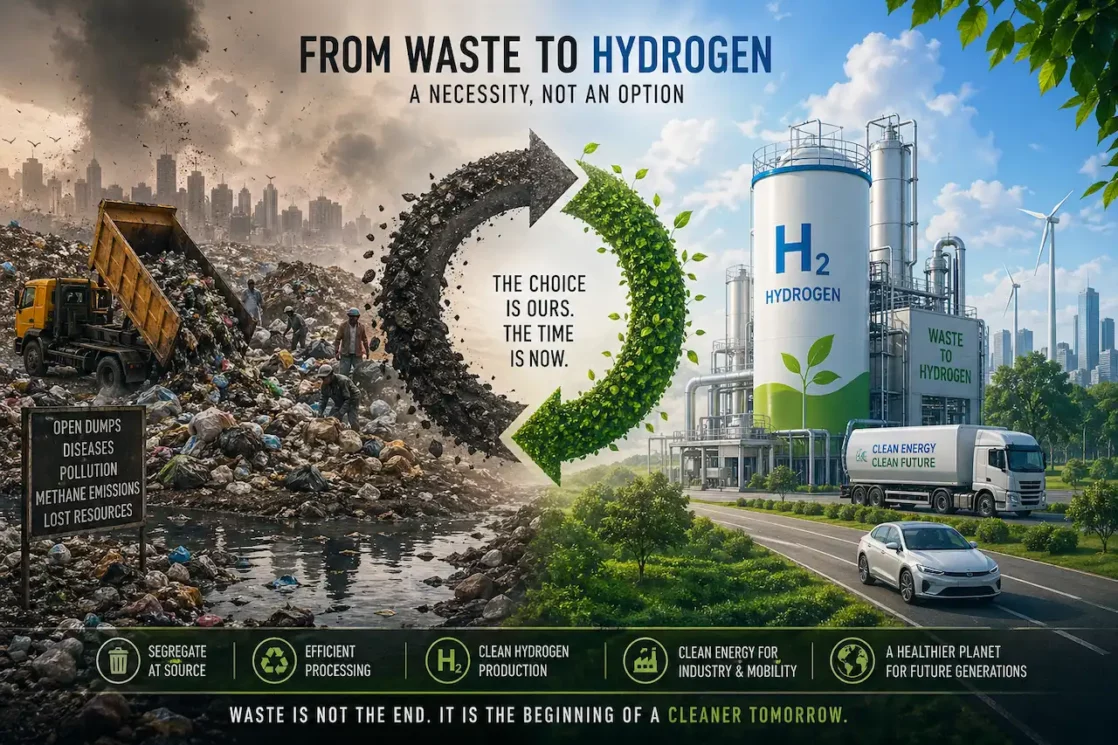
There was a time when waste was biodegradable, cities were smaller, and nature had the capacity to quietly absorb human excesses. That time is long gone. Today, waste is no longer a by-product of life—it has become a defining threat to it. And nowhere is this more visible than in India, where the garbage crisis is not creeping up slowly; it is already sitting at our doorstep, uncollected, untreated, and increasingly unmanageable.
Every year, the world generates over 2 billion tonnes of waste. A large portion of this ends up in landfills, where it decomposes to release methane—a greenhouse gas nearly 28 times more potent than carbon dioxide. This is not just an environmental statistic; it is a warning signal. While global discussions obsess over emissions from vehicles and factories, the silent contribution of waste to climate change continues largely unchecked.
India’s situation is more precarious. With its growing population, rapid urbanization, and changing consumption patterns, the country is producing waste at a scale its systems were never designed to handle. Mountains of garbage in cities like Mumbai and Delhi are not anomalies; they are the new normal.
These landfills leak toxins into soil and groundwater, emit poisonous gases, and routinely catch fire, choking entire neighborhoods.
Let’s call it what it is—this is not merely a waste management issue. It is a failure of planning, discipline, and long-term thinking.
For decades, India has treated waste disposal as a logistical inconvenience rather than a structural challenge. The approach has been predictable: collect, dump, forget. Out of sight, out of mind. But waste does not disappear. It festers. It accumulates. And eventually, it demands attention—often in the form of public health crises, environmental degradation, and economic loss.
The hygiene implications alone are staggering. Poor waste management contributes directly to the spread of diseases, contaminates water sources, and degrades air quality.
The irony is almost painful: a civilization that once placed cleanliness next to godliness now struggles with basic sanitation in its urban centers. Campaigns and slogans have their place, but without systemic change, they remain exactly that—words.
At the same time, India faces another pressing challenge: the urgent need to decarbonize its energy systems.
Heavy industries, transportation, and power generation remain heavily dependent on fossil fuels. The transition to clean energy is no longer a matter of choice; it is a necessity dictated by both environmental realities and global commitments.
Traditionally, these two problems—waste and energy—have been addressed in isolation. Waste was something to be managed; energy was something to be produced. But this separation is outdated.
The future lies in integration, in recognizing that one problem can, in fact, be the solution to the other.
This is where waste-to-hydrogen technology enters the conversation—not as a luxury, not as an experiment, but as a necessity.
The premise is straightforward but powerful: convert waste into hydrogen, one of the cleanest forms of energy available. Municipal solid waste, plastic waste, food waste, refuse-derived fuel, and even sewage sludge can be processed to produce hydrogen.
Instead of rotting in landfills and releasing methane, waste becomes a feedstock for clean energy.
Hydrogen is often described as the fuel of the future, and for good reason. It can power industries, run vehicles, and generate electricity, all while producing minimal emissions. But producing hydrogen sustainably has always been the challenge. Conventional methods are energy-intensive and often rely on fossil fuels, defeating the purpose.
Using waste as a source changes that equation entirely.
It addresses two crises at once—reducing the burden on landfills while creating a viable pathway for low-carbon energy production. In a country like India, where both waste and energy demands are enormous, this is not just innovative thinking; it is practical necessity.
Yet, let’s not romanticize the solution. Technology, no matter how advanced, cannot compensate for systemic inefficiency. India’s waste problem is not due to a lack of ideas; it is due to inconsistent execution. Segregation at source remains weak.
Municipal systems are overstretched. Informal recycling sectors operate without adequate support or integration.
If waste-to-hydrogen is to succeed, it must be part of a broader ecosystem—one that includes disciplined waste segregation, efficient collection systems, and policy frameworks that encourage adoption rather than stifle it.
Institutions like Indian Institute of Technology Bombay have already engaged with such technological approaches, indicating that the scientific groundwork is being taken seriously. Support from industrial players such as Tata Group and Hindustan Petroleum Corporation Limited reflects a growing recognition that the future of energy cannot be divorced from the realities of waste.
But let’s be clear—this is not about corporate participation or academic validation. This is about survival with dignity.
India’s environmental degradation is no longer a distant concern; it is immediate and visible. Rivers are polluted, air quality is deteriorating, and urban living conditions are increasingly compromised. Waste is at the center of this decline. It clogs drains, causes flooding, breeds disease, and erodes the basic quality of life.
And yet, there remains a tendency to normalize it. To walk past garbage heaps without a second glance. To accept pollution as the price of progress. That mindset is perhaps the biggest obstacle of all.
The idea that waste can be transformed into energy challenges this complacency. It forces a shift in perspective—from disposal to utilization, from neglect to responsibility. It asks a simple but uncomfortable question: if waste has value, why are we treating it as worthless?
India does not lack the capacity to implement such solutions. What it often lacks is the will to do so consistently and at scale. Policies are announced, pilot projects are launched, but momentum is frequently lost in bureaucracy and short-term thinking.
This cannot be another half-hearted attempt.
The scale of India’s waste crisis demands bold, sustained action. Urban planning must integrate waste processing infrastructure from the outset. Citizens must be held accountable for segregation. Industries must invest not just for profit, but for long-term sustainability. And governments must move beyond rhetoric to execution.
There is also a deeper cultural dimension to this issue. Traditional Indian practices emphasized minimal waste and maximum reuse. Nothing was discarded casually; everything had a purpose. Modern consumerism has eroded that mindset, replacing it with a disposable culture that the environment simply cannot sustain.
In a way, technologies like waste-to-hydrogen are not just futuristic—they are a return to an older wisdom, adapted for contemporary realities.
The decision to bring such solutions to India is not coincidental. It reflects the country’s unique position—a place where challenges are immense, but so is the potential for impact. If it works here, it can work anywhere.
But success will not come from technology alone. It will come from discipline, accountability, and a refusal to accept the status quo.
India does not need another awareness campaign. It needs execution. It needs systems that function, policies that endure, and citizens who participate.
Waste is not going away. The question is whether we continue to drown in it—or finally learn to rise from it.
The answer will define not just the future of our cities, but the character of our nation
