


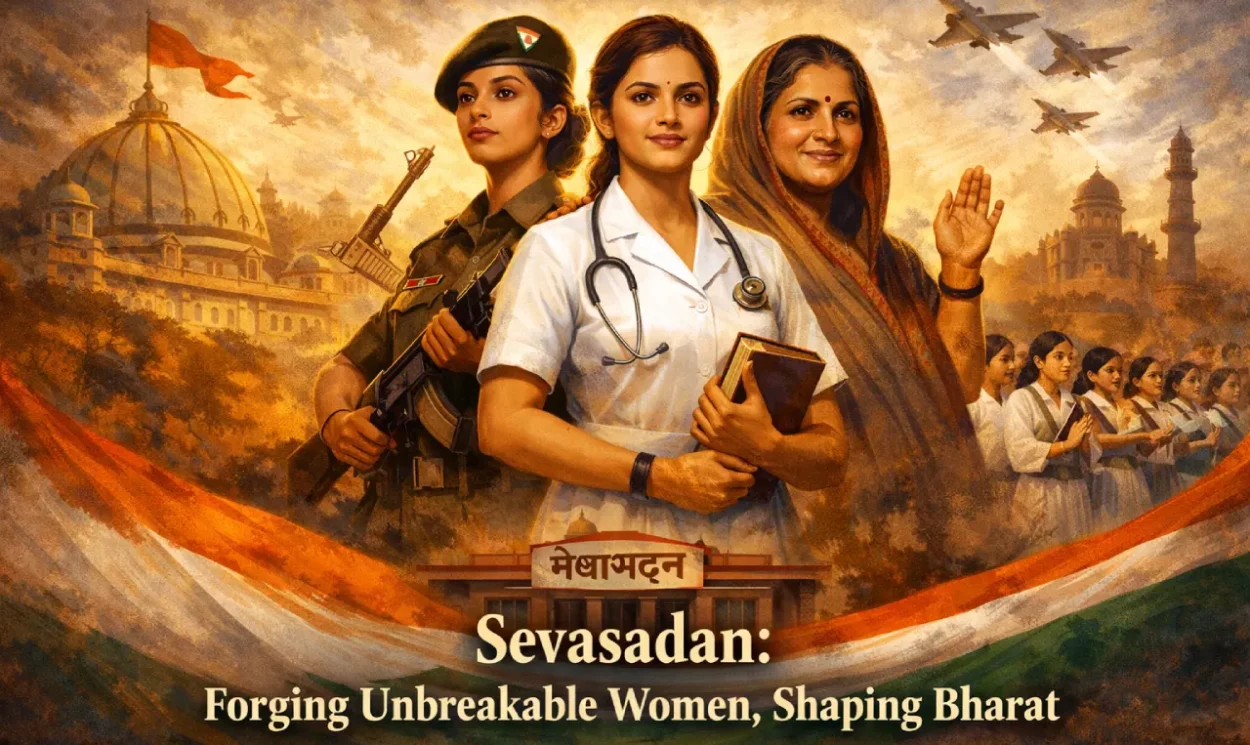
Nagpur is not just a city for me; it is memory, grounding, and a quiet inheritance of values. It is my nanihal, where childhood was not merely spent but shaped. The lanes of Dhantoli, the steady rhythm of everyday discipline, and the unmistakable influence of Rashtriya Swayamsevak Sangh shakhas create an environment where identity is not confused, it is cultivated. Nagpur does not try to impress; it builds. It does not chase noise; it produces clarity. And somewhere within this ecosystem of संस्कार and structure stands an institution that embodies the very spirit of this city—Sevasadan.
To understand Sevasadan is to understand the difference between intent and impact. In 1927, when India was still navigating colonial constraints and social conservatism, Ramabai Ranade did not merely speak about women’s empowerment—she institutionalized it. At a time when educating women was seen as unnecessary, even disruptive, she created a space that quietly challenged that mindset. The Nagpur branch, inaugurated by S. B. Tambe in Dhantoli, began with limited means but unlimited conviction. It started in a rented space, offering sewing, nursing, English language, music, and adult education classes—not as token gestures, but as tools of self-reliance. The message was simple yet revolutionary: a woman is not dependent by default; she is made dependent by design, and that design can be changed.
What makes Sevasadan extraordinary is not just its origin, but its continuity. Many institutions begin with idealism and fade into irrelevance. Sevasadan did the opposite. It grew, adapted, and expanded without losing its foundational ethos. It became not just an educational institution, but a cornerstone of women’s empowerment in Nagpur and beyond. Thousands of women have passed through its corridors, not just acquiring skills, but reclaiming dignity. And that is where its true strength lies—it does not produce statistics; it produces transformation.
In today’s world, where empowerment is often reduced to slogans and campaigns, institutions like Sevasadan serve as a reality check. Empowerment is not a trend; it is a process. It is not loud; it is layered. Modern discourse often behaves as if women’s upliftment is a recent discovery, but the groundwork was laid long ago by individuals and institutions that chose action over applause. Sevasadan belongs to that legacy. It did not wait for validation. It built its own credibility, brick by brick, life by life.
Nagpur, as a city, reinforces this philosophy. It has always had a certain ideological clarity, a rootedness that refuses to be diluted. The influence of organizations like the Rashtriya Swayamsevak Sangh is not merely political; it is cultural. It instills discipline, a sense of belonging, and a deep connection to civilizational identity. Sevasadan operates within this broader framework, complementing it by focusing on women’s empowerment without disconnecting from cultural roots. It proves that progress and tradition are not adversaries; they are allies when approached with sincerity.
As the institution moves into its centenary phase, it is evident that it is not content with resting on its legacy. Under the leadership of Kanchan Gadkari, Sevasadan is expanding its vision in ways that are both ambitious and necessary. Plans for a dedicated military school for girls and a nursing school at Hingna reflect a forward-thinking approach that recognizes the evolving role of women in society. This is not symbolic expansion; it is strategic. A military school for girls is not just about education; it is about leadership, discipline, and preparedness. It signals a shift from empowerment as a concept to empowerment as capability.
At the same time, Sevasadan has not abandoned its cultural foundation. Initiatives like collective Bhagavad Gita chanting remind us that education is incomplete without values. In an age where knowledge is often divorced from wisdom, this balance becomes critical. The institution demonstrates that one can embrace modern education without discarding traditional grounding. It is not about choosing between the two; it is about integrating them meaningfully.
There is a larger lesson here, one that extends beyond Nagpur or Sevasadan. Societies do not weaken suddenly; they erode gradually when their institutions lose purpose and their education loses direction. When learning becomes purely transactional, when values are treated as optional, and when identity is seen as inconvenient, the consequences are inevitable. Institutions like Sevasadan act as stabilizers in such times. They remind us that real progress is not measured only in economic terms, but in the strength of individuals who can think, act, and stand with conviction.
For me, this is deeply personal. Nagpur is not just a place on the map; it is a part of who I am. Every memory from this city carries a lesson, whether it is the discipline of a morning routine, the cultural richness of its traditions, or the quiet strength of its people. Sevasadan is a reflection of all of this. It represents continuity in a world that is obsessed with change, substance in an era of superficiality, and commitment in a time of convenience.
As Sevasadan completes nearly a century of service and steps into its hundredth year, the real question is not about its relevance—it has already proven that. The question is whether we, as a society, recognize the value of such institutions. Because they cannot be replicated overnight. They are built through decades of effort, guided by clarity of purpose and sustained by integrity. If India genuinely seeks to empower its women, not just in numbers but in spirit, then the model offered by Sevasadan is not optional—it is essential.
Nagpur teaches you, in its own understated way, that strength does not need to announce itself. It is built quietly, consistently, and with intention. Sevasadan embodies that strength. It does not seek attention, yet it commands respect. It does not chase relevance, yet it remains indispensable. And perhaps that is its greatest achievement—it continues to shape lives without ever losing sight of why it began in the first place.
