


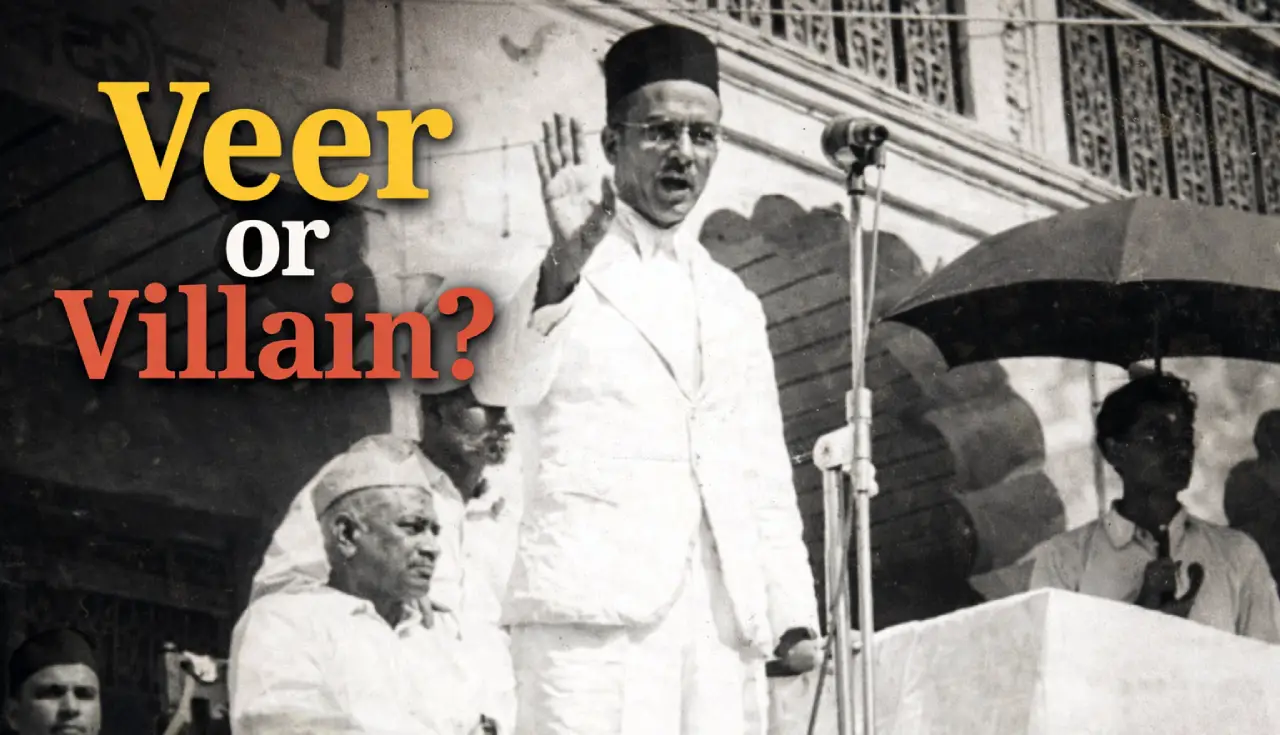
The debate over whether Vinayak Damodar Savarkar deserves the title “Veer” is not really about Savarkar. It is about us—our intellectual honesty, our political maturity, and our willingness to treat history as something more than a weapon of convenience.
Let’s begin with a simple, uncomfortable truth: “Veer” was not a government-issued decoration. It was not conferred by a regime, nor printed in any official gazette. It was a title earned in the court of public consciousness. Savarkar was called “Veer” because people of his time saw in him extraordinary courage—whether in organizing revolutionary networks in London, inspiring armed resistance against the British Empire, or enduring the horrors of the Cellular Jail in the Andamans.
And those horrors were not symbolic. They were real, brutal, and dehumanizing. Prisoners were yoked to oil mills like cattle, flogged for the smallest defiance, and subjected to psychological isolation designed to break the human spirit. To reduce such a life to a shallow talking point about “mercy petitions” is not critique—it is intellectual laziness dressed up as moral superiority.
Yet, this is precisely what modern political discourse has done.
When leaders like Rahul Gandhi publicly dismiss Savarkar as someone who “apologized” to the British, they are not engaging in historical debate—they are simplifying history into slogans. The aftermath has been predictable: defamation cases filed across India, including ongoing proceedings in courts such as those in Pune, where complainants argue that such statements malign not just a man, but the dignity of India’s freedom struggle itself.
This is where the issue stops being political and starts becoming civilizational.
A nation that begins to casually defame those who fought for its existence is not displaying courage—it is displaying amnesia. And amnesia, in civilizational terms, is a slow form of self-destruction.
Let’s be clear: Savarkar is not beyond criticism. No historical figure is. He evolved over time—from a fiery revolutionary to a political ideologue. His views, particularly in later years, can and should be debated. But debate requires depth, context, and integrity. What we are witnessing instead is selective outrage, where complex lives are reduced to single episodes, stripped of context, and then weaponized for electoral gain.
This is not history. This is propaganda.
And the damage is not limited to Savarkar alone.
When we begin ranking freedom fighters based on current political convenience, we fracture the very foundation of our national narrative. Mahatma Gandhi, Subhas Chandra Bose, Bhagat Singh, and Savarkar represented different streams of resistance—non-violence, militarized struggle, revolutionary activism, and ideological nationalism. Together, they formed the mosaic of India’s freedom movement. Remove one, distort another, and the entire picture collapses.
The British did not rule India for two centuries because Indians lacked courage. They ruled because Indians were divided. It is a bitter irony that decades after independence, we are recreating that division—not under foreign pressure, but through our own political narratives.
So what should be done?
First, we must draw a firm line between criticism and defamation. Criticism questions actions; defamation distorts intent. Saying “Savarkar’s political ideology is debatable” is legitimate. Reducing him to a caricature of cowardice is not. It is not only historically dishonest—it is morally irresponsible.
Second, history must be reclaimed from the courtroom and returned to scholarship. Courts can adjudicate defamation, but they cannot settle historical truth. That responsibility lies with historians, researchers, and a society willing to engage with nuance rather than noise.
Third—and perhaps most importantly—we must develop a baseline of respect for all those who endured the brutality of colonial rule. You may disagree with their methods. You may challenge their ideologies. But you cannot deny the price they paid.
A man who spent years in the Cellular Jail did not do so for comfort. A revolutionary who risked execution did not do so for applause. These were individuals who placed the idea of India above their own lives. That alone demands a certain dignity in how we speak about them.
There is also a generational responsibility at stake.
Today’s youth are not reading primary sources. They are consuming fragments—tweets, headlines, political speeches. If those fragments are distorted, then their understanding of India’s past will be equally distorted. And a generation disconnected from its history is a generation vulnerable to manipulation.
This is why the Savarkar debate matters. Not because it will change the past, but because it will shape the future.
If we normalize the casual dismantling of historical figures, then no one will remain untouched. Today it is Savarkar. Tomorrow it could be Gandhi. The day after, Bose. Once the culture of selective defamation takes root, it does not stop—it spreads.
A mature civilization does not erase its complexities; it engages with them. It does not flatten its heroes into propaganda tools; it studies them, questions them, and ultimately respects them.
So, was Savarkar “Veer”?
That is the wrong question.
The real question is this: Do we, as a nation, possess the intellectual honesty to evaluate our past without turning it into a political battlefield?
Because if the answer is no, then the tragedy is not Savarkar’s legacy being debated—it is India’s historical consciousness being diminished.
And that is a far greater loss than any title could ever represent.
