

Home Blog Page 98

Betrayal, Struggle, and Victory: Dumak’s Relentless Fight for a Road

uttarakhand, chamoli, dhumak, dumak gaon, dhumak gaon, uttarakhand village, road, anil baluni
Betrayal, Struggle, and Victory: Dumak's Relentless Fight for a Road 2

In India, justice takes time, and politicians take people for granted. Corruption is another issue where many villages need urgent attention because they are deprived of basic necessities such as roads, water, electricity, job opportunities, and medical facilities. During elections, politicians beg for votes with lofty promises, but once the elections are over, those promises vanish. People suffer, but in Uttarakhand, the resilience of the people has set a strong example of determination and unwavering struggle for their rights. Their courage deserves recognition, and their fight for justice is a lesson in perseverance.

After months of protest and an indefinite strike, there is now a glimmer of hope for the road to reach Dumak, the most remote village in Chamoli district. The government has finally given financial approval to connect Dumak with the Saanji Laga-Maikot-Dumak-Kalgoth (32 km) road. On paper, this road already existed—a classic case of corruption where public money is syphoned off while development remains stagnant. Villagers took the government to court, exposing the blatant fraud. However, the legal system’s limitations meant that justice remained elusive for the voiceless. Undeterred, the villagers continued their agitation, and their persistence paid off. The defining moment came when spiritual leader Shri Kalikanand Saraswati joined the hunger strike, becoming the bridge between the authorities and the villagers. His presence reinforced the movement, and the villagers’ courage remained unstoppable.

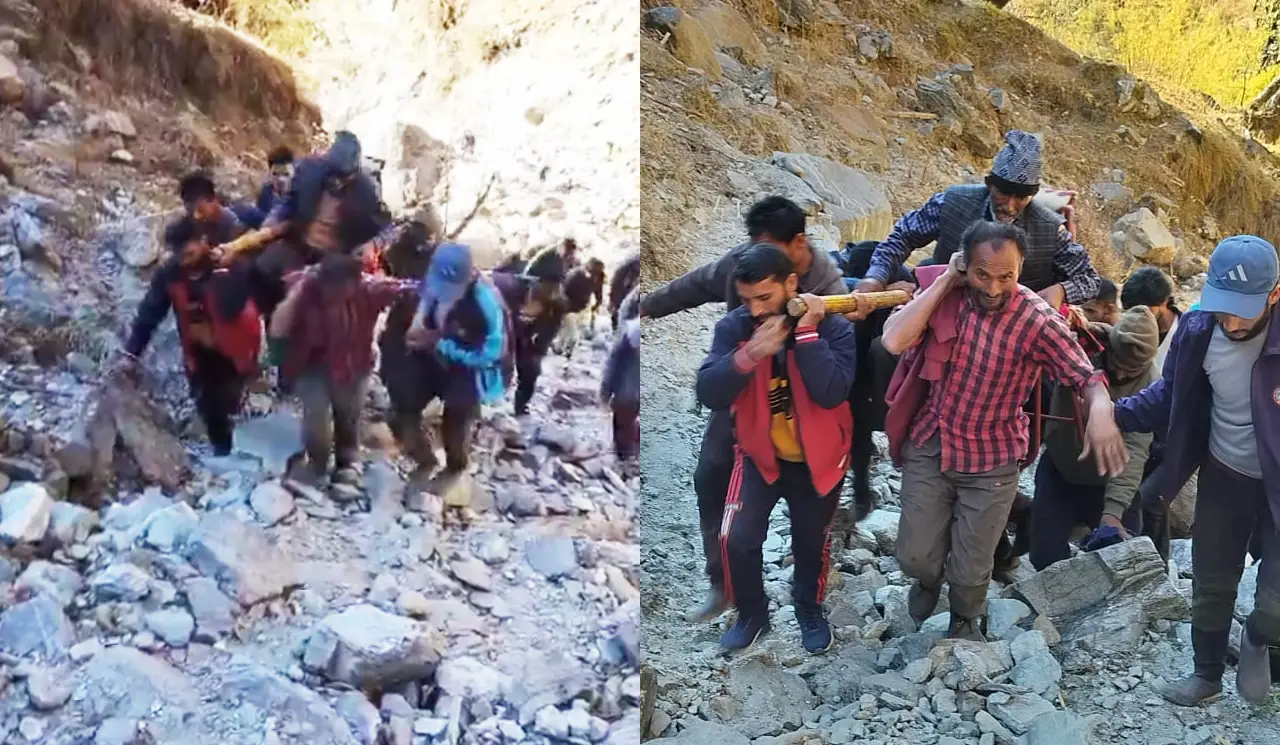
Eventually, the District Magistrate informed the villagers that during a meeting chaired by the Chief Secretary, financial approval for road construction had been granted, with a formal government order soon to follow. This road is not a luxury but a necessity—without it, villagers are forced to carry pregnant women, senior citizens, and critically ill patients on their shoulders for miles to reach a hospital.

The struggle for this road dates back to 2007-08, when the government first approved the Saanji Laga-Maikot-Dumak-Kalgoth road, yet nothing materialised. Road connectivity in Uttarakhand, especially in the higher hills, remains a serious issue. Some remote areas in border districts have been neglected for decades, with repeated demands falling on deaf ears. For this project, Rs. 15.85 crore was sanctioned under the Pradhan Mantri Gram Sadak Yojana (PMGSY) Pokhari scheme. In 2018, the department cleared about 19 km of road till Syun village, but the remaining 12 km was abandoned. PMGSY later proposed an alternative route directly to Kalgoth, citing landslide risks between Syun and Dumak—an excuse rejected outright by the villagers. They demanded road construction along the original alignment, leading to eight geological surveys since 2010. Now, after years of bureaucratic delays, the government has finally agreed to construct the road along the 2010 alignment. However, the so-called high-level meetings that were postponed twice earlier do not inspire much confidence.

A recent meeting chaired by the Chief Secretary led to verbal financial approval for the project. The District Magistrate, Sandeep Tiwari, played a key role in pushing the demand forward. Until now, PMGSY officials merely made empty promises, but it was the villagers’ relentless struggle and the DM’s proactive stance that pushed the government into action. The villagers’ phased agitation stretched over six years, intensifying in 2024 with prolonged protests throughout the year. A 115-day gradual fast took place, even reaching the Collectorate premises. This victory is the result of people’s relentless fight and the guiding influence of the monk who stood with them.

Earlier, the agitation reached the district headquarters, where angry villagers burnt the effigy of Chief Minister Pushkar Dhami. The government had been lying to them for years, offering false assurances while doing nothing. Despite government officials visiting occasionally to pacify them, their demands remained unmet. More than 75 years since independence, they still lack basic road access. Frustrated by years of deception, villagers finally burnt the effigy of the Rural Development Secretary in the Panchayat Bhawan courtyard, raising slogans against the administration. The movement gained support from several think tanks and spiritual leaders, adding pressure on the authorities.

One of the most striking moments of the protest came when a 100-year-old resident of Dumak, Bachhi Devi, began a fast unto death, demanding road construction. The villagers had already been participating in a relay fast for 40 days, and her involvement drew national attention. Despite her age, Bachhi Devi remained firm, declaring that she would not break her fast until the administration met their demands. Dumak, a remote village in Jyotirmath tehsil, is situated 52 km from the sub-district headquarters and 119 km from the district headquarters in Gopeshwar. With only 68 households and a population of around 311, Dumak has been left in isolation for far too long.

Villagers in hilly states like Uttarakhand endure immense hardships due to a lack of roads, particularly in remote areas where even basic amenities remain out of reach. The villagers of Dumak, having suffered for years, are demanding that the administration restart the long-pending construction of the Saanji-Maikot-Dumak-Kalgoth road on the previously approved route. Their frustrations have escalated to the point where they have threatened to boycott the Lok Sabha polls, a bold move signalling their desperation.

Historically, politicians have manipulated these villagers during election seasons. Before elections, construction agencies rush machinery to the village, raising false hopes, only to withdraw them once polling concludes. Dumak, one of the most remote polling stations in Chamoli district, has been consistently used as a pawn in this game. The residents of Dasholi and Pankhanda have twice boycotted elections since the 1990s to demand road construction, yet their appeals remained ignored.

In 2019, Dumak residents announced an election boycott, prompting the authorities to hastily send machines a week before polling day, tricking them into withdrawing their protest. However, as soon as voting ended, the machines disappeared. Five years later, the road remains incomplete. The agitation intensified again in January 2024, with villagers launching a full-scale protest. Despite Chief Minister Pushkar Singh Dhami’s intervention and assurances, construction has yet to begin, pushing villagers to renew their election boycott.

The demand for the Sainji-Lagga-Maikot-Bemru-Dumak-Kalgoth motor road has been pending for decades. Dumak, one of the highest-altitude villages in Chamoli, hosts the second-highest polling booth in the state at an elevation of around 10,000 feet. The village falls within the Badrinath Assembly segment, part of the Garhwal (Pauri) Lok Sabha constituency. BJP’s national media in-charge, Anil Baluni, contested and won the elections, playing a role in addressing the villagers’ grievances. Finally, there is hope that this road will soon become a reality, offering some relief to the high-altitude residents who have been deprived of basic infrastructure for far too long.

This is not just about a road; it is about justice, dignity, and holding the government accountable. The villagers of Dumak have fought long and hard, proving that persistence and solidarity can challenge even the most negligent authorities. The question remains: how many more years will it take for the government to honor its promises?

Pune’s GBS Crisis Deepens: Death Toll Hits 7, Cases Surge to 19

gbs syndrome, gbs, guillain barre syndrome, pune crisis, pune
Pune's GBS Crisis Deepens: Death Toll Hits 7, Cases Surge to 19 4

A 37-year-old driver from Pune, diagnosed with Guillain-Barre Syndrome (GBS), has succumbed to the rare nerve disorder, pushing the death toll in Pune to seven. The city’s suspected GBS cases have surged to 192, with 167 confirmed infections and 21 patients currently on ventilator support, according to health authorities.

The deceased, who worked as a driver, initially sought treatment at a Pune hospital after experiencing weakness in his lower limbs. However, his relatives declined hospitalisation and instead shifted him to Nipani, Karnataka, on February 1. Later, he was admitted to a hospital in Sangli, where he received intravenous immunoglobulin (IVIg) treatment, the standard therapy for GBS.

On February 5, despite medical advice, the family discharged him and admitted him to PMC-run Kamala Nehru Hospital in Pune. His condition deteriorated, leading to supraventricular tachycardia, a severe heart rhythm disorder. He suffered a cardiac arrest on February 9 and died, officials confirmed.

As per state health department data, of the 192 suspected GBS cases, 167 have been officially diagnosed. The geographical spread includes 39 cases from Pune Municipal Corporation (PMC) areas, 91 from newly-added villages, 29 from Pimpri Chinchwad, 25 from Pune rural, and eight from other districts.

Currently, 91 patients have been discharged, while 48 remain in ICUs, and 21 are on ventilators, raising concerns over the outbreak’s severity. With cases continuing to rise, health officials are on high alert, investigating the cause and possible links to environmental or medical factors.

Engineer Rashid’s Bail Limbo Ends? Delhi HC Lists Plea After SC Clarity

engineer rashid, baramulla, supreme court, bail plea, bail
Engineer Rashid's Bail Limbo Ends? Delhi HC Lists Plea After SC Clarity 6

The Delhi High Court has scheduled the hearing of jailed MP Abdul Rashid Sheikh, also known as Engineer Rashid’s bail plea, for February 24, following the Supreme Court’s clarification regarding the jurisdiction of the NIA court in his terror funding case.

Justice Vikas Mahajan deferred the hearing after the High Court administration informed them that the Supreme Court had ruled that the NIA court could hear Rashid’s bail application. Rashid had earlier approached the High Court, arguing that his case was stuck in a legal vacuum since the NIA court handling his bail plea was not designated as a special MP/MLA court, leaving him without a legal remedy.

Meanwhile, as an interim relief, Rashid was granted two-day custody parole to attend the ongoing Parliament session on February 11 and 13.

The Baramulla MP, who won the 2024 Lok Sabha elections while incarcerated, has been lodged in Tihar Jail since 2019, after being arrested by the NIA under the UAPA in a 2017 terror-funding case. The agency alleges that Rashid financed separatist and terror groups in Jammu and Kashmir.

The issue of which court should hear Rashid’s bail plea arose due to a 2016 Supreme Court ruling, which designated special MP/MLA courts to handle cases involving lawmakers. Rashid had urged the High Court to either expedite his bail plea’s disposal by the NIA court or intervene directly.

In December 2023, Additional Sessions Judge Chander Jit Singh had refused to rule on Rashid’s pending bail plea, stating that only a designated MP/MLA court could handle the matter. This led to further confusion until the Supreme Court’s clarification now allows the NIA court to proceed with the bail application.

With the legal deadlock now seemingly resolved, all eyes will be on the February 24 hearing, where Rashid will seek bail in a case that has sparked political and legal debates.

Ravindra Chavan: A Visionary Leader Strengthening Maharashtra BJP’s Political Landscape

ravindra chavan, maharashtra bjp, bjp, mumbai, minister, bjp minister, dombivali
Ravindra Chavan: A Visionary Leader Strengthening Maharashtra BJP's Political Landscape 8

The Maharashtra BJP, in recent years, has made concerted efforts to bring stability and provide capable political leadership to the state, ensuring the successful execution of its development agenda. Ravindra Chavan, a grassroots leader, has played a pivotal role in redefining the BJP’s local political strategies and reinforcing its commitment to governance and progress. The Bharatiya Janata Party (BJP) stands as a cadre-based party, thriving on the unwavering support of millions of dedicated activists and followers across the nation. Its structure is built on rewarding commitment, diligence, and ideological devotion, providing every hard-working activist with opportunities to rise within the organisation. Among the leaders who have emerged from the grassroots, Ravindra Chavan has distinguished himself as an astute strategist, an efficient administrator, and a dynamic politician. His dedication to the party’s ideology and his unparalleled ability to translate vision into action have made him a towering figure in Maharashtra politics.

Ravindra Chavan’s political acumen and relentless drive have reinforced the BJP’s stronghold in Maharashtra, particularly in the Konkan region. As a leader with deep roots in the party’s organizational framework, he has been instrumental in ensuring electoral victories and consolidating support across various demographics. His keen understanding of political dynamics, coupled with his ability to build strategic alliances, has significantly strengthened the BJP’s impact in the state. Whether it is inspiring the party’s cadre, spearheading critical campaigns, or implementing policies that resonate with the people, his efforts have been crucial in advancing the BJP’s vision for Maharashtra.

Having begun his journey as a grassroots activist, Chavan’s rise in the political landscape has been marked by hard work and strategic foresight. From serving as a corporator in the Kalyan-Dombivli Municipal Corporation to holding key positions within the Maharashtra BJP, his trajectory has been one of steadfast commitment and effective leadership. His tenure as the PWD Minister in the previous Mahayuti government was a testament to his ability to drive infrastructure development, enhance urban planning, and improve civic amenities, thereby strengthening his status as a performer and a visionary leader.

A four-time MLA from Dombivli, Chavan has played an active role in shaping the party’s fortunes in Maharashtra. During the recent Lok Sabha elections, his meticulous planning and execution secured victories for Mahayuti candidates in five parliamentary constituencies in the Konkan region, demonstrating his strategic prowess and deep electoral understanding. His success in managing political campaigns, mobilizing support, and countering opposition narratives has established him as a crucial asset to the BJP.

Recognising his contributions, Chavan has been entrusted with critical responsibilities in the party’s organisational structure. His appointment as the Maharashtra State in-charge for the ‘Sangathan Parv’ campaign underscores his expertise in strengthening the party’s grassroots machinery and expanding its outreach. As the BJP gears up for the upcoming elections to local self-government bodies, including the prestigious Mumbai Municipal Corporation, his role becomes even more significant. The Mumbai Municipal Corporation, being the wealthiest civic body in the country, represents a crucial battleground where Chavan’s leadership will be instrumental in shaping the party’s strategy and ensuring electoral dominance.

Amidst shifting political equations, with Uddhav Thackeray’s decision to go solo and BJP’s evolving alliance dynamics with Eknath Shinde’s Shiv Sena, Chavan’s insights and leadership will be central to navigating these complexities. His ability to adapt to changing political landscapes, negotiate alliances, and mobilise support will play a crucial role in consolidating the BJP’s position in Maharashtra. His recent interactions with influential political figures, including Ashish Shelar’s meeting with Raj Thackeray, reflect the strategic deliberations taking place to reinforce the party’s electoral prospects.

Beyond electoral strategies and organisational responsibilities, Chavan’s commitment to public service remains unwavering. His tenure as an MLA has been characterised by a relentless focus on infrastructure development, urban modernisation, and strengthening public services. His initiatives in enhancing road networks, fostering entrepreneurship, and ensuring efficient governance have significantly contributed to Maharashtra’s progress. His emphasis on digital accessibility, smart city development, and improved civic amenities has transformed Dombivli into a model of urban development.

A leader who prioritises action over rhetoric, Chavan’s ability to connect with people at the grassroots level has earned him widespread admiration and support. His transparent and efficient governance model, driven by innovation and accountability, has set new benchmarks in Maharashtra’s political landscape. Whether it is addressing public grievances, implementing transformative policies, or championing developmental projects, his proactive approach has made a tangible difference in the lives of countless citizens.

Chavan’s rising prominence within the BJP has led to growing speculation about his future political trajectory. With the possibility of him being pegged as the next Maharashtra BJP President, his influence and leadership capabilities are poised to play an even greater role in shaping the state’s political future. His inclusion in the party’s star campaigner list further underscores the high regard in which he is held within the party’s ranks.

As a formidable force in Maharashtra politics, Ravindra Chavan embodies the qualities of a true leader—vision, perseverance, and an unwavering commitment to public service. His ability to devise and implement effective political strategies, mobilise grassroots support, and drive developmental initiatives cements his status as a key architect of the BJP’s success in the state. His leadership will continue to shape the future trajectory of Maharashtra politics, ensuring that the BJP remains at the forefront of governance and development in the years to come. Through his relentless dedication, Maharashtra moves forward on the agenda of growth, prosperity, and progress, with Ravindra Chavan at the helm of its political transformation.

Eknath Shinde Snubbed? Exclusion from Key Panel Sparks Mahayuti Rift Speculation

eknath shinde, shinde, mahayuti, devendra fadnavis, fadnavis
Eknath Shinde Snubbed? Exclusion from Key Panel Sparks Mahayuti Rift Speculation 10

The exclusion of Maharashtra Deputy Chief Minister Eknath Shinde from the State Disaster Management Authority (SDMA) has sparked political controversy, with many seeing it as a sign of growing tensions within the ruling Mahayuti alliance. The restructured SDMA, led by Chief Minister Devendra Fadnavis, includes Deputy CM Ajit Pawar but has left out Shinde, despite his crucial role as head of the urban development department, which is central to disaster response efforts.

The SDMA, formed after the 2005 Mumbai floods, is responsible for coordinating emergency responses, making Shinde’s omission particularly noteworthy. Political analysts suggest this move reflects a power struggle between Fadnavis and Shinde, with the BJP consolidating control over key decisions.

Reports of discontent within Mahayuti have persisted since the coalition’s formation, with Shinde reportedly unhappy over cabinet allocations and the appointment of district guardian ministers, especially in Raigad and Nashik. The controversial appointment of NCP leader Aditi Tatkare as Raigad’s guardian minister, despite objections from Shinde’s camp, further fueled speculation of BJP and NCP sidelining the Shiv Sena faction led by Shinde.

While a senior BJP minister has dismissed reports of infighting, observers believe Shinde’s gradual marginalization within the alliance is becoming more evident. His exclusion from the key disaster management body is being interpreted as another sign of Mahayuti’s internal power struggles, adding to the uncertainty over its long-term stability.

Maha Kumbh Chaos: Prayagraj’s Sangam Station Shut Amid Massive Pilgrim Rush

prayagraj, sangam, sangam station closed, allahabad, maha kumbh
Maha Kumbh Chaos: Prayagraj's Sangam Station Shut Amid Massive Pilgrim Rush 12

The Prayagraj Sangam railway station has been temporarily shut down as authorities struggle to control the overwhelming rush of pilgrims attending the Maha Kumbh Mela in Uttar Pradesh. The move aims to prevent overcrowding and ensure public safety amid an unprecedented surge in visitors.

Officials stated that train services have been rerouted to nearby stations, and special arrangements are in place for pilgrims’ safe transportation. The shutdown is part of crowd management efforts, as authorities brace for even larger gatherings in the coming days.

Meanwhile, in neighboring Madhya Pradesh, traffic congestion has forced authorities to halt hundreds of vehicles heading towards Prayagraj. Deputy Inspector General (DIG) of Rewa Range, Saket Prakash Pandey, said, “We are allowing vehicles to pass one by one after getting clearance from Prayagraj administration.”

Pilgrims have reported massive traffic jams en route to the Mela, with some stranded for hours. A Nagpur resident recounted being stuck in Maihar for over two hours, while another appreciated the food arrangements for stranded travellers, urging cooperation with government measures.

With the Maha Kumbh Mela drawing millions of devotees, authorities continue to implement stringent measures to prevent stampedes, manage infrastructure pressure, and ensure a safe pilgrimage experience.

Sonia Gandhi Demands Government to Conduct Population Census at Earliest

sonia gandhi, population census, rajya sabha, congress
Sonia Gandhi Demands Government to Conduct Population Census at Earliest 14

Senior Congress leader Sonia Gandhi on Monday asked the government to complete a population census at the earliest, claiming that around 14 crore people in the country are being deprived of the benefits under the food security law.

In her maiden Zero Hour intervention in the Rajya Sabha, Gandhi said beneficiaries under the National Food Security Act (NFSA) are being identified as per the 2011 Census, and not the latest population numbers.

The senior Congress leader called the NFSA introduced by the UPA government in September 2013 a landmark initiative aimed at ensuring food and nutritional security for the country’s 140 crore population.

The legislation, Gandhi said, played a crucial role in protecting millions of vulnerable households from starvation, particularly during the COVID-19 crisis.

She also said that the quota for the beneficiaries is still determined based on the 2011 Census, which is now well over a decade old.

The National Food Security Act, 2013, provides for coverage of up to 75 per cent of the rural and up to 50 per cent of the urban population for receiving highly subsidised foodgrains under the Targeted Public Distribution System (TPDS), which according to the 2011 Census comes to about 81.35 crore.

At present, the government provides 5 kg of free foodgrains per person per month under the food security law.

“For the first time in the history of independent India, the decennial census has been delayed by more than four years. It was originally scheduled for 2021, but there is still no clarity as to when the census will be conducted,” she said.

Gandhi also claimed that the Budget allocations show that the updated census is unlikely to be conducted this year.

Around 14 crore eligible Indians are thus being deprived of their rightful benefits under the NFSA, she said.

“It is imperative that the government prioritises completion of the census as soon as possible and ensures that all deserving individuals receive the benefits guaranteed to them under the NFSA. Food security is not a privilege. It is a fundamental right,” the former Congress chief said.

The period for distribution of free foodgrains under the Pradhan Mantri Garib Kalyan Anna Yojana (PMGKAY) has been extended for five years from January 1, 2024.

Punjab Police Busts Terror Module in Amritsar; 3 Arrested With AK-47, Pistols

amritsar police, punjab police, terror links, busts terror, ak-47
Punjab Police Busts Terror Module in Amritsar; 3 Arrested With AK-47, Pistols 16

Punjab Police has busted a terror module with the arrest of a trio allegedly involved in carrying out an ‘explosion’ near a closed police post here on February 3, officials said on Monday.

Police also recovered one AK-47 rifle, two pistols and cartridges from their possession, they said.

After their arrest, the suspects allegedly tried to escape as one of them snatched a pistol from a police officer and opened fire. In retaliatory fire, two accused suffered bullet injuries and were admitted to a hospital, police said.

The trio has been identified as Lovepreet Singh, Buta Singh and Karandeep Singh, all residents of Amritsar Rural having links with a Dubai-based man who helped in providing them with money and weapons.

Confirming the arrests, Amritsar Police Commissioner Gurpreet Singh Bhullar said the module was being operated by terrorist Happy Passia and others from abroad.

During preliminary investigation, it was found that they were behind the ‘explosion’ near a closed police post on the Fatehgarh Churian by-pass road on February 3 when a ‘blast-like’ sound was heard.

Centre’s U-Turn on Amending CNLD Act Aimed at Appeasing Foreign Firms: Congress

jairam ramesh, ramesh, congress, press, CNLD Act
Centre's U-Turn on Amending CNLD Act Aimed at Appeasing Foreign Firms: Congress 18

The Congress on Monday alleged that the Modi government’s announcement that it will amend the Civil Liability for Nuclear Damage Act 2010 was a “U-turn” aimed at appeasing French and American companies since Prime Minister Narendra Modi is travelling to these two countries over the next four days.

Congress general secretary in-charge communications Jairam Ramesh recalled that on February 8, 2015, the Ministry of External Affairs issued a booklet called ‘Frequently Asked Questions and Answers on Civil Liability for Nuclear Damage Act 2010 and related issues’.

“Q3 said the following: ‘Has India agreed to amend its Civil Liability for Nuclear Damage Act of 2010 (CNLD Act 2010) and the CNLD Rules of 2011? If not now, would they be amended in the future?’ The Answer given to this Question by the Modi Govt then was the following: ‘There is no proposal to amend the Act or the Rules.’,” Ramesh said on X.

On February 1, 2025, the Finance Minister in her Budget speech announced that this Act will be amended, he said.

“The U-turn has been done clearly to appease French and American companies since the PM is travelling to these two countries over the next four days,” Ramesh alleged and pointed out that negotiations with these companies have been going on for over 15 years.

“The Civil Liability for Nuclear Damage Act, 2010, was passed after considerable discussion both in and out of Parliament. As Leader of the Opposition in the Rajya Sabha, the late Arun Jaitley, had played an important role in crafting this law,” the Congress leader said.

Modi will be in France from February 10-12 to co-chair the AI Action Summit with French President Emmanuel Macron.

Prime Minister Modi will also pay a two-day working visit to the US from February 12 during which he will hold a bilateral meeting with President Donald Trump and interact with business leaders and members of the Indian community.

BJP Ends 27-Year Drought in Delhi, Ousts AAP in Historic 2025 Election Victory

delhi victory celebration bjo
BJP Ends 27-Year Drought in Delhi, Ousts AAP in Historic 2025 Election Victory 20

In 2025, the BJP made a stunning comeback in Delhi, ending a 27-year hiatus of not holding power in the national capital. The results of the February 5 elections marked a dramatic shift, as the Aam Aadmi Party (AAP) was ousted from its position of power, securing only 22 seats. Meanwhile, Congress continued its disappointing performance, failing to win a single seat. The BJP emerged victorious with 48 of the 70 seats in the Delhi Assembly, securing a significant win after nearly three decades of absence from power. This victory in the 2025 elections placed the saffron party in a strong position, paving the way for the appointment of the next Chief Minister, a decision that will be made by the central leadership of the party.

This election marked the end of a long political drought for the BJP, who, after being out of power for 27 years, managed to claim victory in a fiercely contested battle. The BJP’s win set the stage for the fourth leader of the party to take the helm as Delhi’s Chief Minister. The identity of this leader remains under wraps, with speculation growing about who will be chosen for this crucial role. Interestingly, the last BJP Chief Minister in Delhi held office almost 26 years ago, a period during which the city saw rapid changes in its leadership, with three different Chief Ministers serving between 1993 and 1998.

The BJP’s first Chief Minister of Delhi, Madan Lal Khurana, took office in 1993 after the 69th Amendment to the Constitution restored an elected assembly in the capital. Khurana’s tenure, however, was short-lived, lasting just over two years from December 1993 to February 1996. During the 1993 Delhi Assembly elections, the BJP secured 49 out of the 70 seats, while Congress won 14, Janata Dal secured 4, and three seats went to independent candidates. However, Khurana faced a significant political scandal in 1995 involving the infamous Hawala case, which led to his resignation under immense pressure in 1996. His resignation was followed by Sahib Singh Verma, who became the next Chief Minister.

Sahib Singh Verma’s tenure lasted from February 1996 to October 1998. His leadership was marked by internal party conflicts, particularly with his predecessor Khurana, who sought to reclaim the position after being cleared of the charges against him. Verma, however, faced criticism for his handling of key issues like rising onion prices and the ongoing water crisis in Delhi, which led to his resignation in 1998. In his place, Sushma Swaraj was appointed as the next BJP Chief Minister, making her the first woman to hold the position in Delhi. Her term, however, was brief, lasting only 52 days, from October to December 1998. Despite her efforts to tackle the onion supply crisis and other pressing issues, the BJP’s leadership could not prevent the party’s defeat in the ensuing assembly elections. Congress returned to power with Sheila Dikshit at the helm, serving as Chief Minister for the next 15 years, until her defeat by AAP leader Arvind Kejriwal in 2013.

In the 2013 Delhi elections, the AAP emerged as a strong contender, securing 28 seats, while Congress won 8 seats and BJP obtained 31 seats. This result led to the formation of a coalition government between AAP and Congress. However, the government did not last long and was replaced by President’s Rule. In the 2015 elections, AAP achieved a sweeping victory, winning 67 of the 70 seats and bringing Arvind Kejriwal back as Chief Minister. AAP maintained its stronghold in the 2020 elections, securing 62 seats and continuing Kejriwal’s leadership.

However, in 2025, the political landscape shifted once again. The BJP managed to break its 27-year-long drought in Delhi, capitalizing on issues like AAP’s alleged involvement in a liquor scam and other controversies surrounding their governance. What further shifted the tide in BJP’s favor was the electoral success of Parvesh Verma, the son of former Delhi CM Sahib Singh Verma, who defeated Arvind Kejriwal in the New Delhi assembly constituency by over 4,000 votes. This victory solidified BJP’s position in the capital and ended AAP’s long reign, marking a significant political milestone for the party in Delhi’s history.