


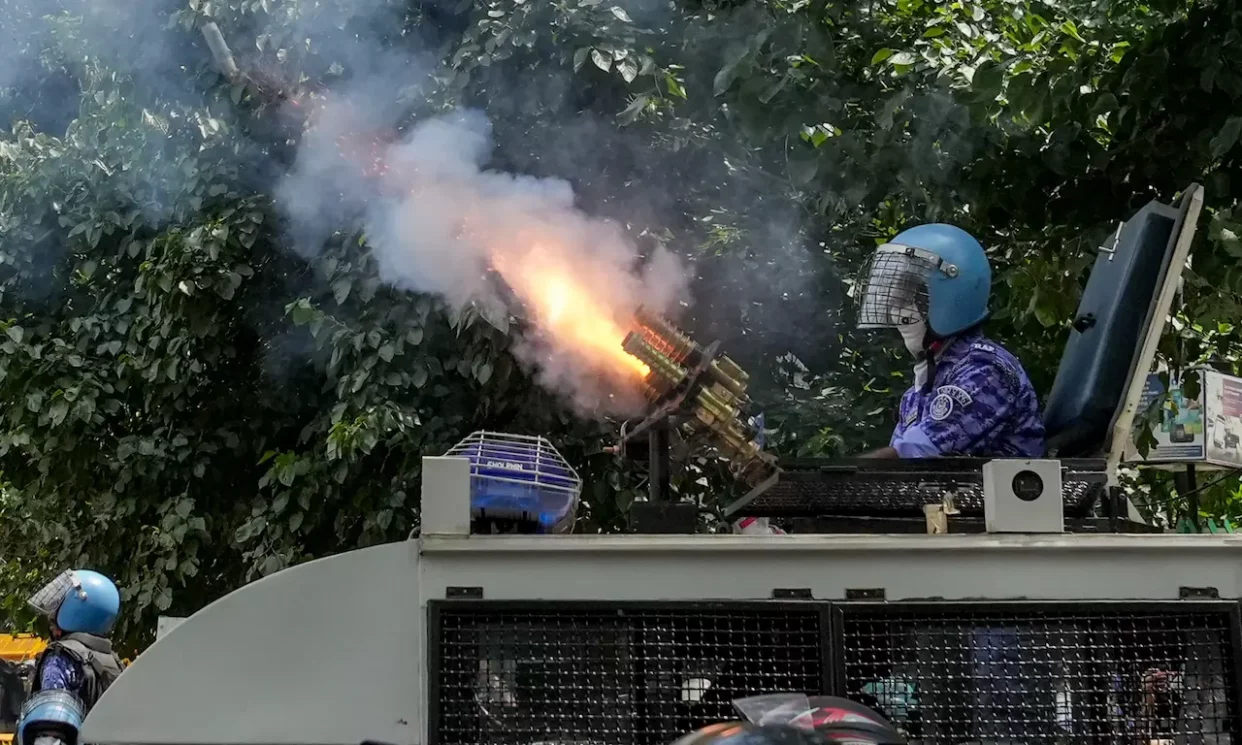
The Supreme Court on Thursday observed that police regulations permit the use of pellet guns in exceptional circumstances, while agreeing to examine allegations that metallic pellets were fired at students during the Cockroach Janata Party’s (CJP) “Sansad Chalo” protest in Delhi on July 20.
A Bench comprising Chief Justice of India Surya Kant and Justices Joymalya Bagchi and V. Mohana directed the Centre to preserve the ammunition log of the Rapid Action Force (RAF) personnel deployed during the demonstration.
The Court also directed the Delhi government to ensure adequate medical treatment for the petitioners and others who allegedly sustained pellet injuries during the protest over alleged examination paper leaks.
The Bench was hearing a petition filed by former IPS officer Yashovardhan Azad along with two alleged pellet victims, Prasant Kumar Singh and Sheikh Irshad Mansoori.
The petition seeks a prohibition on the use of wholly or partly metallic pellet ammunition by law enforcement agencies for dispersing civilian gatherings. It also seeks compensation, medical treatment and rehabilitation for those allegedly injured during the July 20 police action.
Court Examines Scope of Police Powers
During the hearing, Justice Joymalya Bagchi observed that existing police regulations permit the use of pellet guns in exceptional situations and questioned how the Court could impose a blanket ban without the petitioners specifically challenging the validity of those regulations.
The Bench described the prayer seeking a complete prohibition as “vague” in the absence of a constitutional challenge to the rules governing the use of pellet ammunition.
However, Justice Bagchi clarified that the Court was willing to examine whether the alleged use of pellet guns during the July 20 protest was consistent with the graded-response framework followed by law enforcement agencies.
Petitioners Seek Disclosure of Rules
Appearing for the petitioners, advocate Vrinda Grover submitted that the case specifically concerned the alleged use of metallic pellets, some of which had reportedly been surgically removed from injured protesters.
She argued that the relevant police guidelines were not readily available in the public domain and urged the Court to direct the Union government to place all applicable regulations and standing orders on record so that the petitioners could amend their pleadings if necessary.
Grover submitted that no Delhi Police standing order authorising the use of pellet ammunition could be located and said the petitioners had obtained a 2016 Bureau of Police Research and Development document only through the Right to Information Act.
Solicitor General Tushar Mehta assured the Bench that the Centre would extend full cooperation and place the required material before the Court.
Ammunition Records to Be Preserved
Grover also sought preservation of ammunition records, pointing out that the Supreme Court’s July 28 interim order had directed the preservation of CCTV footage, drone recordings, body-camera footage, police wireless communications and other evidence, but had not specifically included ammunition logs.
Mehta informed the Court that all material relevant to the investigation would be preserved.
The Bench subsequently directed the Centre to preserve the Rapid Action Force’s ammunition log relating to the July 20 incident.
Justice Bagchi observed that even peaceful protests could become violent if anti-social elements infiltrate demonstrations, requiring security personnel to respond in a graded and proportionate manner depending on the circumstances.
Mehta added that officers deployed on the ground are sometimes required to take immediate operational decisions as situations evolve.
Petition Alleges Improper Use of Pellet Guns
According to the petition, RAF personnel allegedly fired pump-action guns during the protest, dispersing pellets across a wide area.
The petitioners claimed that Singh and Mansoori suffered penetrating pellet injuries that caused bleeding and required surgical treatment at Lady Hardinge Medical College.
The plea also referred to reports stating that the RAF’s logbook recorded the firing of seven pellet-gun rounds on July 20.
The petitioners argued that pellet ammunition travels unpredictably and can seriously injure the eyes and other vital organs, making it unsuitable for crowd control during civilian demonstrations.
They contended that the use of such weapons against peaceful assemblies fails the constitutional tests of proportionality, necessity and reasonableness.
The matter has been adjourned to enable the Centre to place the relevant regulations, standing orders and official records before the Court for further consideration.
