


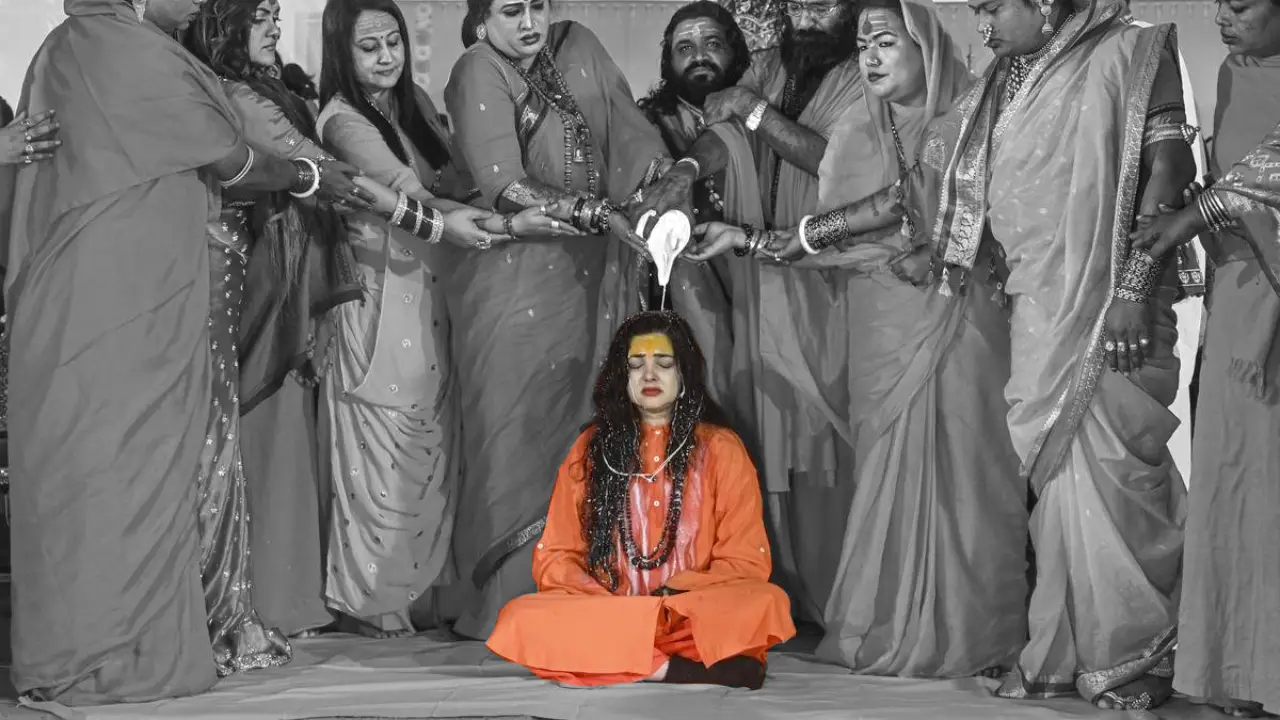
The spiritual fabric of Sanatana Dharma, steeped in rigorous discipline, unwavering commitment, and profound renunciation, faces yet another challenge as commercial theatrics masquerade as asceticism. The recent anointment of Mamta Kulkarni—once a Bollywood starlet entangled in underworld associations and drug syndicates—as a Mahamandaleshwar of the Kinnar Akhada is nothing short of an affront to the sacred traditions of renunciation. Mamta Kulkarni, whose notoriety far outweighs any credible spiritual contributions, abruptly declared her sanyasa at the Maha Kumbh 2025, performing her own Pind Daan and proclaiming herself a renunciate. The glaring question that arises is—can one truly become a monk overnight? The essence of monastic life is not an impulsive refuge but a deliberate, lifelong journey rooted in deep study, rigorous discipline, and selfless service.
The credibility of Kulkarni’s renunciation is questionable at best. Here is a woman who, for decades, epitomised material excess, controversy, and illicit ties. Her alleged romantic involvement with underworld don Chhota Rajan and her later association with Vicky Goswami—a convicted drug kingpin—paint a picture far removed from the moral integrity expected of a saintly figure. The 2016 Rs 2000 crore drug scandal, in which Kulkarni was named a fugitive, casts an indelible stain on her credibility. In 1998, her purported relationship with Chhota Rajan stirred intense media scrutiny, culminating in threats against filmmakers and an alleged forced reinstatement in Rajkumar Santoshi’s China Gate. Her downward spiral led her deeper into the abyss of crime, culminating in her alleged role in Goswami’s narcotics empire. Such a past, riddled with questionable associations and illicit dealings, raises significant doubts about her recent claims of spiritual awakening.
Self-realisation and liberation are fundamental rights, but the abuse of asceticism for personal refuge is a mockery of Sanatana Dharma. True renunciation demands the abandonment of material attachments, rigorous adherence to scriptural wisdom, and unwavering devotion to selfless service. Kulkarni, by all accounts, lacks the foundational knowledge of Hindu scriptures, the discipline of Vedic studies, and the lived experience of a true monk. Her saffron robes, rather than signifying a sacred vow, seem to be a calculated escape from the shadows of her past. What is even more disheartening is the dubious legitimacy of her initiation. The very individual who bestowed her sanyasa, Laxmi Narayan Tripathi, continues to lead a life steeped in worldly engagements, luxury, and public spectacles. The glaring inconsistency of this act further diminishes the sanctity of the path of renunciation. If the guru has not relinquished materialism, how can the disciple be expected to embody true detachment?
Yoga Guru Baba Ramdev was among the few vocal critics, condemning Kulkarni’s instant anointment as Mahamandaleshwar. He rightfully emphasised that sainthood is not a title to be acquired overnight but a station reached through decades of unwavering discipline and sacrifice. His concerns extend beyond Kulkarni’s case; they address a growing, disturbing trend—the dilution of the sacred into mere theatrics. The instant elevation of individuals with checkered pasts into revered monastic positions erodes the spiritual and moral fabric of the ascetic tradition. The dangers of such unwarranted sainthood are manifold. Firstly, it discredits the genuine monks and saints who have dedicated their lives to the arduous path of self-realisation. Secondly, it sends a misleading message to society, where renunciation becomes a spectacle rather than a sacred pursuit. Lastly, it opens doors for individuals to misuse religious institutions as safe havens for personal interests rather than as centres of spiritual enlightenment.
Sanatana Dharma is not a costume to be donned at convenience, nor is it a refuge for those seeking an escape from their past misdeeds. The path of renunciation is not a means of evasion but an act of utmost self-discipline, requiring one to transcend worldly attachments and not merely hide behind them. The case of Mamta Kulkarni is a stark reminder of the urgent need for stricter adherence to monastic traditions, ensuring that ascetic titles remain reserved for those who have genuinely walked the path of spiritual realisation. It is imperative that Hindu religious institutions exercise greater vigilance and accountability in their appointments. Saffron robes must be worn with reverence, not as a disguise. Let us not allow the sacred traditions of Sanatana Dharma to be reduced to a farcical charade of opportunism. The time has come for introspection and corrective action to preserve the integrity of spiritual renunciation.
