


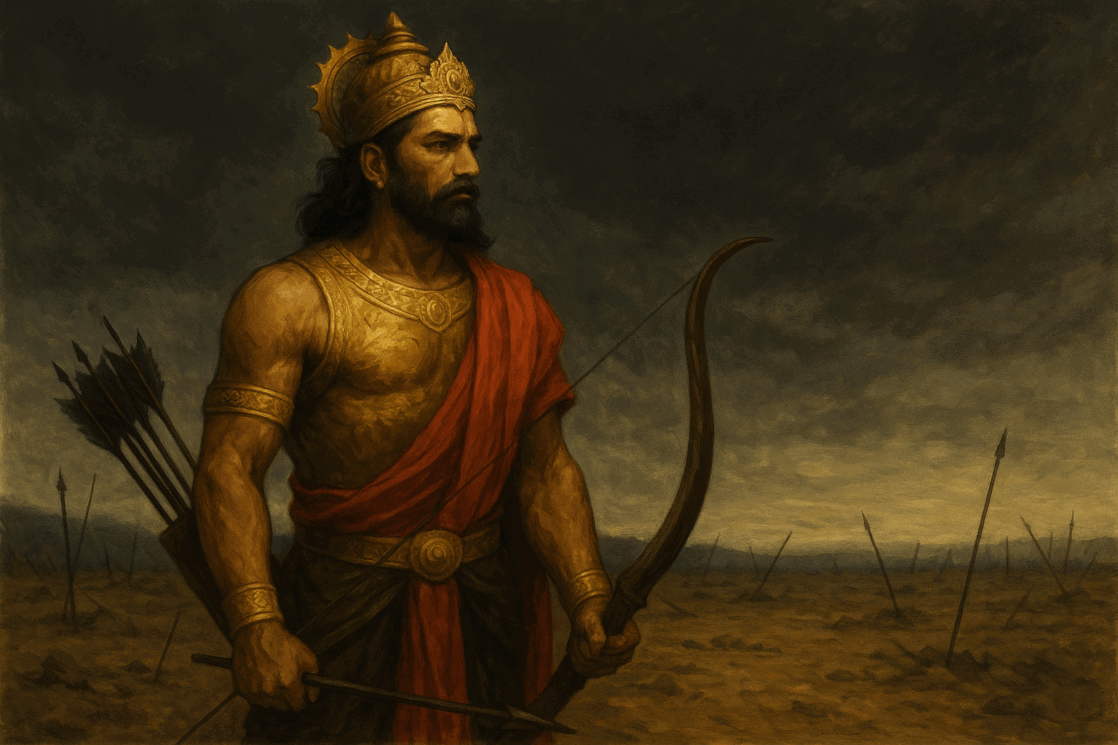
There’s a certain tragic pattern that repeats itself through history — a pattern that might well be called the Karna Syndrome. It is not just a mythological symbol but a living political phenomenon that re-emerges whenever a man, convinced of his own brilliance, begins to believe that he alone defines discipline, truth, and power. Such a person may rise high, shake the system, even appear invincible for a while — but eventually, he ends up isolated, misused by others, and consumed by his own ego. He can disturb, yes — but he can never truly defeat the system that gave him birth.
Look at modern India, and this syndrome shows its face in several forms. You see it in people like Subramanian Swamy, Prashant Kishor, Shatrughan Sinha, Yashwant Sinha — men once celebrated within the Bharatiya Janata Party ecosystem, now adrift, neither here nor there. You see it even in Narendra Modi himself, who at one point appeared to have detached from the very collective discipline that created his rise, leaning instead on the weight of his personal image. And when you begin to detach from your own foundation, when self-belief begins to overshadow collective wisdom, that’s when Karna Syndrome starts to show its cracks.
Let’s start from the roots of the idea. In the Mahabharata, Karna was a warrior of unmatched skill and courage. Born of Kunti but abandoned at birth, he grew up away from his true lineage, denied his rightful place among the Pandavas. Out of loyalty and gratitude, he allied himself with Duryodhana — a man who recognized his talent but also used him as a weapon against his own brothers. Karna’s tragedy was not his lack of ability; it was his misplaced faith and his disconnection from his origin. He believed in his own discipline, in his own code of honor, so fiercely that he ignored where he truly belonged. That self-imposed exile defined his destiny. He could fight the greatest battles, but he could never win the war for himself.
In today’s political arena, the same script unfolds with startling familiarity. Subramanian Swamy — an intellectual powerhouse, an economist, and a fighter — built his reputation alongside the very ideology that shaped modern Hindu politics. Yet, his repeated clashes with his own party leadership reveal a man caught between brilliance and bitterness. He is a classic case of the Karna Syndrome — convinced that his intellect alone is the final truth, dismissing the need for collective discipline. He can wound with his words, expose weaknesses, and create tremors within the system, but he can’t defeat it because he long severed his roots with the very institution that gave him a platform.
Prashant Kishor, on the other hand, carries a different version of the same ailment. He began as a strategist within the BJP camp, a brain behind successful campaigns. Over time, he built his own brand — a one-man political consultancy machine that promised to outsmart every party, ideology, and structure. He started believing that his formula could replace conviction, that data could substitute roots. But politics is not a math problem; it’s a living organism built on trust, loyalty, and belonging. In Bihar, where he now seeks to play his biggest gamble, this syndrome might come to claim its next victim. Because in Bihar’s soil, politics still demands a connection to the heartland — not just clever arithmetic. If you lose touch with the people, if you float too far above the ground, you become just another ambitious outsider, eventually crushed between factions and forgotten when the dust settles.
What’s striking is that even a leader as powerful as Narendra Modi wasn’t immune to shades of this syndrome before the 2024 election. Over the years, his image grew larger than the party, larger than the ideology, larger even than the collective wisdom of his peers. The BJP, once a disciplined cadre-based organisation built on teamwork, slowly began to revolve around one man’s aura. Modi’s discipline became the only discipline. That concentration of power brought him unmatched dominance — but it also created fractures. In believing that his own style was the final word, he unintentionally created dozens of smaller Karnas — ambitious men who thought they too could rise purely on their personal discipline, without loyalty to the collective. They sprouted inside and outside the party, from Shatrughan Sinha to Yashwant Sinha to even Kishor and Swamy, each convinced they could fight their own battles, free of the mother structure that nurtured them.
The irony is sharp: these men drew their strength from the very party or ideology they later rebelled against. Their identity was born in that soil — like Karna born of Kunti — yet they turned their energies against it, often aligning with rivals or critics who were too happy to use their rebellion as ammunition. They became tools in someone else’s fight, believing all the while that they were masters of their destiny. But like Karna, their loyalty to a borrowed cause never brought them peace. You can lend your sword to another side, but if your roots are elsewhere, you will always stand alone in the battlefield.
And this loneliness shows. Swamy, once a giant in intellectual politics, now fights his battles on social media, ignored by the system he helped shape. Shatrughan Sinha, once a fiery voice of rebellion, now echoes clichés in borrowed platforms. Yashwant Sinha, once a respected finance minister, turned critic and faded into irrelevance after switching sides. Each one is an example of how the Karna Syndrome ends — not with defeat by others, but with defeat by disconnection. The tragedy isn’t betrayal; it’s isolation.
Even Prashant Kishor, who now projects himself as Bihar’s independent messiah, seems to be walking into the same trap. He believes he can out-think every party, that his data-driven discipline will triumph over ideology. But Bihar’s political landscape doesn’t reward outsiders — it rewards belonging. He may shake the tree, but he cannot change its roots. When the election dust settles, he might discover that Bihar is not a chessboard; it’s a pulse, a sentiment, a legacy. And those who play against their own origins rarely win the long game.
The Karna Syndrome also explains a subtler danger within Indian politics — the slow erosion of rootedness. When individuals begin to think they alone define the movement, they hollow out the very institutions that made them powerful. They create noise, not continuity. They draw applause, not allegiance. And soon, they find themselves surrounded not by comrades, but by opportunists — people who will cheer them while they rise and vanish when they fall. This cycle is repeating today with eerie precision: too many stars, too little sky.
You mentioned that Modi himself, at one point, seemed to embody the same syndrome that produced his critics. Indeed, his belief in his personal discipline — his unshakeable image, his method of command — became the defining feature of his rule. But leadership divorced from the collective eventually begins to wobble. When the same self-belief that built a leader becomes too absolute, it isolates him from the very base that sustained him. What follows is the rise of internal dissent, the birth of new mini-Karnas, and a sense of drift both within and beyond borders. Once personal pride replaces collective identity, decline begins — not always visible immediately, but inevitable in time.
And when such a decline sets in at the top, it trickles down through the ranks. The leader’s detachment legitimises individual detachment. The system starts producing replicas of himself — people who speak his language but follow their own ambitions. The discipline that once united the movement now fragments into competing egos. The faithful turn cynical, the opportunists take charge, and the movement begins to lose its moral gravity. This isn’t just politics — it’s psychology. When self-belief becomes arrogance, it stops inspiring and starts isolating.
That is why the “Karna Syndrome” is not just about individuals — it’s about a culture. A culture that forgets the sanctity of roots. A culture that mistakes self-confidence for self-sufficiency. A culture that believes one’s personal code is greater than the collective destiny. Such a mindset can shake systems, create temporary storms, even alter narratives — but it cannot build lasting order. Because real power comes not from standing apart, but from standing rooted.
And when this syndrome spreads too deep, it threatens more than just parties or politicians — it threatens the dignity of national discourse itself. When men who were once torchbearers of certain ideals start fighting against their own origins, they weaken not just themselves, but the moral spine of the institutions they once represented. In such moments, even the opposition should not remain silent. Because when internal disintegration begins, when ego starts to eat ideology, the consequences ripple beyond partisan lines. It’s no longer a party problem — it’s a national problem. It’s a question of self-respect and sovereignty. A house divided from within can be invaded from without, and silence becomes complicity.
The lesson of Karna, then, is timeless. Talent, intellect, and strength are never enough without rootedness. You can fight brilliantly, but if you forget where you belong, you will eventually fall — not because you lacked ability, but because you lost alignment. Karna was brave, generous, loyal — yet all that nobility couldn’t save him once he severed his link with his truth. His tragedy wasn’t written by fate; it was written by dislocation.
In today’s politics, we are seeing too many modern Karnas — intelligent, ambitious, capable — but torn away from their origins, wandering in search of validation, often from the very forces they once opposed. They create tremors, yes. They make noise. But in the long run, they fade, one by one. Their fall isn’t dramatic — it’s quiet, lonely, inevitable.
Prashant Kishor’s upcoming Bihar election may well be the next chapter of that story. Like every Karna, he believes his own discipline will rewrite destiny. But history has a way of humbling such men. Karna Syndrome, as we know it, never fails to punish brilliance without belonging.So yes — they may disturb, they may challenge, they may even appear unstoppable for a while. But they cannot defeat the order that gave them birth. Because in the end, roots are stronger than rebellion, and loyalty.
