


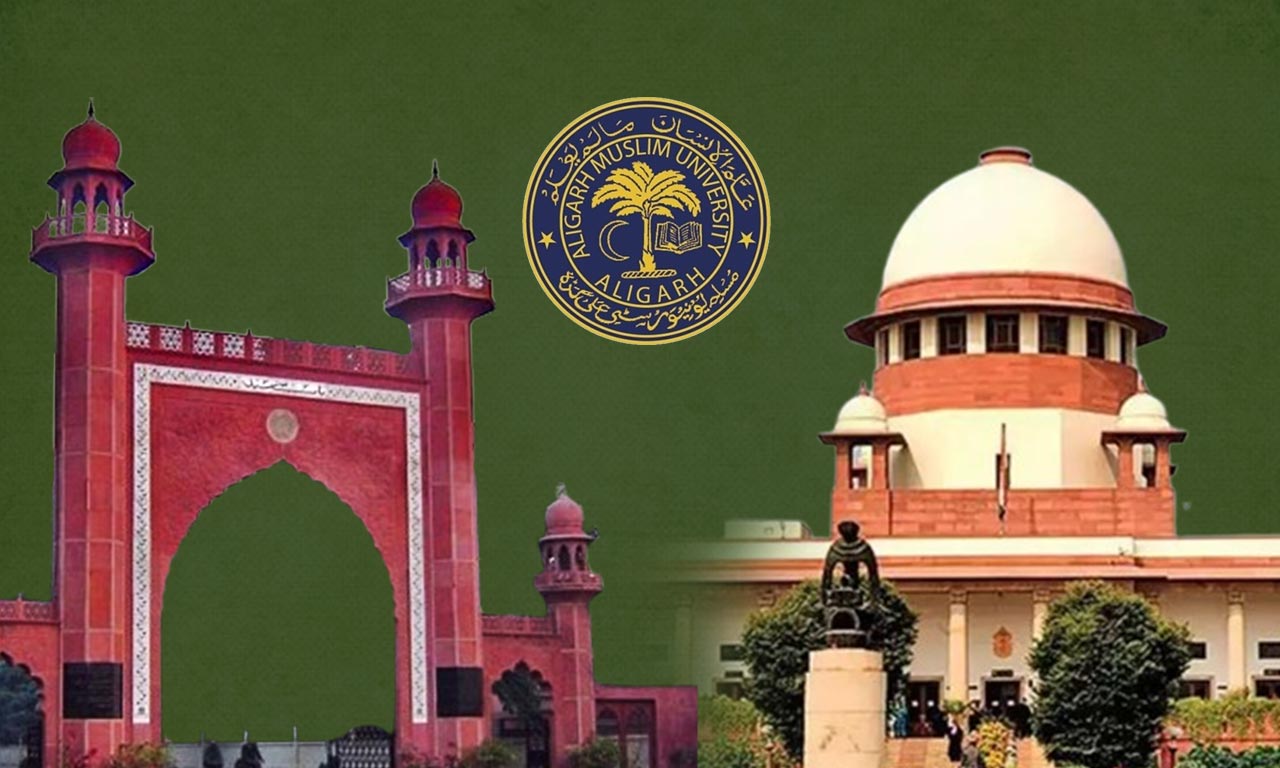
A seven-judge Bench of the Supreme Court headed by Chief Justice of India DY Chandrachud, in a majority judgment of 4:3 ratio, overruled a 1967 Constitution Bench decision which held that a minority community cannot claim to have established an educational institution if it was created by a statute.
The 2006 Verdict by Allahabad High Court
In 2006, the Allahabad High Court struck down the reservation policy implemented by Aligarh Muslim University (AMU) that reserved 50% of seats in its postgraduate medical courses for Muslim students. The court ruled that AMU could not claim minority status. This decision was based on the 1967 Supreme Court ruling in S Azeez Basha v Union of India, which held that AMU was not a minority institution because it was established by an act of legislation — the Aligarh Muslim University Act, 1920 — and not by the Muslim community.
Background and Amendments to AMU Act
AMU was initially founded in 1875 as the Muhammadan Anglo-Oriental College. It was later incorporated as a university by imperial legislation in 1920. A key amendment to the AMU Act in 1951 removed the provision for compulsory religious instruction for Muslim students. In 1981, another amendment attempted to restore the university’s pre-1951 position regarding its minority character. However, this amendment was dismissed by the 2006 High Court ruling, which stated that AMU did not qualify as a minority institution.
Supreme Court Rulings and the Question of Minority Status
The 1967 S Azeez Basha ruling by a five-judge Constitution Bench concluded that AMU, as a central university established by a statute, could not claim minority status. This legal precedent significantly influenced subsequent judicial decisions.
In 2006, after the Allahabad High Court’s verdict, the matter was referred to the Supreme Court. The Congress-led UPA government and AMU filed appeals against the High Court’s decision. The case remained unresolved for years until 2024 when a seven-judge Constitution Bench of the Supreme Court delivered a split verdict (4:3) on the matter.
2024 Supreme Court Verdict
On November 8, 2024, the Supreme Court overturned the 1967 ruling that denied minority status to institutions established by a statute. However, the majority opinion led by Chief Justice DY Chandrachud deferred the final decision on AMU’s minority status to a yet-to-be-constituted three-judge bench.
Key points from the majority judgement:
- Founding and Genesis: The court emphasized identifying the institution’s origins to determine its minority status. It stated that being incorporated by legislation does not preclude the possibility of having been established by a minority community.
- Secular and Minority Education: An institution need not exclusively serve the community that established it to qualify as a minority institution. The emphasis on secular education does not negate its minority character.
- Regulation by Government: The court allowed government regulation of minority institutions as long as it does not interfere with their essential minority character.
Dissenting judges, however, held differing views. Justice Dipankar Datta ruled that AMU is not a minority institution, while Justice SC Sharma emphasized that minority control over such institutions must ensure secular educational opportunities.
Government and Financial Factors
The central government argued that AMU’s extensive reliance on state funds — over ₹5,000 crore between 2019 and 2023 — undermines its claim to minority status. The BJP-led government also refused to accept the contentious 1981 amendment that attempted to restore AMU’s minority character, favoring a return to the 1967 precedent.
Academic Performance and Rankings
Despite the ongoing legal disputes, AMU has performed well in national and international academic rankings. In the National Institutional Ranking Framework (NIRF) 2024, it ranked 8th among Indian universities. In the QS World University Rankings 2025, AMU was placed in the 1001-1200 band, while Delhi University and Jamia Millia Islamia ranked higher at 328 and 851-900, respectively.
Current Status and Sub-Judice Matters
As of 2024, the issue of reservations at AMU remains unresolved. The Supreme Court has maintained the status quo on reservations since 2006, and the matter of AMU’s minority status continues to be sub-judice.
This legal saga underscores the complexities of balancing constitutional provisions for minority rights with the principles of secularism and state regulation.
