


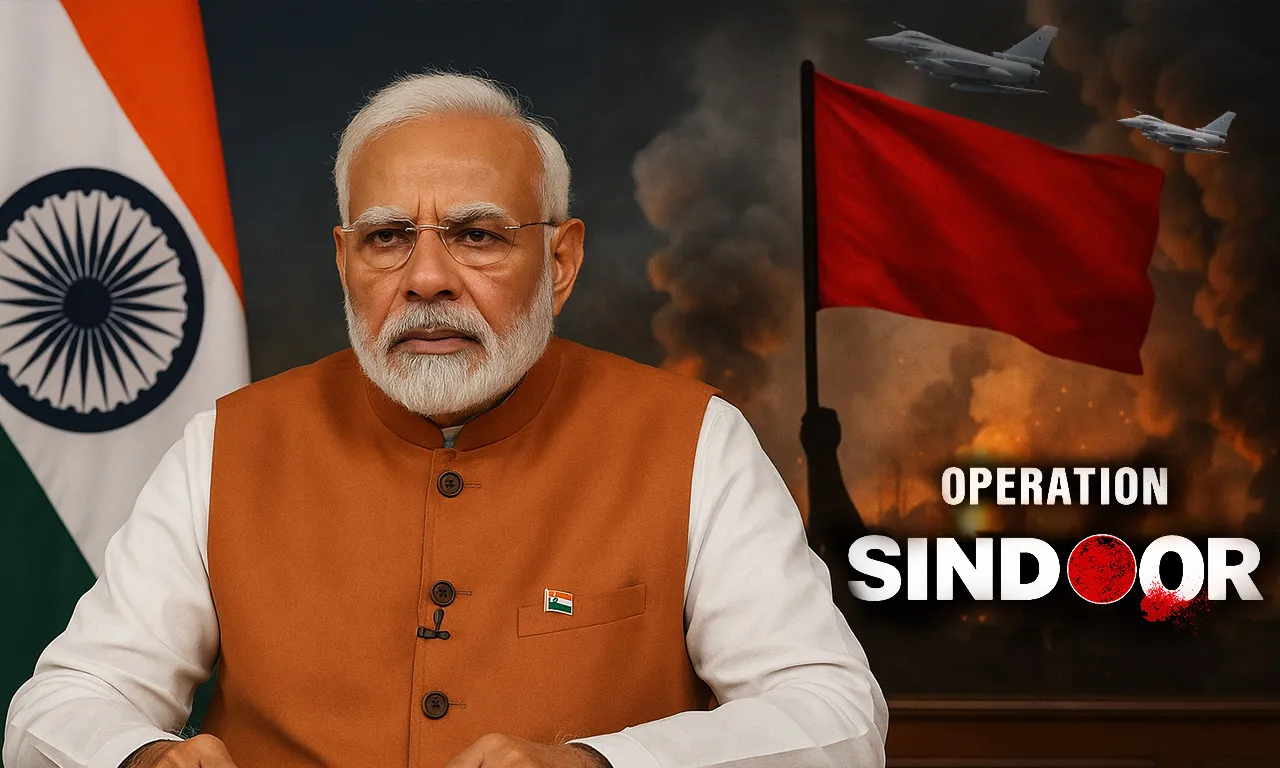
Prime Minister Narendra Modi’s address to the nation following the ceasefire announcement between India and Pakistan left many critical questions unanswered. At a time when India’s armed forces were inflicting heavy losses on Pakistan through swift and strategic drone and missile operations, why was a sudden halt called? What compelled the government to show a red flag when momentum was decisively in India’s favour?
Operation Sindoor had brought Pakistan to its knees within just four days. The Pakistani military suffered major losses, with numerous soldiers killed and key defence infrastructure—including radar systems and terrorist launch pads—systematically dismantled. India’s precision airstrikes reportedly destroyed nine terrorist camps, eliminating over 100 militants. From diplomatic protests to economic sanctions, water embargoes, and the expulsion of Pakistani nationals, India had escalated its strategy step-by-step with unprecedented resolve.
Then came the decisive military action—surgical strikes, coordinated assaults by land, sea, and air, and the deployment of BrahMos missiles with devastating impact. Pakistan, in retaliation, attempted missile strikes on Indian military bases in Jammu & Kashmir, Punjab, Rajasthan, and Gujarat, all of which were intercepted and neutralised by India’s defence systems. With both nations being nuclear powers, global concerns of a catastrophic escalation were valid—but so was India’s right to defend itself.
So, the question that haunts every patriotic Indian today is: Why was Operation Sindoor called off just as Pakistan was reeling under pressure? Why did India retreat from the battlefield when a clear message of zero tolerance toward terrorism was finally being delivered with impact?
The Prime Minister’s speech was loaded with strong warnings to Pakistan. He made it clear that India would no longer tolerate nuclear blackmail and that any future talks would only center on terrorism and Pakistan-occupied Kashmir. He rightly asserted that “terror and talks cannot go hand in hand” and that “water and blood cannot flow together.” Yet, the emotional intensity and moral clarity of his words contrast starkly with the strategic ambiguity of the ceasefire itself.
The deeper concern remains: How can India trust a nation that has consistently exported terrorism across its borders? Since Partition, Pakistan has bled India through countless terror attacks. Decades of goodwill gestures, peace talks, and diplomatic overtures have only been met with betrayal. Each ceasefire has been followed by more infiltration, more bloodshed, more widows and orphans—most recently seen in the Pahalgam massacre that left 26 Indian women widowed.
It is in this context that the timing and nature of the ceasefire raise alarms. Was it India’s sovereign decision, or was it brokered under international pressure?
Adding to the complexity is the statement by U.S. President Donald Trump, who hastily took credit for brokering the ceasefire. Trump publicly declared that the U.S. had “stopped a nuclear war” and even threatened economic consequences for both countries if hostilities didn’t cease. He proclaimed that America would now “monitor both nations closely”. Yet, Prime Minister Modi’s speech made no mention of the U.S., Trump, or any mediation role by a foreign power. This stark contrast between the U.S. narrative and India’s official communication begs the question: Was India compelled to stop Operation Sindoor due to foreign pressure, and if so, why is the government not being transparent about it?
The Indian public, swelling with pride in the armed forces, now finds itself in a moral quagmire. On one hand, they witnessed the nation’s unmatched military and strategic capability; on the other, they are left wondering why that strength was restrained just as Pakistan was cornered. Was the decision to halt the operation a matter of political diplomacy, economic pragmatism, or external coercion?
The government owes the people of India an honest explanation. If Operation Sindoor was halted as a strategic pause, what is the long-term plan to ensure Pakistan never dares to repeat its crimes? If the decision was influenced externally, why wasn’t the nation taken into confidence? And above all, how long must India continue the cycle of forgiving a rogue neighbor that thrives on bloodshed and terrorism?
The nation stood united behind Operation Sindoor. The ceasefire has left behind more than just silence on the border—it has left behind unanswered questions and an uneasy silence in the hearts of millions.
