


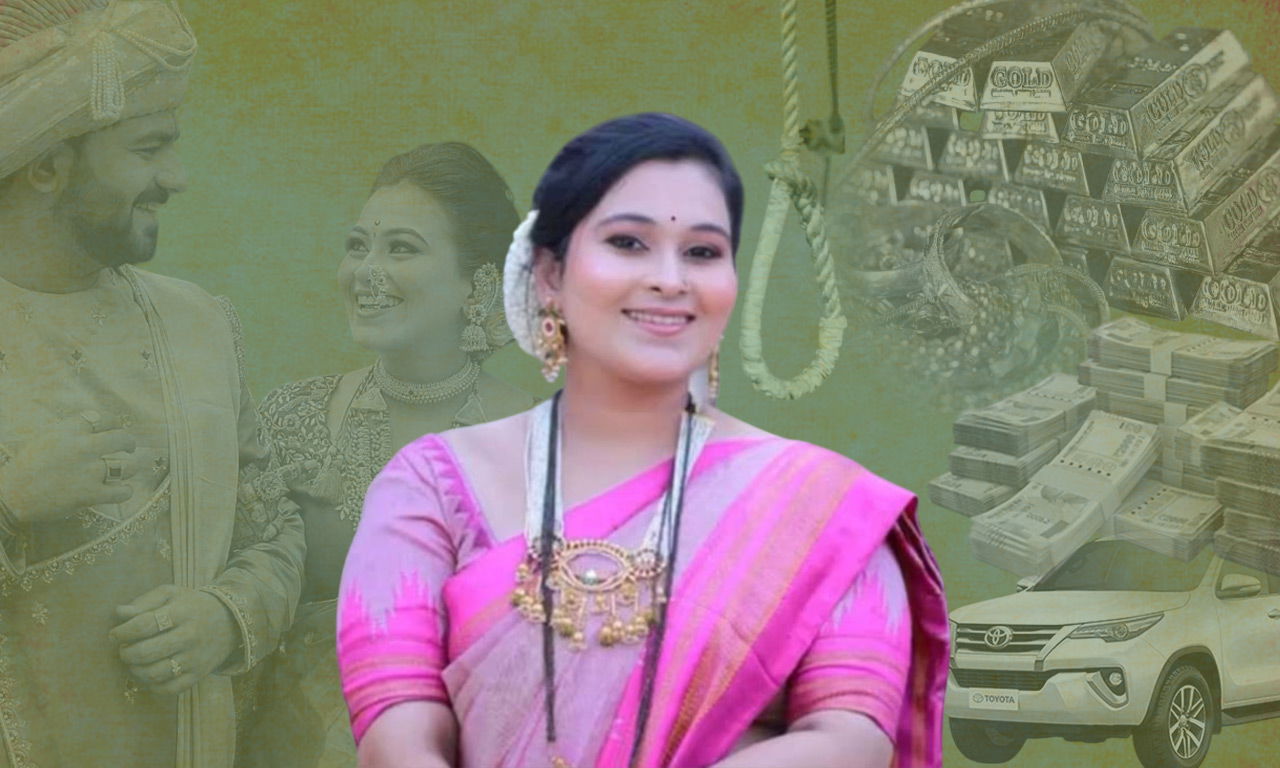
A straight and bold call for justice in the face of dowry-driven brutality
Vaishnavi Kasapate did not take her own life. She was pushed. Pushed by a system that still allows the ancient evil of dowry to thrive. Pushed by a society that looks away when a woman screams from within the four walls of her marital home. Pushed by a powerful family who saw her not as a daughter-in-law but as a financial deal that didn’t quite meet expectations.
She had a love marriage. She chose her partner, Shashank Hagwane—the son of NCP leader Rajendra Hagwane, a man with political clout and influence in Maharashtra’s Mulshi taluka. But her love was not enough to shield her from the toxic greed that soon engulfed her life. Her marriage was never fully accepted by her in-laws because they had hoped for a richer bride—one who could bring in more wealth, more dowry. Still, Vaishnavi’s family agreed to give in: 51 tolas of gold, silver utensils, and a Fortuner SUV. And still, they wanted more. Two crore rupees more—to buy land, to satisfy their endless appetite for wealth.
The harassment began. The pressure grew. Her husband, her mother-in-law, and her sister-in-law all reportedly played their parts in tormenting her. One day, it ended. Or rather, they ended it. Vaishnavi was found hanging on May 16 at her in-laws’ house in Pune. The family says it was suicide. But her father has filed an FIR, claiming it was murder, a premeditated act masked as suicide. Her body bore injury marks. No suicide note was found. The pain she carried inside her—hidden, silenced—was finally exposed only after her death.
Her husband Shashank, her mother-in-law Lata, and her sister-in-law Karishma were arrested. But her politically connected father-in-law Rajendra Hagwane and brother-in-law Sushil Hagwane are absconding. The police claim they are searching for them, but how long will it take? How long before power shields the guilty and justice fades into silence?
This is not an isolated case. This is not rare. It’s happening everywhere—in cities, in villages, in homes that look respectable on the outside but are soaked in cruelty inside. Let’s look at the numbers:
In 2022, nearly 6,400 women were killed in dowry-related deaths across India. That’s almost 18 women every single day. In 2020, over 10,000 cases were filed under the Dowry Prohibition Act. Yet, convictions remain painfully low. The legal process is slow, cumbersome, and often biased toward the powerful.
According to the National Commission for Women (NCW), in 2024, there were 25,743 complaints related to crimes against women. Out of these, 6,237 were related to domestic violence, while 4,383 were specifically about dowry harassment. There were 292 cases reported as dowry deaths. Imagine how many more went unreported, buried under shame, fear, or the influence of power.
Complaints about the right to live with dignity made up nearly 28% of total cases—because dignity is still a luxury denied to most women in their marital homes. Most of these complaints came from Uttar Pradesh (54%), followed by Delhi, Maharashtra, Bihar, Madhya Pradesh, and Haryana. The so-called “progressive” states are not immune either. The monster of dowry is alive, well-fed, and protected—by silence, by complicity, and by power.
And now, a politician’s family is under the scanner. The accused are being given VIP treatment at the police station. Why? Because justice bends when it meets influence? Because laws can be manipulated when the surname is big enough?
Let us be very clear—Vaishnavi did not die because of personal issues or mental health. She died because our society killed her: our culture of glorifying marriage while ignoring the abuse, our failure to enforce laws, and our willingness to stay silent.
This time, we won’t be silent. This is not just about one girl. This is about every girl who is forced to barter her freedom for acceptance. About every father who sells his dreams to fulfil dowry demands. About every mother who loses her daughter in the name of family honour.
We demand immediate arrest of all the accused, no bail, and no political protection. We demand a fast-track court, not another endless trial. We demand police accountability—no VIP treatment for murder accused. And most importantly, we demand that India finally treats dowry deaths as national emergencies, not private tragedies.
Justice for Vaishnavi is not just about punishing her killers. It is about sending a message—that daughters are not dowry. That marriage is not a licence for cruelty. And that no amount of power will shield murderers from the truth.
Let her death not be just another news report. Let it be a turning point.
Let us raise our voices—louder than their silence.
Let us demand justice—before another Vaishnavi is pushed to her death.
