


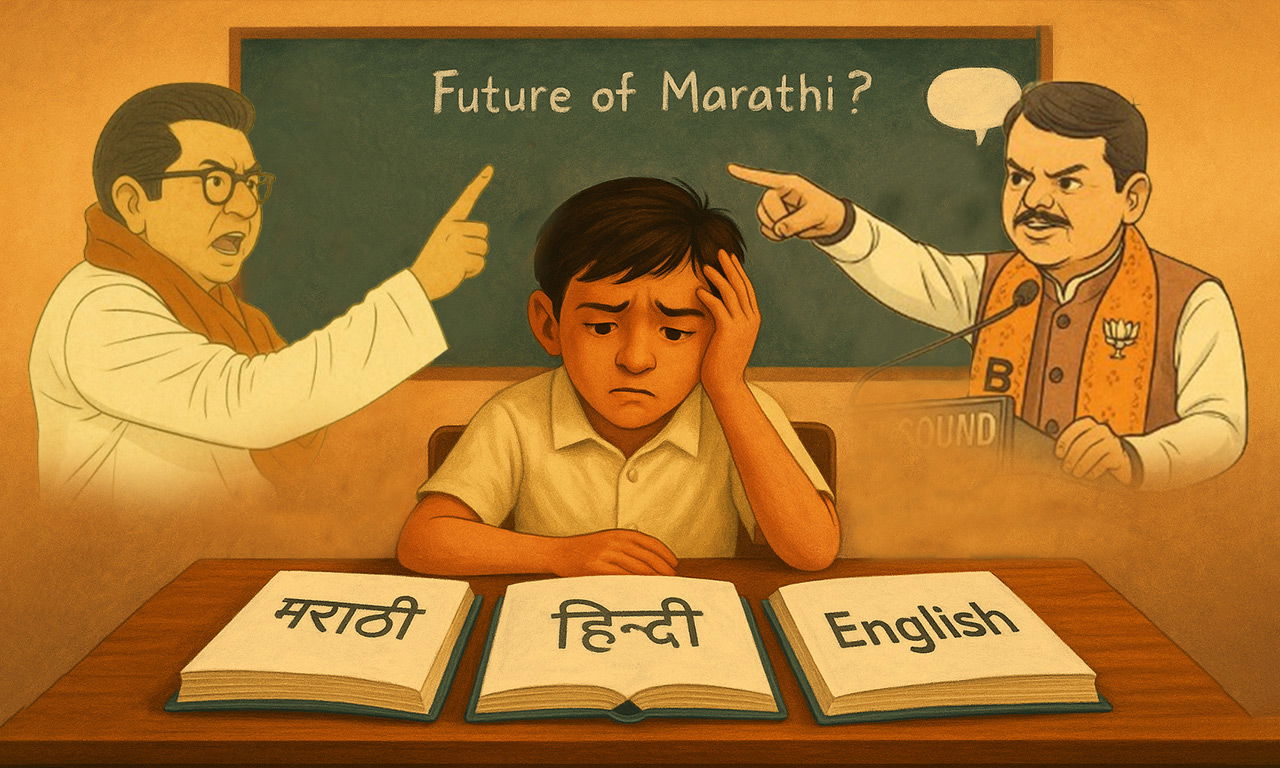
Ah, the grand circus of politics has a new act in town—the “Language Tug-of-War”! And once again, the Marathi Manoos is sitting in the stands, watching his so-called guardians juggle interests, dance to Delhi’s tunes, and occasionally throw him a half-eaten vada pav of cultural tokenism.
One day it’s Marathi pride; the next day it’s “Hindi is our national language, so learn it, love it, live it.” And all this while the Marathi-medium school kid is still figuring out why he’s learning trigonometry in English and prayers in Sanskrit while politicians debate his third language like it’s a toss-up on a game show: “Aur aapki teesri bhasha ke liye aapka option hai… Hindi, ya phir… good luck finding 19 more students!”
Let’s be honest—when Marathi was made compulsory, did the fate of Marathi Manoos change? Did job interviews suddenly start happening in Marathi? Did state-level exams or bureaucratic functioning start operating in Marathi? Nope. But now that Hindi is being parachuted in via a convenient “default option,” we’re being told it’s just a matter of linguistic love—not imposition. Of course! When Marathi is brought in, it’s a symbolic victory; when Hindi enters, it’s a “progressive policy.”
What’s more heartwarming is how our netas are performing in this linguistic drama. One camp is busy lighting diyas for their North Indian vote bank while chanting “Bharat Mata Ki Jai” in chaste Hindi. The other is standing with a saffron tilak and “Jai Maharashtra” slogans, pretending to be the last bastion of Marathi identity. But scratch the surface, and all you’ll find is political varnish. Because the truth is—nobody really cared. Not when Marathi was being diluted in administration. Not when Marathi films struggled for screen space. Not when job postings quietly demanded English or Hindi fluency, pushing Marathi into the margins of “cultural heritage.”
Let’s not forget the State Education Minister’s dazzling flip-flops—first Hindi is mandatory, then it isn’t, then it’s just a recommendation, and now it’s the “default.” If this were a yoga pose, it’d be called “Rajneetik U-turn-asana”.
And of course, Raj Thackeray enters the scene with his trademark thunder—questioning why even Gujarat didn’t impose Hindi. A rare moment of Marathi manhood flex, while the Shiv Sena (Uddhav edition) is conveniently on mute mode. Probably busy choosing between Bollywood scripts and BMC seats.
Fadnavis, defending the move, says learning another Indian language isn’t a threat—well, sure, but why does Marathi always have to be the sacrificial goat in every “three-language formula”? Why not make Marathi the default in North Indian schools, just to be fair? Oh wait, fairness was never part of the curriculum.
This isn’t about learning languages—it’s about who controls the script of identity. And right now, the Marathi Manoos is watching his own language be auctioned off for electoral math again. Classical status, literary legacy, historical depth—all sound great in speeches, but on the ground, Marathi is being treated like that relative everyone invites to the wedding but never gives a seat at the main table.
So, here’s the real question: When will Marathi Manoos stop being the bait and start being the priority? Because every time language becomes a political football, it’s his cultural soul that’s kicked around.
Until then, enjoy the show. Coming soon to a classroom near you: “Marathi, Hindi, English aur Rajneeti—Teen Bhasha, Ek Dhoka.”
