


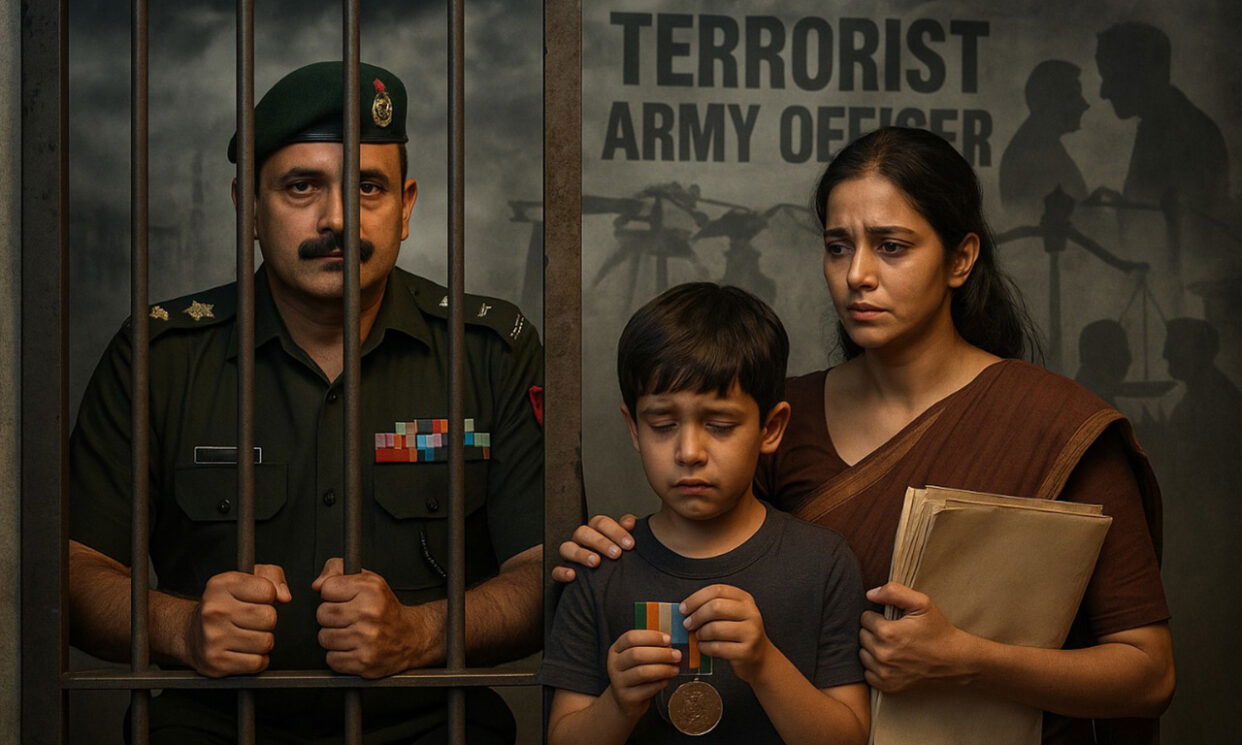
When a soldier dons the uniform, he takes an oath—to protect the nation, to serve with integrity, to put the country before himself. Lieutenant Colonel Shrikant Prasad Purohit, an officer from a patriotic family in Pune, lived by that oath. He served in Military Intelligence, conducted counter-terrorism operations in hostile zones like Jammu and Kashmir, and risked his life in service to Bharat. And yet, this very nation turned its back on him.
In 2008, a bomb blast in Malegaon killed six people and injured over a hundred. Within days, Purohit—who was serving the country through intelligence work—found himself branded a terrorist. A soldier who was trained to fight enemies of the nation was now projected as the enemy himself. And just like that, without trial, without proof, without question, a man was ripped away from his uniform, his honour, and his family—and thrown into a cell.
He spent nine years in jail—nine years without a single day of trial. The agencies slapped him with charges under UAPA, IPC, and the Explosives Act. But let’s call it what it really was: a systematic political witch-hunt, driven not by facts but by agendas.
What was his crime? According to Purohit, he was doing his job too well. As an intelligence officer, he had infiltrated dubious groups and gathered critical reports—including details on Dawood Ibrahim’s underworld-Maoist nexus and the suspicious funding patterns of Zakir Naik. He compiled dossiers, some of which named influential politicians. That, perhaps, became his real mistake.
Purohit’s own testimony is chilling. He alleged that investigative agencies pressured him to name senior right-wing leaders—including members of the RSS and even Yogi Adityanath, now the Chief Minister of Uttar Pradesh. He claimed that witnesses were tortured and threatened at gunpoint and that evidence—including RDX—was planted to frame him. According to him, officers from the Anti-Terrorism Squad (ATS) not only fabricated narratives but even orchestrated extrajudicial killings to close the case quickly.
The tragedy deepened when the courts took years just to acknowledge what was already visible. In 2017—nine years after his arrest—the Supreme Court finally granted him conditional bail, acknowledging that several facts in the case required re-evaluation and that keeping him in jail indefinitely without trial was not justifiable. The NIA Special Court later observed that no direct evidence linked Purohit to the Malegaon blast and stated that applying UAPA was not appropriate.
But by then, the damage was irreparable.
This wasn’t just a legal case. It was a complete and brutal character assassination. A respected Army officer, celebrated for his service, was suddenly painted as a terrorist. The media ran unverified stories. Political leaders passed comments. Public opinion was shaped not by facts but by headlines. And what of his family?
His wife fought a relentless legal battle—practically becoming a lawyer herself—just to prove her husband’s innocence. Their sons grew up with a father in jail, burdened by society’s label: “terrorist ke bachche.” The younger one was just a toddler when Purohit was taken away. The elder son would later join the legal struggle as he grew up. Their schools, neighbours, and society did not see them as children of a soldier—they saw them as offspring of a traitor. What greater cruelty can a nation inflict on a loyal family?
Even today, Purohit has not been restored to full service. He is posted in an administrative role in Pune, not allowed to serve in the field. He can’t leave the country without court permission. A man who wore his uniform with pride is now constantly reminded of the stigma that the system still refuses to fully erase.
This is not just Purohit’s story. It is the story of a nation’s utter failure to protect its own warriors. The rot in the system, the bias in investigations, the lethargy of the judiciary, and the complicity of the political class have together created a nightmare—one that has lasted seventeen years and counting.
And now the nation must ask itself:
- Who will return these stolen years?
- Who will erase the label of ‘terrorist’ from his children’s memory?
- Who will restore the dignity of a man who risked everything for his country and was betrayed by the very system meant to protect him?
The people responsible for this miscarriage of justice—the investigating officers, the political masters who pulled the strings, the bureaucrats who looked away, and the judiciary that moved at a snail’s pace—must be named and held accountable.
Because if we can do this to a soldier, we can do it to anyone.
Because if our institutions can be manipulated to destroy lives on the basis of politics, no one is safe.
Because if justice delayed becomes justice denied—then this wasn’t justice. This was state-sponsored cruelty.
And because some wounds can’t be healed by bail or verdicts.
The question remains: who will pay the price for destroying a patriot’s life?
