


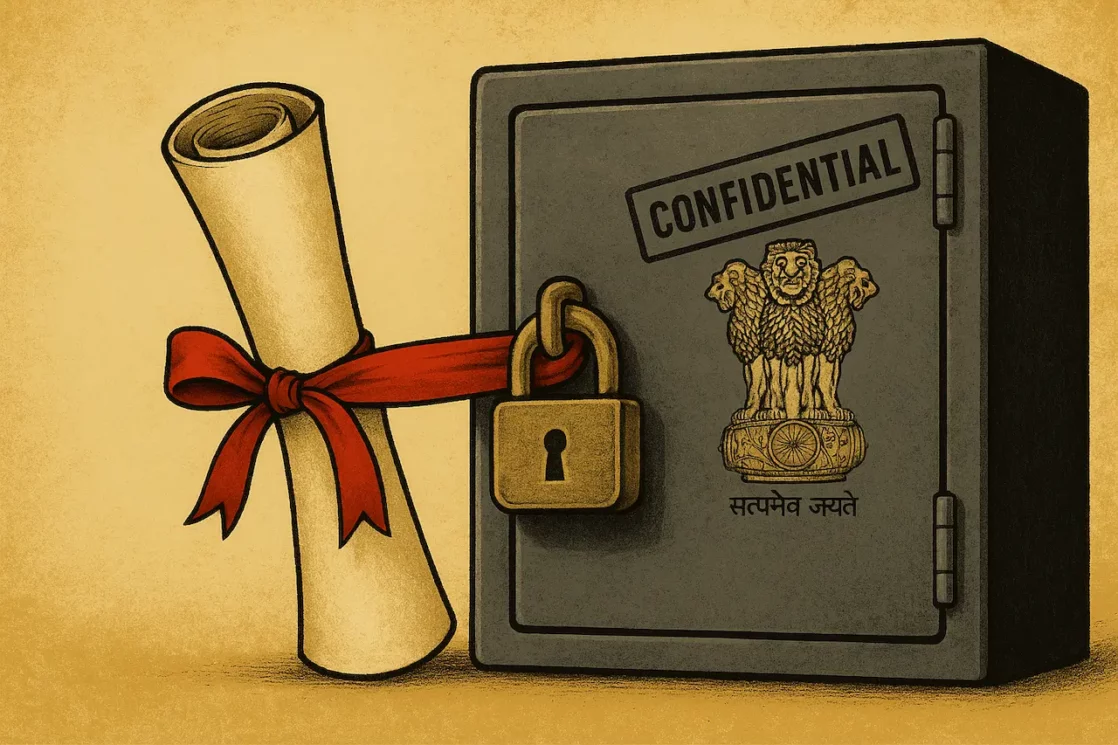
In most democracies, a Prime Minister’s education is the least controversial aspect of their life. Their policies, their politics, even their personal lives may be dissected and debated, but their qualifications are usually a matter of record. In India, however, the question of Prime Minister Narendra Modi’s degrees has become a saga of contradictions, cover-ups, and credibility crises—one that raises troubling questions about the health of the world’s largest democracy.
The Myth of the Dropout
Narendra Modi has long cultivated the image of a self-made man. From the earliest days of his political career, he proudly told the story of being a “chaiwala” (tea seller), a struggler who never had the benefit of higher education. In interviews, campaign speeches, and public addresses, he often spoke of being a “school dropout,” presenting his lack of academic credentials as a badge of authenticity, a contrast to the privileged elites of India’s political dynasties.
For millions, this humility resonated. Here was a leader who symbolized aspiration—someone who, without college or pedigree, could rise to the highest office in the land. It was a compelling narrative, one that helped define his political brand.
The Sudden Emergence of Degrees
And then, abruptly, the story changed. In 2016, Modi’s closest aide and India’s current Home Minister, Amit Shah, convened a press conference to display Modi’s “degrees”—a Bachelor of Arts from Delhi University and a Master’s degree from Gujarat University. The timing was not accidental. Questions had been raised in the Delhi Assembly about the authenticity of Modi’s educational background. Instead of Modi clarifying personally, Shah stepped in to show certificates to the media.
But rather than silencing controversy, this revelation deepened it. Why had Modi, who so often stressed his lack of education, never mentioned these degrees? Why did these documents appear so late, and under such politically charged circumstances? More importantly, why did discrepancies begin to surface almost immediately? The spelling of names, formatting issues, and inconsistencies in university records sparked suspicion.
The RTI Battles and Legal Hurdles
Journalists and activists began filing Right to Information (RTI) applications to obtain official confirmation from Delhi University and Gujarat University. The responses were, at best, opaque. Gujarat University refused to release details, citing “privacy.” Delhi University, when pressed, gave vague confirmations without providing verifiable records.
The matter eventually reached the courts. Instead of demanding transparency, however, the judiciary often appeared reluctant to pursue the issue aggressively. Petitions were dismissed, sometimes on technical grounds, other times on the argument that the Prime Minister’s qualifications were irrelevant to his ability to govern. Critics saw this as institutional capture—an example of how the very bodies meant to hold leaders accountable were shielding them from scrutiny.
Democracy Under Question
The deeper issue is not whether Modi studied or did not study. The real danger lies in the precedent such a cover-up sets. A Prime Minister’s lie about his education is not a private fib; it is a public deception. It undermines the very premise of democratic accountability—that leaders must be truthful with the people they serve.
For India’s youth, the irony is particularly bitter. Every year, millions of students fight for jobs, struggling through grueling exams and interviews, where even minor discrepancies in certificates can end careers. To them, the idea that the nation’s most powerful man could possess questionable degrees and yet face no consequence is both humiliating and demoralizing.
The Global Optics
Internationally, the scandal raises awkward questions. In a world where credibility is currency, what does it mean if the Prime Minister of India—a country positioning itself as a global leader—cannot be transparent about his own academic history? Foreign governments, investors, and institutions may not say it aloud, but such controversies corrode trust. When the head of state is accused of forging credentials, the integrity of the system itself comes under suspicion.
Global media have occasionally touched on the issue, often with a tone of disbelief. How could a country with such a proud democratic tradition, home to some of the world’s finest universities, allow its leader to evade basic accountability? The answer lies not only in Modi’s own narrative management, but in the silence—or complicity—of institutions that chose to look the other way.
The Broader Scam
Seen chronologically, the degree controversy is not a side note—it is a scam at the heart of governance. First, a leader builds his image as uneducated yet authentic. Then, when challenged, allies produce degrees of dubious provenance. Questions are deflected, institutions stonewall, courts hesitate, and the media—often polarized—fails to sustain the inquiry. In the end, the lie is normalized, and the deception becomes part of the political landscape.
This is the true danger. When the most powerful man in the country can manipulate the narrative around something as basic as his education, what else can he hide? If fake degrees can be waved away, why not fake statistics, fake economic claims, or fake promises? The degree saga is not about certificates—it is about truth itself.
A Nation Compromised
For India, the cost is profound. Democracy rests on accountability, and accountability rests on honesty. A Prime Minister caught in a lie about his past and shielded from consequences represents not just personal failure but systemic rot. It is an eye-opener for citizens who still believe that institutions will safeguard their rights.
Ultimately, the scandal of Narendra Modi’s degrees is not about whether he attended Delhi University or Gujarat University. It is about whether India can still claim to be a democracy of truth and transparency, or whether it has become a republic where power rewrites history and fabricates credentials at will.
The world is watching. And what it sees is a nation where the Prime Minister’s degrees remain more mysterious than state secrets—and where democracy itself looks dangerously compromised.
