


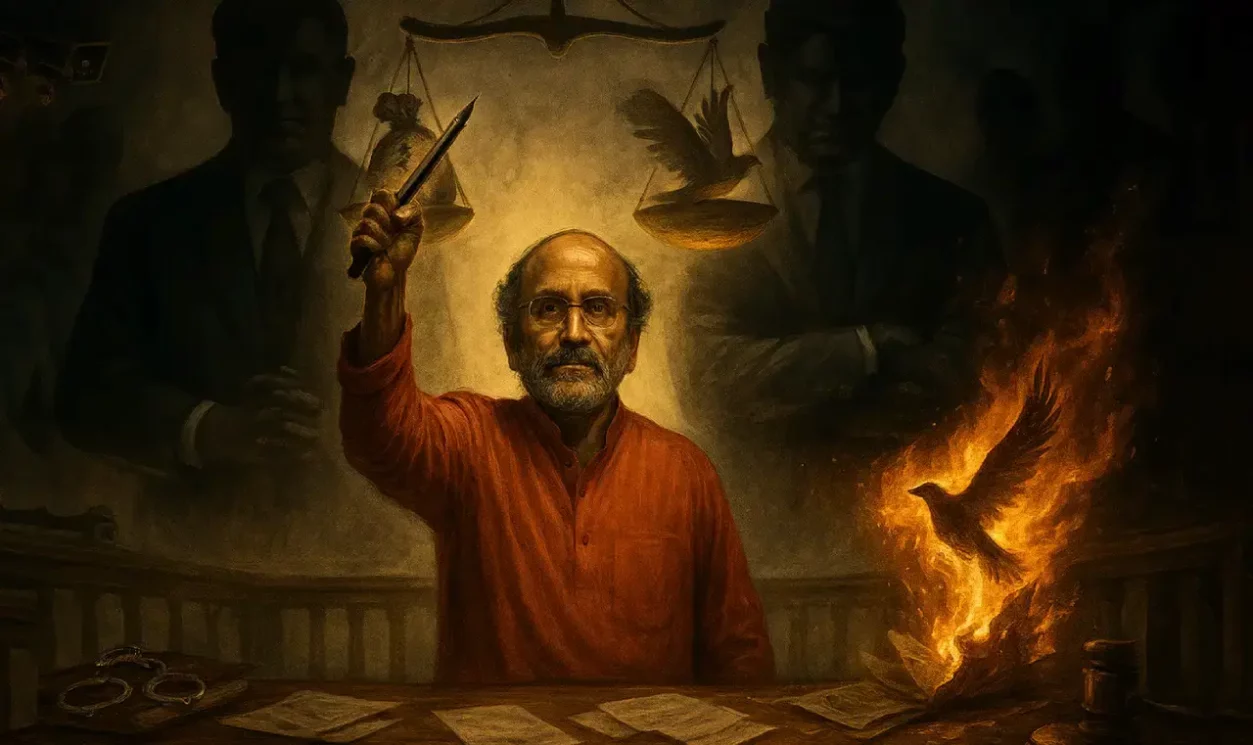
In a democracy, journalism is meant to be the conscience of the nation — a watchdog that questions authority, exposes wrongdoing, and speaks truth to power. But in India, successive governments, irrespective of ideology, have treated that conscience as a threat. The Congress mastered the art of controlling the narrative through state machinery, but the BJP has elevated it into a fine science, deploying lawsuits, surveillance, regulatory crackdowns, and character assassinations to muzzle those who dare to question. In this environment of fear and intimidation, Paranjoy Guha Thakurta stands as a rare, unflinching voice — a journalist who has refused to bend or bow, even as the weight of political power and corporate muscle bore down on him.
The recent developments in his legal battle with the Adani Group could set a precedent and offer a glimmer of hope to independent journalists like Abhisar Sharma and Raju Parulekar, who now face similar persecution. Both were summoned by a magistrate’s court in Gandhinagar after criminal defamation complaints were filed by Adani. This legal harassment is not about justice — it’s about deterrence. It’s about sending a chilling message to every journalist in the country: toe the line or be dragged into courtrooms for years. What both the government and corporate giants like Adani need to understand is simple — journalists are not criminals; they are performing their constitutional duty. And the law applies to them just as it does to the powerful they expose.
The Rohini Court’s ex-parte injunction in Adani Enterprises Ltd. v. Paranjoy Guha Thakurta & Ors. — ordering alleged “unverified” content to be “expunged” within 36 hours under the IT Rules, 2021 — is emblematic of how vague and overbroad legal tools are now used to silence dissent. Within days, the Ministry of Information and Broadcasting issued a sweeping directive to remove over 140 links across Instagram and YouTube. This wasn’t about protecting reputations; it was about erasing inconvenient facts from public memory. And who was at the center of it all? Paranjoy Guha Thakurta — the only Indian journalist cited in the global Hindenburg Report on Adani, the whistleblower who dared to pull back the curtain on one of India’s most powerful conglomerates. Until he spoke, there was no watchdog watching Adani’s meteoric rise. He made the unthinkable thinkable — that the empire might be built on sand.
This is not the first time Paranjoy has been targeted. In 2016, as Editor of Economic and Political Weekly, he published a bombshell investigation exposing how government policies were tweaked to benefit an Adani Group company by ₹500 crore. The Ministries of Finance and Commerce were contacted for clarification — none came. As the story gained traction, Adani’s legal team struck back with a defamation notice. The Sameeksha Trust, fearing an expensive courtroom battle with one of India’s wealthiest corporations, pulled down the article. Paranjoy resigned in protest. That resignation wasn’t just about an article — it symbolized a deeper rot in Indian media: when truth becomes too expensive to print, democracy begins to die.
This wasn’t Paranjoy’s first battle with power. In 2014, his book Gas Wars: Crony Capitalism and the Ambanis, co-authored with Subir Ghosh and Jyotirmoy Chaudhuri, exposed irregularities in natural gas pricing. Reliance Industries promptly hit him with a defamation notice. Since the BJP came to power, Adani and Ambani have not just dominated headlines — they’ve become synonymous with a political-business ecosystem that feeds off each other. They bankroll policies, elections, and propaganda — and in return, enjoy unprecedented regulatory leniency. Journalists who try to trace the money trail are treated as enemies of the state.
The release of the Hindenburg Research report in January 2023 marked another turning point. It alleged opaque accounting, bribery, and environmental violations — wiping billions off Adani’s market value and sparking calls for a probe. Once again, Paranjoy’s work was vindicated: he was the only Indian journalist cited in the report. That should have earned him accolades. Instead, he was targeted by Pegasus spyware between April and July 2018. Amnesty International confirmed his phone had been compromised — another glaring example of how far the state will go to punish inconvenient journalism.
Paranjoy’s battles extend beyond corporate boardrooms. He was one of the first to expose the phenomenon of “paid news” — when media houses sold editorial space to the highest bidder. That exposé, during the UPA era, caused a storm. But instead of reforming, the disease metastasized. Today, the mainstream media is no longer just compromised — it’s largely bought and paid for. Prime-time anchors serve as megaphones for the ruling party. Questions are replaced by cheerleading. Investigations are replaced by propaganda. In 2010, Paranjoy had the courage to call out Congress; in 2025, he still calls out BJP. The governments change; the price of truth remains the same — harassment, lawsuits, and isolation.
His integrity is further underscored by his role in the public interest litigation over the 2G spectrum scam — a landmark case that shook the UPA government. That’s the point critics often miss: Paranjoy isn’t partisan. He is not anti-Modi or anti-BJP. He is anti-corruption, anti-cronyism, and pro-accountability. He has spent decades exposing the rot, regardless of who occupies Raisina Hill. And that is precisely why he’s so dangerous to those in power — because he cannot be bought, bullied, or co-opted.
The plight of journalists like Paranjoy reflects a broader crisis in Indian democracy. Reporters Without Borders has consistently downgraded India’s press freedom ranking, citing violence against journalists, political control of media, and abuse of defamation and sedition laws. Investigative reporters are routinely slapped with FIRs, raided by tax authorities, or dragged into court for years. Their families are harassed. Their phones are tapped. Their livelihoods are destroyed. The message is clear: speak softly, or don’t speak at all. It’s a far cry from the role envisioned for the press by the framers of our Constitution — a fearless institution holding power accountable.
In this hostile landscape, journalists like Paranjoy Guha Thakurta, Abhisar Sharma, and Raju Parulekar are not just reporters — they are resistance. They represent the last bastion of democratic accountability in a system that wants none. Their courage is not just professional; it’s deeply personal. It means accepting financial ruin, social isolation, and even physical danger as the cost of telling the truth. It means being labelled “anti-national” by those who confuse patriotism with sycophancy. It means being vilified by troll armies paid to protect billionaires and ministers.
The judiciary, too, must shoulder blame. Courts have often issued sweeping gag orders or entertained frivolous defamation suits that serve no purpose but to intimidate. The ex-parte injunction against Paranjoy’s reporting is a case in point — a legal tool turned into a weapon of censorship. If the judiciary does not stand as a bulwark for free expression, if it does not protect those who risk everything to expose the truth, then it becomes complicit in the erosion of democracy.
The verdict in Paranjoy Guha Thakurta’s case could be more than just a legal outcome — it could be a moment of reckoning for Indian journalism. If the courts affirm that investigative reporting is not defamation, that criticism is not a crime, and that public interest cannot be censored, it might embolden a new generation of journalists to stand their ground. It could remind corporations and governments alike that the press is not their enemy — it is their mirror. And if they don’t like what they see, the solution is not to break the mirror but to change the reflection.
India desperately needs more journalists like Paranjoy — spines of steel in a profession increasingly spineless. His career is a lesson in integrity: call out corruption, no matter who commits it; expose cronyism, no matter who benefits; speak truth, no matter who trembles. That is the essence of journalism. And in an era when truth is under siege, such journalism is not just necessary — it is revolutionary. Without it, democracy will wither into dictatorship wrapped in the cloak of electoral legitimacy.
The real test of a democracy is not how it treats those who agree with the government, but how it treats those who dissent. By that measure, India has a lot to answer for. But as long as journalists like Paranjoy Guha Thakurta refuse to be silenced, there remains a glimmer of hope — that the pen, even battered and bruised, is still mightier than the billionaire and the politician combined.
