


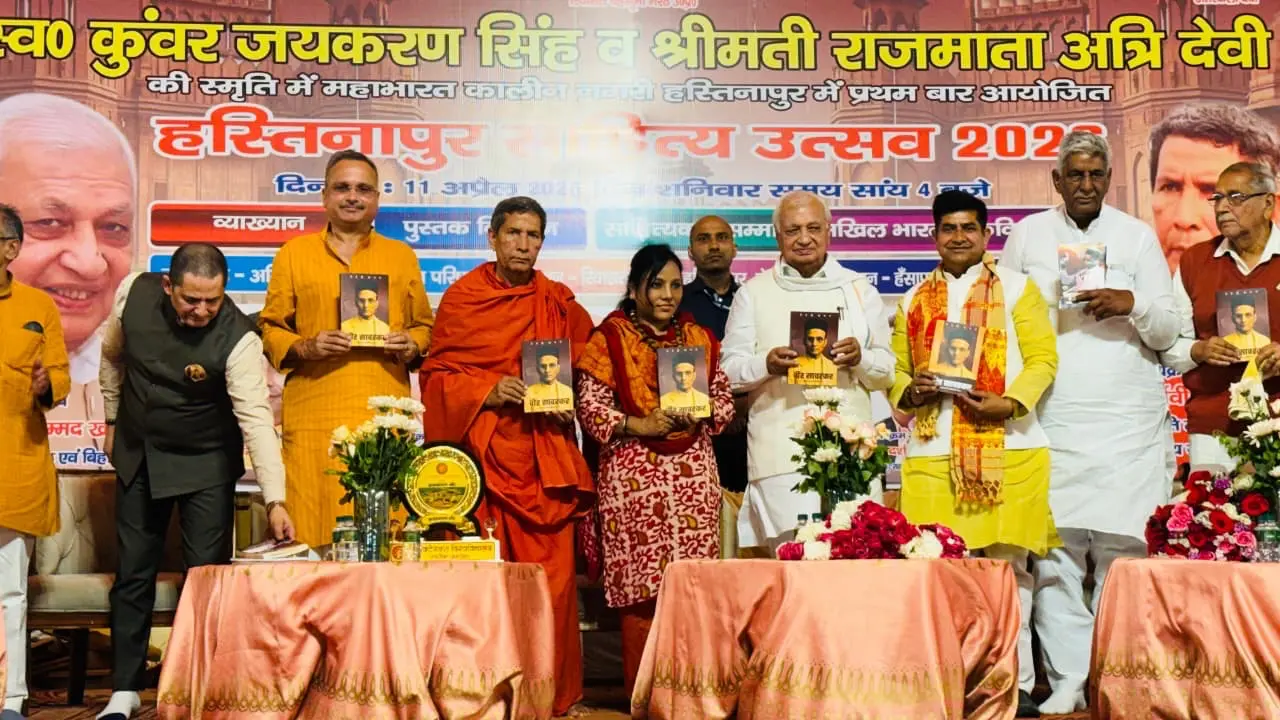
In a historic cultural milestone, the ancient city of Hastinapur witnessed an unprecedented literary awakening as the first-ever Hastinapur Sahitya Mahotsav brought together some of the finest minds in literature, spirituality, and public life. At a time when attention spans are shrinking and cultural depth is under threat, the festival sent out a clear message—giving priority to litterateurs and poets is not a luxury, but the need of the hour.
The highlight of the event was the grand launch of “Hastinapur: Kal, Aaj aur Kal”, authored by noted writer Dr. Yatindra Kataria Vidyalankar. The book was unveiled by former former Governor of Kerala and Bihar Arif Mohammad Khan, alongside spiritual leader Swami Karmveer.
Hosted at the historic Bahsuma estate near Hastinapur, the festival marked the first time the region witnessed such a масштаб literary congregation. Scholars, poets, administrators, and cultural voices from across India and abroad transformed the sacred land of the Mahabharata era into a vibrant hub of intellectual exchange.
Arif Mohammad Khan emphasized that Hastinapur is not merely a relic of the past but a living bridge between “self-realisation and universal consciousness.” He described the festival as a decisive step toward reviving India’s civilizational discourse through literature.
The festival was inaugurated by prominent dignitaries including Dr. Rajeev Tyagi, former DGP Devaraj Nagar, and Mumbai-based author and journalist Dr. Vaidehi Taman.
An accredited and eminent journalist and writer from Maharashtra, Dr. Vaidehi Taman brought a sharp contemporary perspective to the gathering. Her book “Savarkar Ki Krantikari Yatra” was also launched during the event, drawing significant attention among literary circles.
Addressing the audience, Vaidehi Taman said, “I belong to a land of poets—from Bahinabai to Bollywood—poetry plays a vital role in human life. Without literature, society will become lifeless. It is very important to create interest in people for books. In the era of reels, people are drifting away from real life. India is a land of Sahitya, and this is the soul of the soil.” Her words struck a powerful chord, reinforcing the urgency to reconnect with India’s literary and cultural roots.
The central theme, “Atmabodh se Vishvabodh,”explored the profound connection between inner awakening and global harmony—an idea deeply rooted in India’s philosophical tradition yet increasingly relevant in a fragmented modern world.
An All-India Kavi Sammelan infused the festival with poetic energy, while scholars and thinkers engaged in intense discussions on literature, heritage, and national identity. The event concluded with a strong declaration: Hastinapur will now host this literary festival annually, with plans already underway for a similar grand event in Amroha.
More than just a cultural gathering, the Hastinapur Sahitya Mahotsav has firmly positioned itself as a revivalist movement—reclaiming India’s literary and civilizational voice and restoring it to the centre of national consciousness.
