


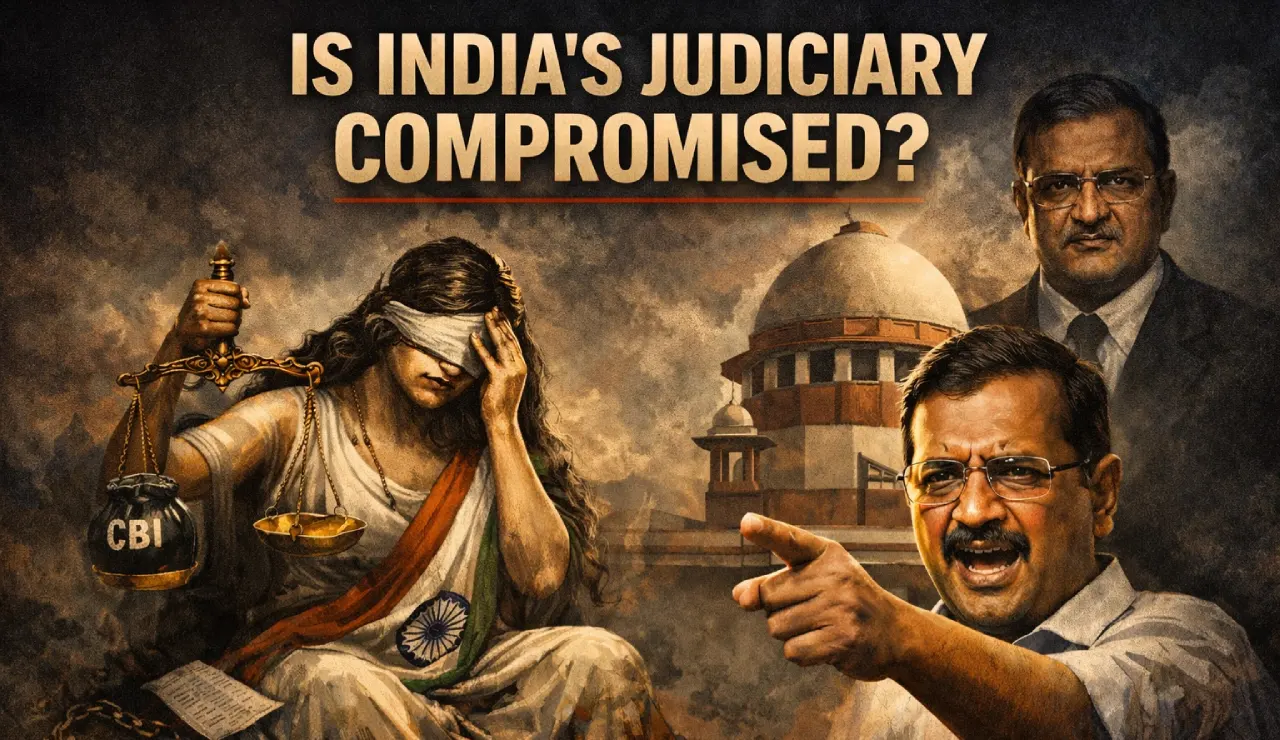
In any serious democracy, the judiciary is not just another pillar—it is the final line of defense. Strip away public trust in courts, and what remains is not order, but managed chaos. Today, India finds itself staring at an uncomfortable question: is the perception of judicial neutrality beginning to crack?
The recent affidavit filed by Arvind Kejriwal in the court of Justice Swarna Kanta Sharma has thrown this issue into sharp focus. Kejriwal has not minced words. His allegation is direct and explosive: that the judge’s children work under Tushar Mehta, who is representing the CBI in related proceedings. According to Kejriwal, this creates a situation where “a fair order against Tushar Mehta becomes difficult,” raising a serious question of conflict of interest.
This is not a routine legal argument. It is a frontal challenge to the idea of impartial justice.
To be fair, these remain allegations. No court has validated them. But here’s the uncomfortable truth—when such claims are made with specifics, they cannot simply be brushed aside as political theatrics. Because in matters of justice, perception is not a side issue; it is the foundation.
Kejriwal’s position is clear: he is questioning not just a decision, but the very environment in which that decision will be made. His argument, in essence, is simple—if professional relationships exist between key actors in a case, then even the possibility of bias must be addressed transparently.
Now, one may disagree with his tone, his timing, or even his intent. But dismissing the question itself would be a mistake.
India’s judiciary has historically stood above the fray. It has been the institution people turned to when everything else failed. From safeguarding constitutional values to checking executive overreach, courts have played a role that goes far beyond legal interpretation.
But institutions do not weaken overnight. They weaken when questions begin to linger unanswered.
And that is exactly what makes this moment dangerous.
Because once citizens start asking—“Is justice truly blind?”—the system has already taken a hit.
This is not about one judge. It is not about one affidavit. It is about a broader and growing unease that powerful networks—legal, political, and institutional—are becoming increasingly intertwined.
The judiciary must recognize that the bar for its credibility is not “absence of wrongdoing.” The bar is far higher—absence of even a shadow of doubt.
In such situations, the traditional wisdom has always been clear: when in doubt, step aside. Recusal is not an admission of guilt; it is an assertion of integrity. It sends a message that the institution values public trust more than individual authority.
Unfortunately, what we are witnessing today is not clarity, but confrontation.
Kejriwal’s affidavit has effectively put the judiciary in a position where silence will be interpreted as discomfort, and action will be interpreted as acknowledgment. It is a tightrope—and one that must be walked with extreme care.
Let us also be honest about the political context.
Kejriwal is not just any litigant. He is a sitting political leader, engaged in a direct battle with central agencies. His words carry weight, but they also carry strategy. This is as much a political move as it is a legal one. By raising the issue of conflict of interest, he is shifting the narrative—from allegations against him to questions about the system itself.
It is a clever move. But that does not automatically make it wrong.
Because sometimes, even politically motivated questions can expose genuine institutional discomfort.
The real issue, therefore, is not Kejriwal.
The real issue is whether the judiciary can respond in a way that strengthens confidence rather than weakens it.
India cannot afford a situation where every unfavorable verdict is dismissed as biased, and every favorable one is seen as influenced. That road leads to institutional collapse.
At the same time, the judiciary cannot expect blind faith. Respect must be reinforced through transparency, consistency, and visible independence.
The larger concern is this: if such allegations become frequent, and if they remain unresolved, they will normalize suspicion. And once suspicion becomes normal, trust becomes exceptional.
That is a dangerous inversion.
India’s strength has always been its institutions. Not perfect, not flawless—but resilient. The judiciary, in particular, has enjoyed a moral authority that few institutions globally can claim.
But moral authority is not inherited. It is maintained.
This moment calls for introspection, not defensiveness. For clarity, not silence. For institutional strength, not individual rigidity.
Because in the end, the question is not whether Arvind Kejriwal is right or wrong.
The question is whether the system is strong enough to ensure that such a question never even needs to be asked.
Justice must not only be done.
It must stand so tall that no allegation—however sharp—can cast a shadow on it.
Right now, that shadow exists.
And ignoring it will not make it disappear.
