


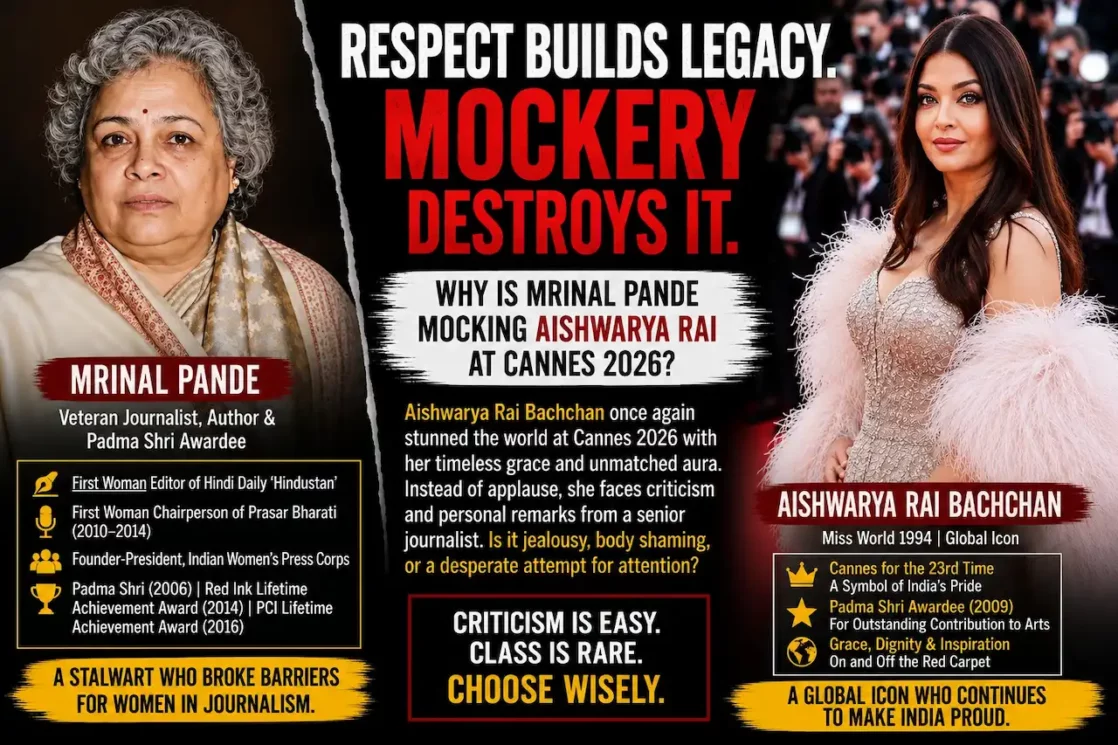
There was a time when Indian women had to fight tooth and nail merely to be seen in public life. Journalism, cinema, politics, literature, television — every field was guarded by gatekeepers who rarely allowed women to occupy space without scrutiny. It took extraordinary determination for women to rise above ridicule and establish themselves as institutions in their own right. That is why it feels deeply unfortunate when two accomplished women from two entirely different generations and professions are suddenly positioned against each other in a controversy that never needed to exist in the first place.
The recent remarks made by Mrinal Pande regarding Aishwarya Rai Bachchan at Cannes 2026 have triggered widespread criticism online. Many people are not merely upset because a senior journalist expressed an opinion about a celebrity appearance; public figures are naturally open to commentary. What has disturbed people is the tone, the persistence, and the personal nature of the remarks directed not only at Aishwarya but reportedly even toward her teenage daughter Aaradhya. That is where criticism stops looking intellectual and starts appearing unnecessarily cruel.
What makes this entire episode stranger is that both women represent remarkable milestones in Indian public life.
On one side stands Mrinal Pande — a veteran journalist, author, television personality, and one of the most influential women in Indian media history. She broke barriers in a male-dominated Hindi journalism industry long before feminism became fashionable in drawing-room conversations. She became the first woman editor of the Hindi daily Hindustan, later chaired Prasar Bharati, and played a major role in creating space for women journalists in India. Her writings on gender inequality, rural women, body politics, and social taboos earned her national respect and prestigious honours, including the Padma Shri.
Mrinal Pande belongs to a generation of women who had to fight institutional patriarchy directly. She did not rise in an era of social media validation or celebrity culture. She earned recognition through intellect, discipline, and years of relentless work. Whether one agrees with her politics or not, her contribution to Indian journalism remains historically significant.
On the other side stands Aishwarya Rai Bachchan — perhaps one of the most globally recognised Indian women of the modern era. From winning Miss World in 1994 to becoming one of the earliest Indian actresses to achieve mainstream international visibility, Aishwarya transformed the image of Indian beauty and cinema on the world stage. Long before global representation became a fashionable buzzword, she was walking international red carpets carrying Indian identity with poise and dignity.
Her Cannes appearances over the years became more than celebrity fashion moments. They became cultural events. Generations watched an Indian woman command attention at one of the world’s most elite cinematic gatherings with confidence, elegance, and grace. Even critics who may not admire every film she acted in cannot deny her global impact. She helped normalize the idea that Indian actresses could belong on international platforms without needing Western approval to validate their presence.
At Cannes 2026, Aishwarya once again drew massive attention. Dressed in a dramatic couture creation by Fjolla Nila and styled by Mohit Rai, she walked the red carpet with the same calm confidence that has defined her public persona for decades. Social media erupted almost instantly. Videos of photographers shouting her name went viral. Admirers praised her timeless beauty and commanding aura. At 52, she continues to possess the rare quality that true stars carry — presence. Some people merely wear clothes; others create moments. Aishwarya has spent over two decades doing precisely that.
This is why many found Mrinal Pande’s remarks jarring and unnecessary.
Criticism of fashion is fair game. Cannes itself invites commentary, analysis, and debate. But when criticism slips into personal ridicule, age-related mockery, or subtle body shaming, it begins to contradict the very values many feminist intellectuals once championed. That contradiction is what people are reacting to most strongly.
Mrinal Pande spent much of her career speaking about the policing of women’s bodies, the hypocrisy surrounding female appearance, and the social scrutiny imposed on women in India. Her writings often challenged society’s obsession with controlling women through shame. Therefore, when someone associated with those ideals appears to target another woman’s appearance or public image, the reaction becomes sharper because expectations are higher.
People are asking a simple question: if a woman cannot age publicly without being mocked even after decades of achievement, what exactly are younger women expected to learn from this?
There is also another uncomfortable reality behind the backlash. Indian society often glorifies successful women only until they cross a certain age. Once they continue occupying attention beyond middle age, the tone suddenly changes. Their visibility begins irritating people. Questions emerge about whether they are “trying too hard,” “holding onto glamour,” or “seeking attention.” Men in public life rarely face the same hostility for aging visibly or remaining socially relevant.
Aishwarya Rai Bachchan’s continued popularity unsettles certain sections precisely because she defies the expiration date society silently imposes on women. She remains admired, photographed, discussed, and celebrated globally after decades in public life. That longevity is rare. Instead of acknowledging that achievement, critics often attempt to reduce it through sarcasm.
Ironically, the internet generation seems to understand this contradiction more clearly than older commentators. Social media users across platforms defended Aishwarya not merely as a celebrity but as a symbol of confidence and endurance. Many women especially pointed out how exhausting it is to constantly watch female public figures being dissected for their appearance regardless of age.
More troubling, however, is the alleged commentary involving Aaradhya Bachchan. Children of celebrities already grow up under relentless public observation. Every expression, outfit, gesture, or appearance gets turned into viral content. Subjecting a teenager to mocking public discourse crosses an ethical line. Public curiosity is one thing; targeted ridicule is another.
One may disagree with celebrity culture, luxury fashion, or red carpet obsession. Those debates are legitimate. But basic decency should remain non-negotiable.
There is also a visible shift in how public intellectuals today interact with social media culture. Earlier, respected journalists maintained a certain restraint because their words carried institutional weight. Today, outrage cycles reward provocation. Sharp comments generate headlines, screenshots, shares, and temporary relevance. In many cases, intellectual criticism slowly transforms into performative commentary designed to stay socially visible.
That is why some observers believe this controversy reflects a larger issue — the growing temptation among public figures to insert themselves into viral conversations for attention. Whether intentional or not, controversial remarks about globally recognised celebrities almost always guarantee instant visibility online. In today’s media ecosystem, outrage itself has become publicity currency.
This is unfortunate because someone of Mrinal Pande’s stature does not need such attention tactics. Her legacy is already secure. She is remembered as a pioneer. That should have been enough.
Similarly, Aishwarya Rai Bachchan does not need constant validation either. Her place in Indian popular culture was cemented long ago. From cinema to international representation, she has already achieved what many aspire to across multiple lifetimes.
Which is precisely why this clash feels unnecessary.
Instead of tearing each other down, India should celebrate the fact that both these women succeeded in fields historically dominated by men. One transformed Hindi journalism; the other transformed India’s international cultural image. Their journeys reflect two different models of female success — intellectual influence and cultural glamour — and both deserve respect.
Disagreement is healthy. Critique is natural. But there is a difference between critique and contempt.
At a time when young women are constantly battling online trolling, appearance-based judgment, and public humiliation, senior women in influential positions carry a greater responsibility with their words. Society learns not only from achievements, but also from conduct.
Aishwarya Rai Bachchan walking confidently at Cannes at 52 should not be treated as something laughable. It should be viewed as proof that women do not become invisible with age. And Mrinal Pande’s extraordinary journalism career should not be overshadowed by remarks that appear petty compared to the stature she built over decades.
India does not need accomplished women competing to diminish one another. It needs them reminding the world that women can age, succeed, disagree, and still carry dignity without descending into bitterness.
