


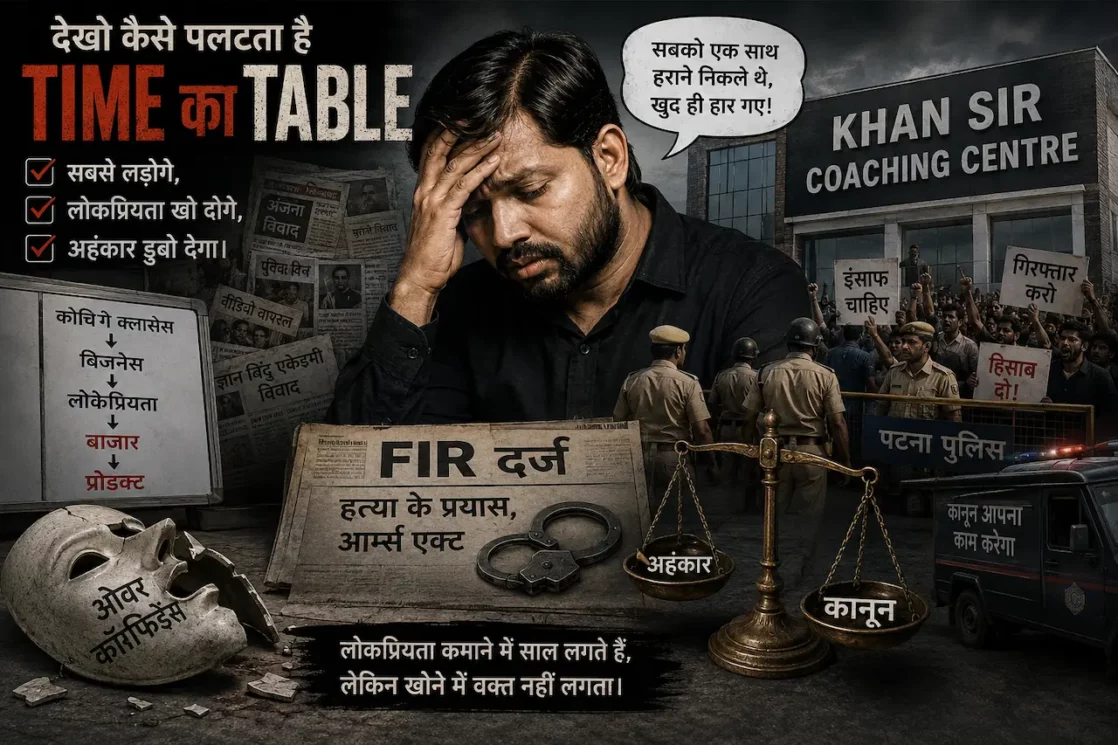
The controversy surrounding Faisal Khan, popularly known as Khan Sir, is no longer merely a dispute between two coaching institutes in Patna. It has evolved into a larger conversation about Bihar’s fragile law-and-order situation, the unchecked rise of coaching empires, and the commercialization of education that has transformed teachers into brands and classrooms into corporate battlegrounds. While the legal process must be allowed to determine individual responsibility and establish the facts, the incident has already exposed a disturbing reality that many have preferred to ignore for years. What began as a disagreement linked to the Bihar Police Constable Recruitment examination results allegedly escalated into violence, vandalism, intimidation, and eventually criminal investigations involving some of the most recognizable names in Bihar’s coaching industry. Such developments raise serious concerns not only about the conduct of individuals involved but also about the larger ecosystem that allowed such a situation to emerge in the first place.
For years, Bihar has projected itself as a state of aspiration and academic ambition. Every year, thousands of young men and women from modest backgrounds prepare relentlessly for government jobs, competitive examinations, and professional careers. Families sacrifice their savings, sell land, take loans, and invest every available resource into the education of their children, believing that success in examinations offers the most reliable path toward social mobility. Unfortunately, this enormous demand for competitive education has also created a parallel economy worth hundreds of crores of rupees. The coaching industry, once intended to supplement formal education, has gradually become a powerful commercial enterprise with its own hierarchy, influence networks, marketing machinery, and business rivalries. In many cases, coaching institutes have become more influential than educational institutions themselves, creating an environment where competition for students is often as fierce as competition for electoral votes.
The events that reportedly unfolded in Patna in recent days demonstrate how dangerous this transformation can become. According to reports, tensions between Khan Sir’s organization and Gyan Bindu Academy intensified after the declaration of recruitment examination results. What should ideally have remained a professional disagreement between educational institutions allegedly escalated into a confrontation involving supporters from both sides. Reports of vandalism, stone-pelting, and violent clashes soon emerged, creating scenes that resembled political street battles rather than disputes within the educational sector. Matters took an even more serious turn when a video surfaced allegedly showing bodyguards associated with Khan Sir firing shots into the air. Following investigations, arrests were made, and subsequent developments reportedly led investigators to scrutinize Khan Sir’s role in the larger controversy. The filing of serious criminal charges has ensured that the matter is no longer confined to the educational sphere but has entered the realm of criminal law and public accountability.
Regardless of the eventual outcome of the investigation, one uncomfortable truth has become impossible to ignore. The coaching industry in Bihar has acquired extraordinary influence without a corresponding framework of accountability. Many coaching operators today command massive social media followings, enjoy celebrity status, and possess the ability to mobilize large numbers of students and supporters. Some have become household names whose public visibility rivals that of politicians and film stars. While there is nothing inherently wrong with success achieved through hard work and talent, problems arise when educational institutions begin functioning as personality-driven enterprises rather than academic organizations. When personal brands become larger than the institutions they represent, disagreements are no longer resolved through dialogue and professionalism. Instead, they risk turning into public spectacles fueled by ego, rivalry, and the pursuit of dominance in an increasingly competitive marketplace.
The Khan Sir controversy also exposes a deeper failure within Bihar’s educational system itself. The phenomenal growth of coaching centers is not a sign of educational strength but rather evidence of systemic weakness. If schools, colleges, universities, and vocational institutions consistently provided high-quality education, students would not be forced to depend so heavily on private coaching institutes. The expansion of the coaching industry has effectively created a parallel education system operating alongside the formal one, often with minimal regulation and oversight. As a result, immense financial interests have become attached to examination results, student enrollments, and institutional reputation. In such an environment, educational competition can quickly transform into commercial warfare, where every successful student becomes a marketing tool and every examination cycle becomes a battle for market share.
Equally concerning is what this controversy reveals about Bihar’s law-and-order situation. Successive governments have repeatedly claimed that the era of lawlessness belongs to the past and that Bihar has emerged as a modern, developing state. While significant progress has undoubtedly been made in infrastructure, governance, and connectivity, incidents such as these remind citizens that deep-rooted problems have not entirely disappeared. When disputes involving educational institutions allegedly escalate into violence and firearms enter the picture, it raises troubling questions about the state’s ability to maintain order and enforce the rule of law. Citizens expect disagreements to be settled through legal mechanisms, not through displays of muscle power, intimidation, or street-level confrontations. The involvement of police, arrests, criminal investigations, and heightened security arrangements around coaching institutions should concern every parent whose child enters such establishments in pursuit of education.
Perhaps the most ironic aspect of this controversy is that it exposes the illusion surrounding modern celebrity educators. Social media has created an environment in which public figures often appear larger than life, surrounded by devoted supporters who view criticism as hostility and scrutiny as persecution. However, history repeatedly demonstrates that popularity is not a substitute for accountability. Public admiration can elevate an individual rapidly, but it can also vanish with equal speed when controversy emerges. The same audience that celebrates success often becomes silent when difficult questions arise. The same social media platforms that create icons can rapidly become arenas of relentless criticism. This reality serves as a reminder that no individual, regardless of influence or popularity, exists above the law or beyond public scrutiny.
The greatest tragedy, however, is that students remain the forgotten stakeholders in this entire drama. Young aspirants enroll in coaching institutes with dreams of securing employment, supporting their families, and building meaningful futures. Their parents invest not merely money but hope, trust, and years of sacrifice into their education. They deserve institutions focused on learning, mentorship, and academic excellence. Instead, they increasingly find themselves witnessing power struggles, rivalries, branding wars, and controversies that have little to do with education itself. The transformation of coaching centers into commercial empires may have generated enormous wealth and influence for a select few, but it has also shifted attention away from the fundamental purpose of education—the development of knowledge, character, and opportunity.
As investigations continue and legal proceedings take their course, Bihar must resist the temptation to view this episode as merely another sensational controversy destined to disappear from public memory. The incident should instead serve as a warning about the consequences of allowing educational institutions to evolve into unregulated power centers driven by commercial interests. It should compel policymakers to strengthen formal education, enforce greater accountability within the coaching industry, and ensure that no individual or institution becomes so influential that they operate beyond scrutiny. Most importantly, it should remind society that education is a public good, not a marketplace commodity, and that teachers are meant to shape futures, not build empires. The day education becomes indistinguishable from business warfare is the day society begins losing sight of its most important mission—the nurturing of the next generation.
