


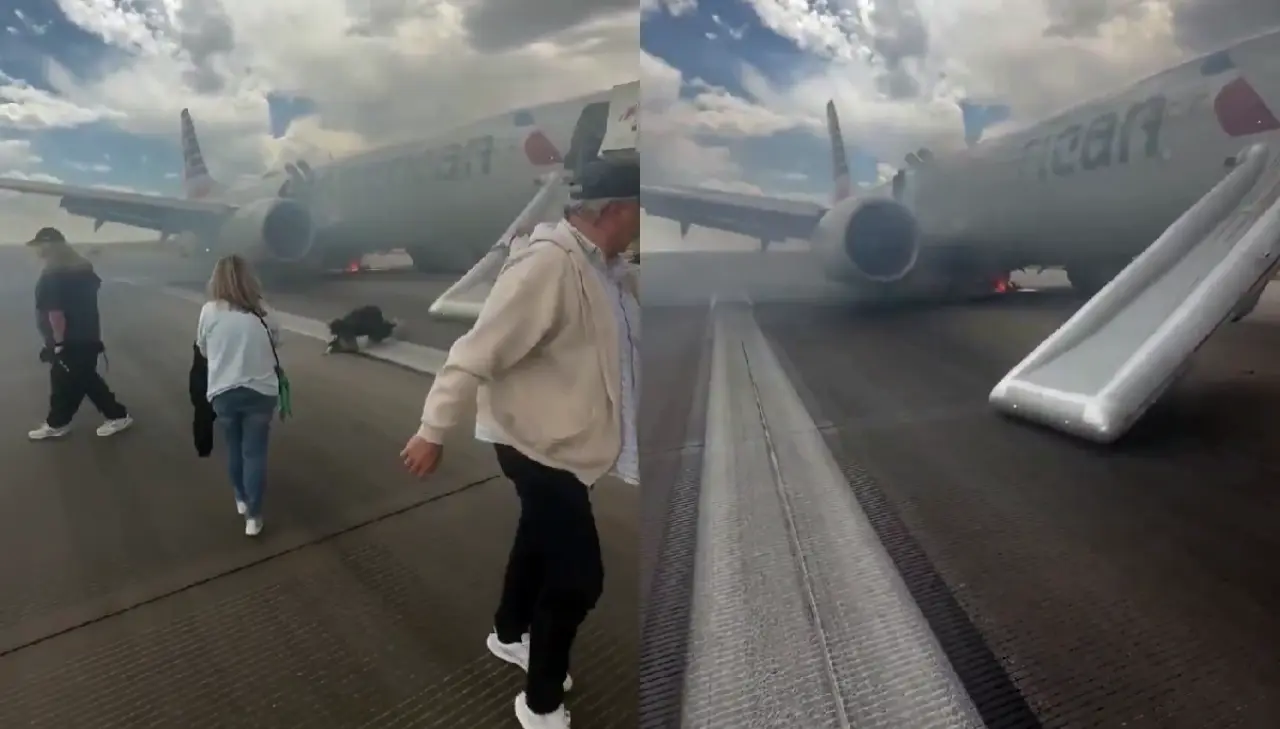
Boeing’s troubled 737 Max series is back in the spotlight after a dramatic incident at Denver International Airport on Saturday, when an American Airlines flight was forced to abort takeoff due to a fire in its landing gear. Flight AA3023, en route to Miami with 173 passengers and six crew on board, came to an abrupt halt at 2:45 p.m. when the right landing-gear tire failed and burst into flames, sending thick smoke across Runway 25L.
Emergency slides were deployed as fire crews rushed to the scene and extinguished the blaze by 5:10 p.m. All passengers and crew safely evacuated the aircraft, though one person sustained minor injuries. Social media videos showed panicked passengers sliding down, some clutching carry-on luggage despite warnings from aviation authorities that such actions can delay evacuations and put lives at risk.
This marks the second Boeing-related emergency involving American Airlines in Denver this year. In March, Flight 1006—operating a 737-800—suffered an engine fire while taxiing, later attributed to maintenance oversight. The National Transportation Safety Board (NTSB) is investigating both events, with a particular focus on Boeing’s landing gear and tire-system design and the effectiveness of its maintenance documentation.
The 737 Max family has faced intense scrutiny since the 2018 and 2019 crashes of Lion Air and Ethiopian Airlines flights, which led to a worldwide grounding of the fleet until late 2020. While Boeing has since introduced software upgrades and revamped pilot training, mechanical problems continue to shadow the aircraft’s safety reputation.
In the wake of the Denver fire, the Federal Aviation Administration (FAA) has issued a directive mandating immediate inspections of all 737 Max 8 landing-gear trunnion pins and tire-pressure sensors. Boeing has pledged full cooperation and launched an internal audit of its quality-control practices. American Airlines, meanwhile, has temporarily grounded the affected 737 Max 8 aircraft and shifted impacted passengers to Airbus A320-family jets.
With peak summer travel underway, the aviation industry—and the flying public—awaits reassurances that Boeing’s next-generation jets won’t again dominate headlines for the wrong reasons.
