


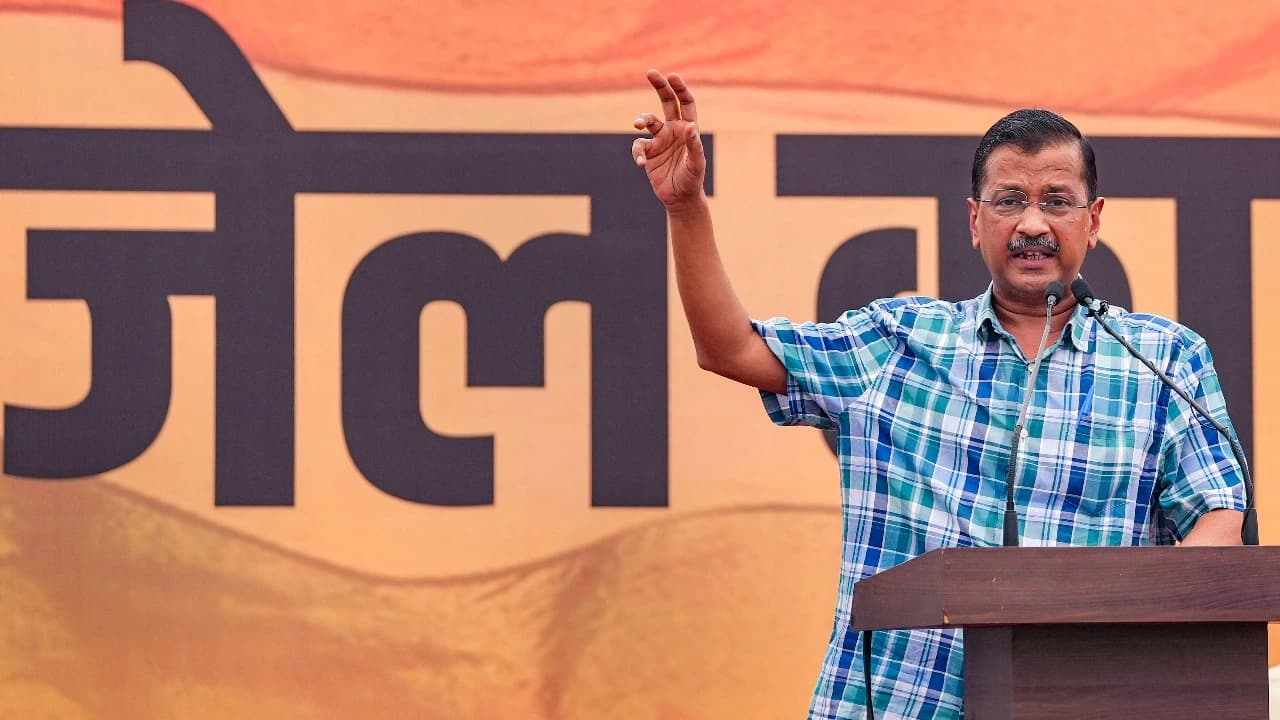
Aam Aadmi Party (AAP) national convener Arvind Kejriwal on Monday announced a “National Townhall Against E20”, urging people to mobilise against the Centre’s mandatory ethanol-blended petrol policy and drawing parallels with the student movement that culminated in the resignation of former Union Education Minister Dharmendra Pradhan.
Announcing the initiative in a post on X, Kejriwal said the townhall would be held at the Constitution Club in New Delhi at 11.30 am on Saturday, August 1. He said members of the public would also be able to participate online and share their experiences and concerns regarding E20 petrol.
“When the youth of the country raised their voice together, Dharmendra Pradhan had to resign. We will have to unite and raise our voice on E20 as well,” Kejriwal said.
AAP has also launched an online campaign inviting citizens to sign a petition addressed to Prime Minister Narendra Modi.
The party has demanded that consumers be given the option to choose between ethanol-free petrol (E0), E10 and E20, instead of having only one standard blend available. It has also argued that E20 should be sold at a lower price to reflect its comparatively lower energy content.
CJP Movement Referenced
Kejriwal’s remarks came after the Cockroach Janta Party (CJP) concluded its 36-day agitation at Jantar Mantar following Dharmendra Pradhan’s resignation.
The movement was led publicly by CJP founder Abhijeet Dipke along with spokespersons Ashutosh Ranka and Saurav Das.
Dipke had previously worked with the AAP’s social media team, while Ranka had served as the Rajasthan state secretary of the party’s intellectual wing.
What is E20 Petrol?
E20 is a blend consisting of up to 20 per cent ethanol and 80 per cent petrol. Ethanol is produced from feedstocks such as sugarcane, molasses, maize, damaged food grains and agricultural residue.
The fuel was introduced at select retail outlets in 2023. The Centre achieved an average ethanol blending level of 20 per cent in December 2025 and made the sale of petrol containing up to 20 per cent ethanol mandatory across the country from April 1, 2026.
The government has maintained that ethanol blending reduces India’s dependence on imported crude oil, lowers carbon emissions and generates additional income for farmers.
According to the Ministry of Petroleum and Natural Gas, the programme has saved more than Rs 1.90 lakh crore in foreign exchange while facilitating payments exceeding Rs 1.60 lakh crore to farmers since 2014-15.
Debate Over Mileage and Compatibility
Critics of the policy have raised concerns over fuel efficiency, compatibility with older vehicles, maintenance costs, fuel pricing and the lack of availability of E0 or E10 petrol as alternatives.
The Centre has repeatedly stated that there is no verified evidence linking E20 to widespread engine failures.
In a reply in the Rajya Sabha on July 20, the government said that more than 20 crore two-wheelers and three crore petrol cars have operated on higher ethanol blends without any established nationwide pattern of engine damage.
However, the government’s own 2021 ethanol roadmap acknowledged that fuel efficiency may decline depending on vehicle design.
It estimated a mileage reduction of 6-7 per cent in four-wheelers originally designed for ethanol-free petrol and calibrated for E10, 3-4 per cent in similarly designed two-wheelers and 1-2 per cent in four-wheelers specifically calibrated for E20.
Political and Public Debate Continues
Union Road Transport and Highways Minister Nitin Gadkari has previously faced allegations of a conflict of interest because businesses run by his sons have interests in the sugar and ethanol sectors.
Gadkari has denied the allegations, stating that the family’s sugar factory predates the ethanol blending programme, that his sons independently manage the businesses and that their operations account for less than 0.5 per cent of India’s ethanol industry.
He has also acknowledged that ethanol’s lower calorific value can result in a marginal reduction in fuel efficiency.
Meanwhile, a newly formed online campaign calling itself the “E20 Janta Party”, inspired by the CJP movement, has demanded the availability of pure petrol and sought Gadkari’s resignation.
The issue has also gained traction on social media, where motorists, mechanics and automobile content creators have shared experiences alleging reduced mileage, damage to fuel components and higher maintenance costs.
Some of the viral claims have later been withdrawn. YouTuber Sourav Joshi, who had initially attributed a sharp drop in his Mercedes SUV’s mileage to E20 petrol, later clarified that the issue was caused by an engine fault rather than the fuel itself.
