FTII Students Slam National Award for 'The Kerala Story', Call It 'Propaganda, Not Cinema' 2
The Students’ Association of the Film and Television Institute of India (FTII) has issued a strong condemnation of the decision to confer national awards on the controversial film The Kerala Story, calling the move not just disappointing but “dangerous.” The association criticised the government for what it described as legitimising propaganda that aligns with a “majoritarian, hate-filled agenda.”
Filmmaker Sudipto Sen won Best Director for The Kerala Story, which also received the award for Best Cinematography at the 71st National Film Awards. The 2023 film has faced backlash since its release for depicting alleged forced religious conversions and the recruitment of women in Kerala by the Islamic State terror group—claims widely disputed and criticised as communal fear-mongering.
In a statement released on August 2, the FTII Students’ Association said the film “is not a film; it is a weapon” used to vilify the Muslim community and misrepresent a state known for communal harmony and social progress. The students accused the state of using cinema to further divisive narratives and normalise bigotry.
“Cinema is not neutral—it is a powerful instrument of influence,” the association said. “When a government-endorsed body elevates a film that spreads misinformation and paranoia against minorities, it is not merely recognising art, it is legitimising violence.”
The students warned that such recognitions could fuel future social unrest, including lynchings and exclusion, under the guise of state-sanctioned storytelling. They further condemned what they called the “reduction of cinema to a tool of state-sponsored communalism” and declared, “We refuse to accept that Islamophobia is now award-worthy.”
Calling for accountability and artistic integrity, the statement concluded with a bold assertion: “The state must understand—giving awards to propaganda does not make it true. And we, as students and citizens, will not stop calling it what it is—incitement. Violence.”
Shibu Soren: The Tribal Trailblazer Who Shaped Jharkhand’s Destiny 4
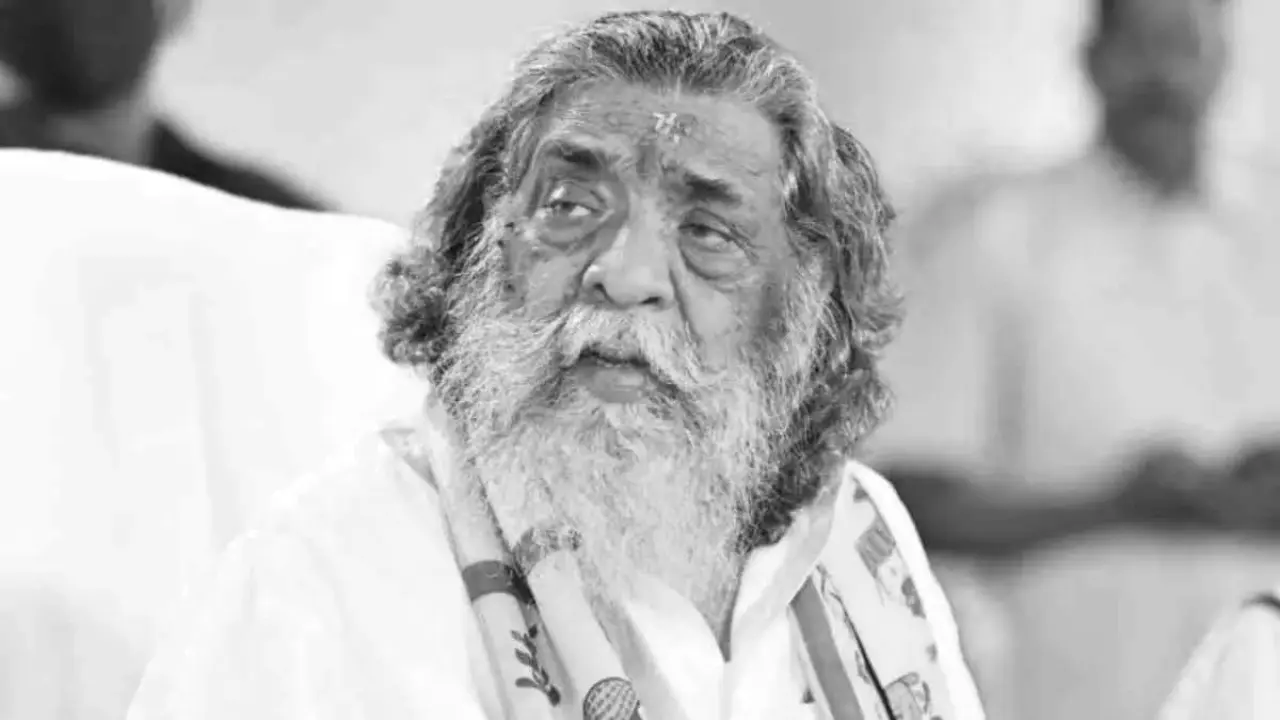
Veteran tribal leader and Jharkhand Mukti Morcha (JMM) founder Shibu Soren, who passed away at the age of 81, leaves behind a towering legacy defined by relentless advocacy for tribal rights, landmark political milestones, and a career punctuated by controversy. His death marks the end of an era in Indian regional politics and the tribal movement he helped bring to national prominence.
Born on January 11, 1944, in Nemra village (then in Bihar, now in Jharkhand), Soren—popularly known as “Dishom Guru”—emerged from personal tragedy and socio-economic hardships to become a voice for the oppressed. The brutal killing of his father by moneylenders when he was just 15 became the catalyst for his lifelong fight against exploitation and injustice.
In 1973, Soren co-founded the JMM alongside AK Roy and Binod Bihari Mahto, transforming a grassroots movement into a powerful political force that championed the creation of a separate tribal state. After years of agitation, Jharkhand was finally carved out of Bihar on November 15, 2000.
Soren’s political influence extended beyond state borders. Elected multiple times to the Lok Sabha from Dumka and later to the Rajya Sabha, he also served thrice as Jharkhand’s Chief Minister—though each term was short-lived due to unstable coalitions. He held the Union Coal Ministry portfolio under the UPA government but faced legal troubles that overshadowed his ministerial roles.
In 2004, an arrest warrant in the 1975 Chirudih massacre case led him to briefly go underground. Though later granted bail and acquitted in 2008, he again found himself at the center of controversy after being convicted in 2006 in the sensational 1994 kidnapping and murder of his former secretary, Shashinath Jha. The case, tied to the infamous 1993 no-confidence vote bribery scandal, captured national attention. However, Soren was acquitted, and the Supreme Court upheld the decision in 2018.
Surviving even an assassination attempt in 2007, Soren’s resilience made him an enduring symbol of tribal resistance and empowerment. His political clout remained unshaken, and he served as JMM president for nearly four decades until April 2025, when he was named founding patron. His son, Hemant Soren, succeeded him as party chief and continues to serve as Jharkhand’s Chief Minister. Another son, Basant Soren, is a legislator, while daughter Anjani leads the party’s Odisha unit.
Despite the controversies, Soren is remembered as the architect of Jharkhand’s tribal identity—a figure who gave voice to the marginalized and left an indelible imprint on Indian politics.
"I Don’t Want to Be King, I Oppose the Very Concept": Rahul Gandhi at Conclave 6
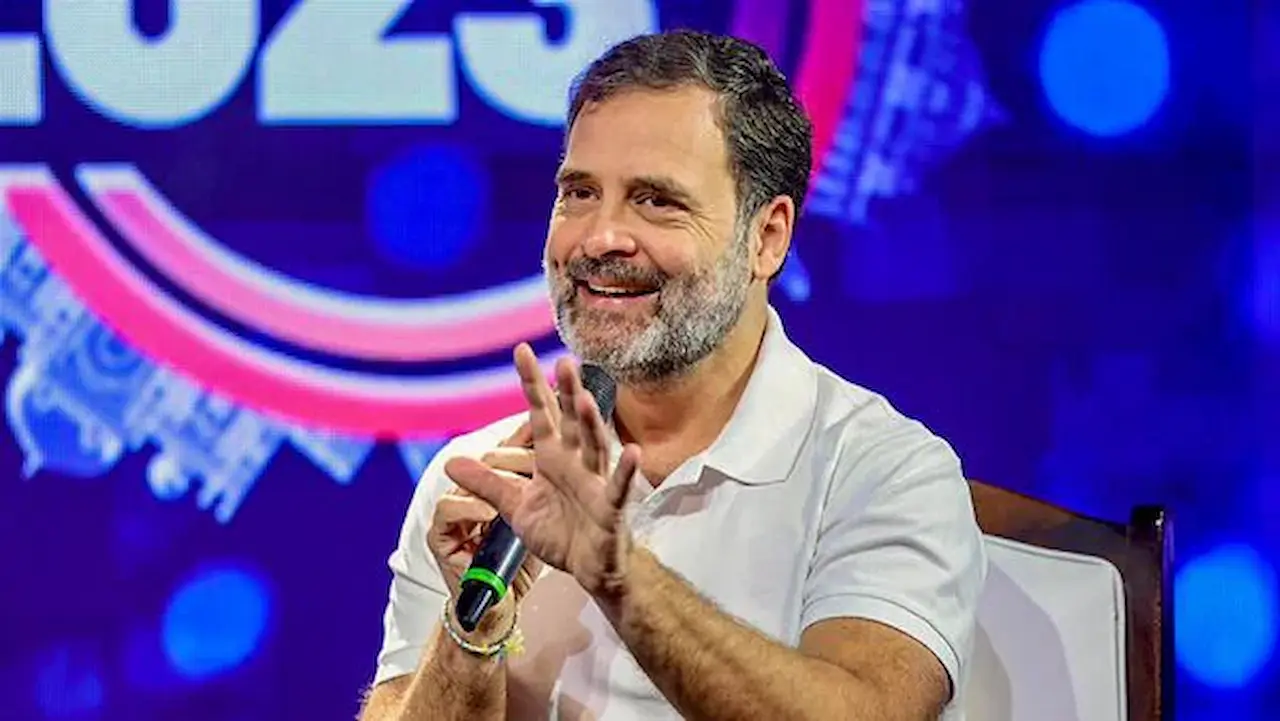
Congress leader Rahul Gandhi on Saturday firmly stated that he does not aspire to be a king and is fundamentally opposed to the very concept of kingship. He made the remark while speaking at the inaugural session of a day-long conclave titled “Constitutional Challenges: Perspectives and Pathways” held at Vigyan Bhawan in New Delhi.
As Gandhi took the stage, enthusiastic members of the audience began chanting slogans such as, “Is desh ka raja kaisa ho, Rahul Gandhi jaisa ho” (What should the king of this country be like? Like Rahul Gandhi). Interrupting the chants, Gandhi responded, “No boss, Main raja nahin hun. Raja banana bhi nahin chahta hun. Main raja ke against hun, concept ke bhi against hun,” meaning, “No boss, I am not the king. I don’t want to become a king. I am against kings, against the very concept.”
Gandhi has previously used similar language while targeting Prime Minister Narendra Modi, accusing him of behaving like a monarch rather than a democratically elected leader who listens to the voice of the people.
His latest comments underscore his long-standing criticism of centralized authority and reinforce his image as a leader who advocates participatory governance.
Two Terrorists Gunned Down in Kulgam Forest Encounter; Operation Still Underway 8
Two terrorists were killed in a fierce encounter with security forces in the Akhal forest area of Jammu and Kashmir’s Kulgam district on Saturday morning. The operation began Friday evening after security personnel launched a cordon and search operation based on specific intelligence inputs regarding terrorist presence in the region.
Following an initial exchange of fire, the operation was paused overnight while additional reinforcements were deployed and the area cordoned off. Hostilities resumed on Saturday morning, leading to the neutralization of the two militants.
Officials said the identity and group affiliation of the slain terrorists are yet to be confirmed. The area remains under tight security, and the operation is still in progress to rule out the presence of any remaining threats.
Chhattisgarh Court Grants Bail to Kerala Nuns Accused in Trafficking and Conversion Case 10
A special court in Bilaspur, Chhattisgarh, on Saturday granted conditional bail to three individuals, including two Catholic nuns from Kerala, arrested in a case involving allegations of human trafficking and forced religious conversion. The accused—Preethi Merry and Vandana Francis from Kerala, and Sukaman Mandavi—were arrested at Durg railway station on July 25, based on a complaint filed by a local Bajrang Dal functionary who alleged they were trafficking three girls from Narayanpur for the purpose of conversion.
The order was delivered by Principal District and Sessions Judge Sirajuddin Qureshi of the NIA court, who had reserved the decision after hearing arguments on Friday. Defence lawyer Amrito Das confirmed the grant of conditional bail and noted that the prosecution did not seek custodial interrogation of the accused. Additionally, the girls allegedly involved in the case have been sent back to their respective homes, further weakening the grounds for continued detention.
The case has stirred political and communal tensions in the region, drawing sharp reactions from both religious and activist circles. The legal battle is expected to continue as the investigation progresses.
From Soldier to Scapegoat: The Unforgivable Ordeal of Lt. Col. Shrikant Purohit and His Family 12
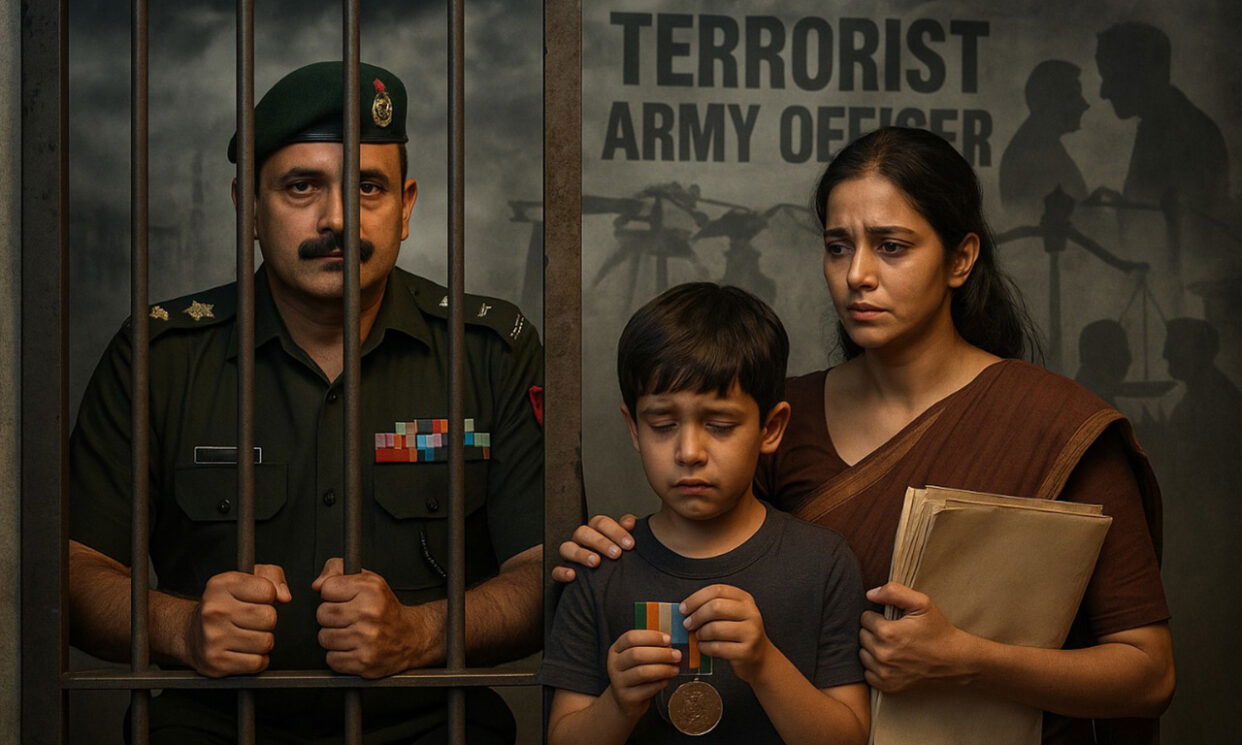
When a soldier dons the uniform, he takes an oath—to protect the nation, to serve with integrity, to put the country before himself. Lieutenant Colonel Shrikant Prasad Purohit, an officer from a patriotic family in Pune, lived by that oath. He served in Military Intelligence, conducted counter-terrorism operations in hostile zones like Jammu and Kashmir, and risked his life in service to Bharat. And yet, this very nation turned its back on him.
In 2008, a bomb blast in Malegaon killed six people and injured over a hundred. Within days, Purohit—who was serving the country through intelligence work—found himself branded a terrorist. A soldier who was trained to fight enemies of the nation was now projected as the enemy himself. And just like that, without trial, without proof, without question, a man was ripped away from his uniform, his honour, and his family—and thrown into a cell.
He spent nine years in jail—nine years without a single day of trial. The agencies slapped him with charges under UAPA, IPC, and the Explosives Act. But let’s call it what it really was: a systematic political witch-hunt, driven not by facts but by agendas.
What was his crime? According to Purohit, he was doing his job too well. As an intelligence officer, he had infiltrated dubious groups and gathered critical reports—including details on Dawood Ibrahim’s underworld-Maoist nexus and the suspicious funding patterns of Zakir Naik. He compiled dossiers, some of which named influential politicians. That, perhaps, became his real mistake.
Purohit’s own testimony is chilling. He alleged that investigative agencies pressured him to name senior right-wing leaders—including members of the RSS and even Yogi Adityanath, now the Chief Minister of Uttar Pradesh. He claimed that witnesses were tortured and threatened at gunpoint and that evidence—including RDX—was planted to frame him. According to him, officers from the Anti-Terrorism Squad (ATS) not only fabricated narratives but even orchestrated extrajudicial killings to close the case quickly.
The tragedy deepened when the courts took years just to acknowledge what was already visible. In 2017—nine years after his arrest—the Supreme Court finally granted him conditional bail, acknowledging that several facts in the case required re-evaluation and that keeping him in jail indefinitely without trial was not justifiable. The NIA Special Court later observed that no direct evidence linked Purohit to the Malegaon blast and stated that applying UAPA was not appropriate.
But by then, the damage was irreparable.
This wasn’t just a legal case. It was a complete and brutal character assassination. A respected Army officer, celebrated for his service, was suddenly painted as a terrorist. The media ran unverified stories. Political leaders passed comments. Public opinion was shaped not by facts but by headlines. And what of his family?
His wife fought a relentless legal battle—practically becoming a lawyer herself—just to prove her husband’s innocence. Their sons grew up with a father in jail, burdened by society’s label: “terrorist ke bachche.” The younger one was just a toddler when Purohit was taken away. The elder son would later join the legal struggle as he grew up. Their schools, neighbours, and society did not see them as children of a soldier—they saw them as offspring of a traitor. What greater cruelty can a nation inflict on a loyal family?
Even today, Purohit has not been restored to full service. He is posted in an administrative role in Pune, not allowed to serve in the field. He can’t leave the country without court permission. A man who wore his uniform with pride is now constantly reminded of the stigma that the system still refuses to fully erase.
This is not just Purohit’s story. It is the story of a nation’s utter failure to protect its own warriors. The rot in the system, the bias in investigations, the lethargy of the judiciary, and the complicity of the political class have together created a nightmare—one that has lasted seventeen years and counting.
And now the nation must ask itself:
Who will return these stolen years?
Who will erase the label of ‘terrorist’ from his children’s memory?
Who will restore the dignity of a man who risked everything for his country and was betrayed by the very system meant to protect him?
The people responsible for this miscarriage of justice—the investigating officers, the political masters who pulled the strings, the bureaucrats who looked away, and the judiciary that moved at a snail’s pace—must be named and held accountable.
Because if we can do this to a soldier, we can do it to anyone.
Because if our institutions can be manipulated to destroy lives on the basis of politics, no one is safe.
Because if justice delayed becomes justice denied—then this wasn’t justice. This was state-sponsored cruelty.
And because some wounds can’t be healed by bail or verdicts.
The question remains: who will pay the price for destroying a patriot’s life?
Caught Playing Rummy in Assembly, Maharashtra Minister Manikrao Kokate Shunted from Agriculture Portfolio 14
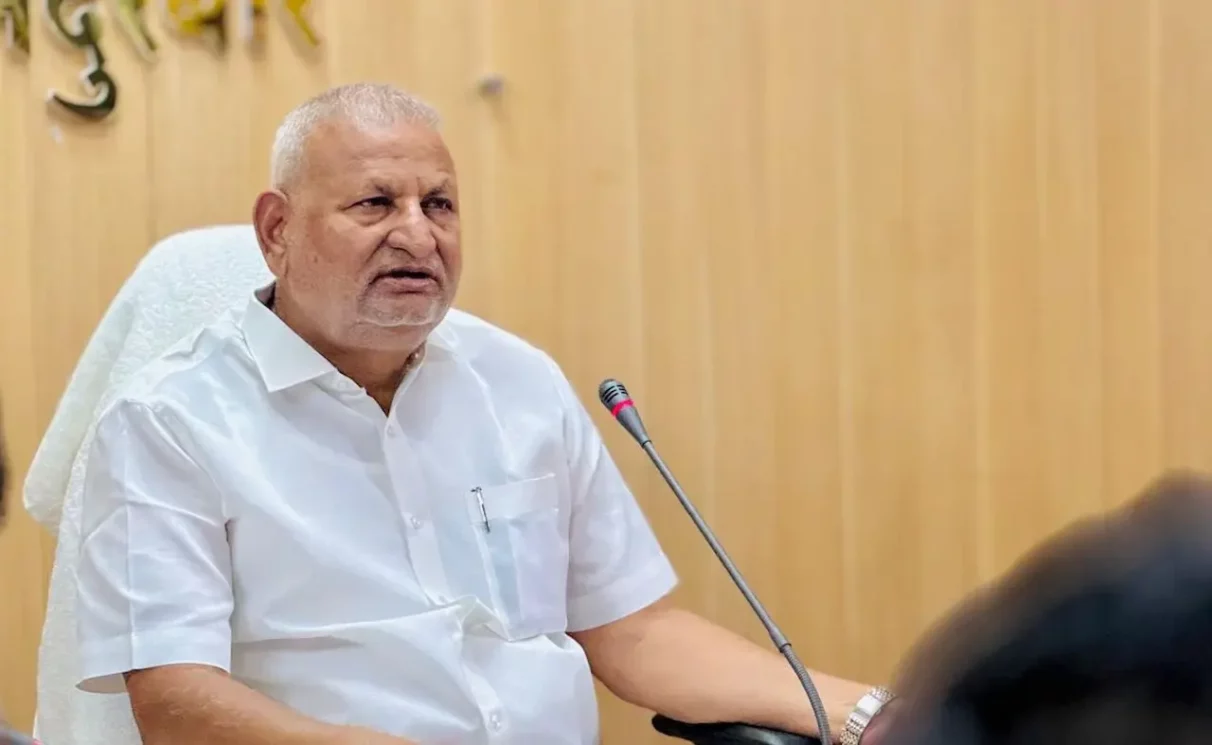
In a late-night cabinet reshuffle, Maharashtra Minister and NCP MLA Manikrao Kokate has been removed from the agriculture ministry after a video of him playing an online rummy game during an assembly session went viral. The footage, reportedly captured during the recent monsoon session, showed Kokate engrossed in the game while seated in the legislative council. The clip was widely circulated by NCP (Sharad Pawar) leaders Rohit Pawar and Jitendra Awhad, sparking criticism and embarrassment for the government.
Following the controversy, Kokate has now been assigned the sports and youth welfare portfolio, in addition to the minority development and Auqaf departments, according to a notification issued by the General Administration Department on Thursday night. Dattatrey Bharne, who previously held the sports ministry, has taken charge as the new agriculture minister. Both Kokate and Bharne are MLAs from the Ajit Pawar-led Nationalist Congress Party, representing Sinnar in Nashik and Indapur in Pune, respectively.
This is not Kokate’s first brush with controversy. Earlier this year, he faced backlash for allegedly comparing farmers to beggars. His reassignment marks the second high-profile shuffle within the Ajit Pawar faction of the NCP in recent months. In an earlier episode, Dhananjay Munde resigned from his ministerial post after his close aide, Walmik Karad, was named the prime accused in the Santosh Deshmukh murder case.
ED Busts 'Fake' Bank Guarantee Racket Tied to Odisha Firm; Reliance Subsidiary Under Lens 16
In a major crackdown, the Enforcement Directorate (ED) on Friday raided multiple premises linked to an Odisha-based company, Biswal Tradelink, accused of orchestrating a fake bank guarantee racket involving commissions and suspicious dealings with prominent business groups. Among the alleged beneficiaries is Reliance NU BESS Limited—a subsidiary of Anil Ambani-led Reliance Power—which reportedly submitted a fraudulent guarantee worth ₹68.2 crore to the Solar Energy Corporation of India Limited (SECI).
The investigation, launched under the Prevention of Money Laundering Act (PMLA), stems from a November 2024 FIR filed by the Delhi Police Economic Offences Wing. The ED conducted searches at three locations in Bhubaneswar and one associate entity in Kolkata, seizing critical documents linked to the fake guarantees.
According to agency sources, Biswal Tradelink allegedly issued forged bank guarantees against an 8% commission. The firm used a deceptive email domain—s-bi.co.in—closely resembling the official domain of the State Bank of India (sbi.co.in), to send fake communications to SECI while impersonating the national bank.
Documents related to the fake guarantees were reportedly seized during a recent raid on Reliance Group’s offices in Mumbai. Investigators have also found multiple suspicious transactions involving various companies routed through undisclosed bank accounts.
Further digging revealed that Biswal Tradelink is essentially a paper entity, with its registered office being a residential address linked to a relative. No official business records were found during the raids. The agency suspects the use of the Telegram app with disappearing messages enabled by key individuals to avoid digital trails.
The ED has also reached out to the National Internet Exchange of India (NIXI) for details regarding the fake email domain’s registration, while a forensic audit of seized data is underway. With financial fraud running into crores, the probe is likely to widen in scope as investigators track the money trail.
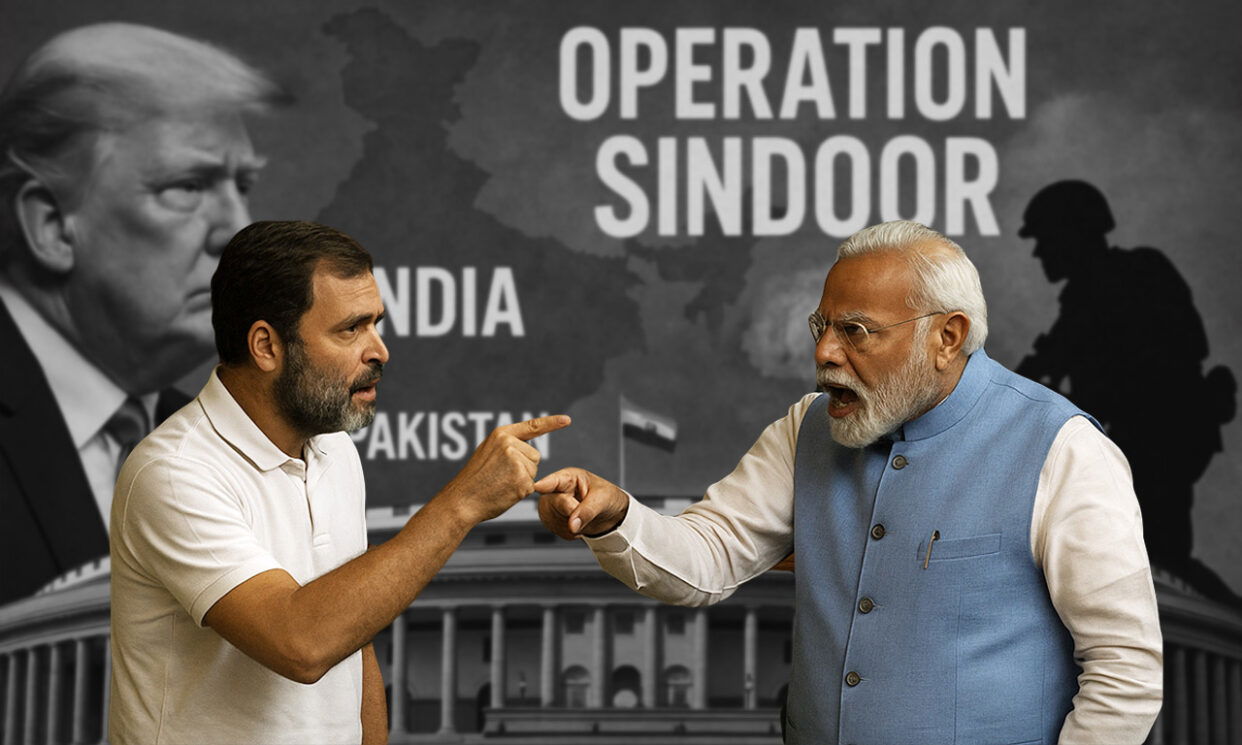
Debate On Operation Sindoor Turned Into a Political Battlefield 18
For the first time in a long while, the Parliament didn’t echo with scripted chest-thumping—it roared with real questions. The debate on Operation Sindoor turned into a political battlefield where the Prime Minister, his top ministers, and the entire BJP machinery were called out, cornered, and crushed by the opposition’s fierce and factual onslaught.
Yes, Prime Minister Modi, Home Minister Amit Shah, Defence Minister Rajnath Singh, and EAM Jaishankar gave long, loud speeches—but none of them had the courage or substance to directly answer the barrage of valid, burning questions raised by the opposition.
Leaders like Mallikarjun Kharge, Rahul Gandhi, Priyanka Gandhi Vadra, Kanimozhi, and Akhilesh Yadav didn’t just speak—they shook the very foundations of Modi’s political grandstanding. The Opposition didn’t indulge in drama; they held a mirror to a government that has lost its political will and moral compass—a government that thrives on PR but falters on accountability.
The House witnessed a direct face-off: Narendra Modi vs the Gandhi siblings—and for once, Modi was on the back foot.
Rahul Gandhi’s powerful, piercing words tore through the BJP’s false bravado. His direct challenge: “Say it in this House—Donald Trump is lying; India didn’t agree to a US-brokered ceasefire. Say it, if you even have 50% of Indira Gandhi’s courage!” left the PM speechless. And Priyanka Gandhi’s question was brutal in its honesty—why hasn’t Amit Shah resigned after the Pahalgam attack that killed innocent citizens? Why has no one taken responsibility?
While the government tried to celebrate Operation Sindoor as a victory, Priyanka Gandhi exposed the bitter truth—a truth soaked in the blood of the innocents. She named the victim, Shubham Dwivedi, whose wife waited an hour during the attack and saw no security personnel, no soldier—just bloodshed and fear. That silence, that vacuum of state presence, is the Modi government’s real face.
She shattered BJP’s favourite attack line about 26/11 and the UPA’s alleged inaction. “The terrorists were killed during the attack, and those responsible in the UPA resigned. That’s what accountability looks like—not this shameless denial and blame-shifting,” she said.
The so-called ‘56-inch chest’ shrunk in front of facts.
Rahul Gandhi drove the stake in deeper. He exposed the BJP’s strategic cowardice—tying the military’s hands, refusing to strike military targets in Pakistan, leading to unnecessary losses. He invoked India’s Defence Attaché and quoted the Defence Minister himself—that India lost aircraft because of political constraints.
He made it clear: “The Army is filled with tigers, ready to die for this country. But tigers must be set free. Don’t cage their strength with your cowardice.”
He thundered that India needs a leader who empowers the military like Indira Gandhi did, not someone obsessed with self-image and media optics. Modi was reminded that the nation is bigger than his brand, bigger than his selective patriotism.
Perhaps the most damning moment was when Rahul Gandhi pointed out that not a single country condemned Pakistan after the Pahalgam attack. That’s how low India’s diplomatic credibility has sunk under Modi.
Throughout the 16-hour debate, it became evident: the Modi government had no answers. Their voices echoed, but their words rang hollow. The Opposition was relentless, sharp, factual—and finally, fearless.
For once, Modi didn’t dominate the narrative—he struggled to survive it.
This was not just a debate; it was a democratic storm. And it revealed a hard truth—when you ignore accountability, when you suppress dissent, when your governance becomes a spectacle, the day will come when Parliament itself demands answers.
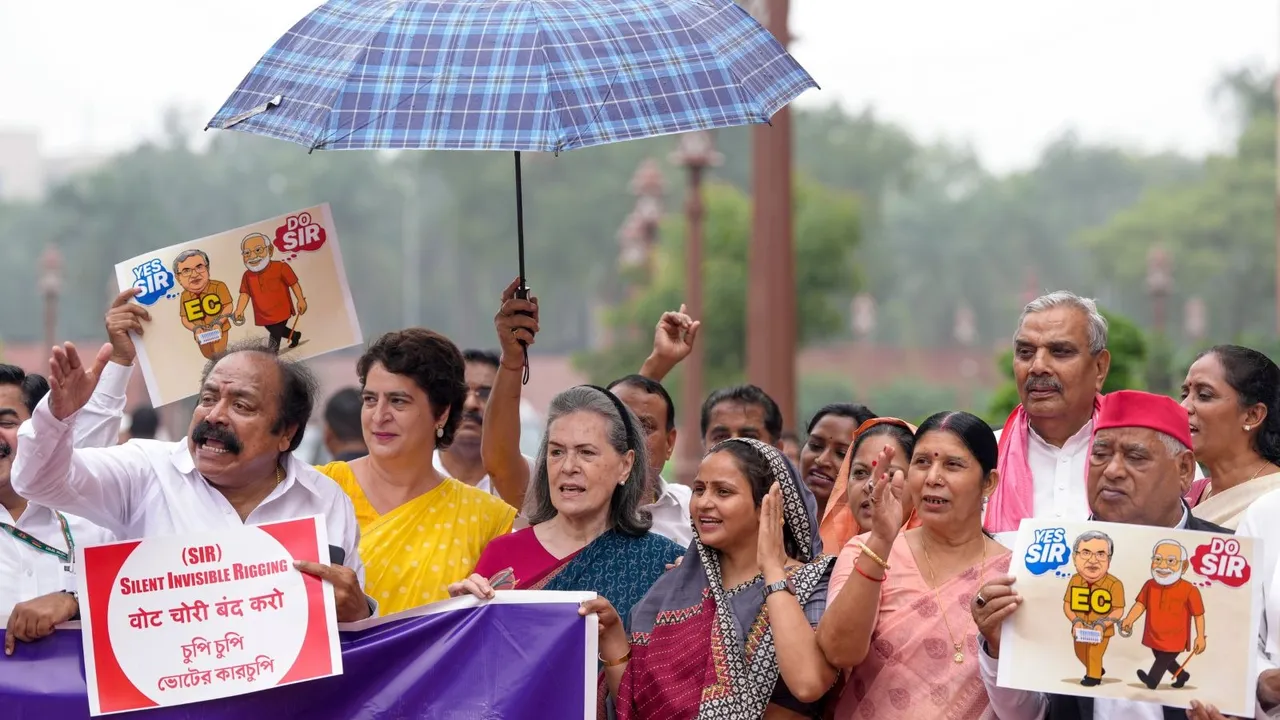
Sonia, Priyanka, Akhilesh Lead 'Stop SIR' Protest, Accuse EC of Attacking Democracy 20
For the eighth consecutive day, senior opposition leaders, including Congress parliamentary party chairperson Sonia Gandhi, Priyanka Gandhi Vadra, and Samajwadi Party chief Akhilesh Yadav, staged a protest in the Parliament House complex against the Election Commission’s Special Intensive Revision (SIR) of electoral rolls in Bihar. The protest, organized by MPs from the INDIA bloc, demanded an immediate rollback of the EC’s voter list revision, alleging it undermines democratic principles.
Before Parliament proceedings began on Thursday, the opposition leaders gathered near the Makar Dwar steps, holding placards reading “Stop SIR” and standing behind a large banner that declared “SIR – Loktantra Pe Vaar” (Attack on Democracy). Protesters accused the Election Commission of acting in collusion with the central government, aiming to disenfranchise voters in Bihar ahead of the upcoming Assembly elections.
Members of the Congress, DMK, TMC, Samajwadi Party, RJD, and Left parties raised slogans and demanded a full debate in both Houses on what they termed an unconstitutional move by the EC. The coordinated protest reflects growing opposition concern over alleged manipulation of the electoral process.