


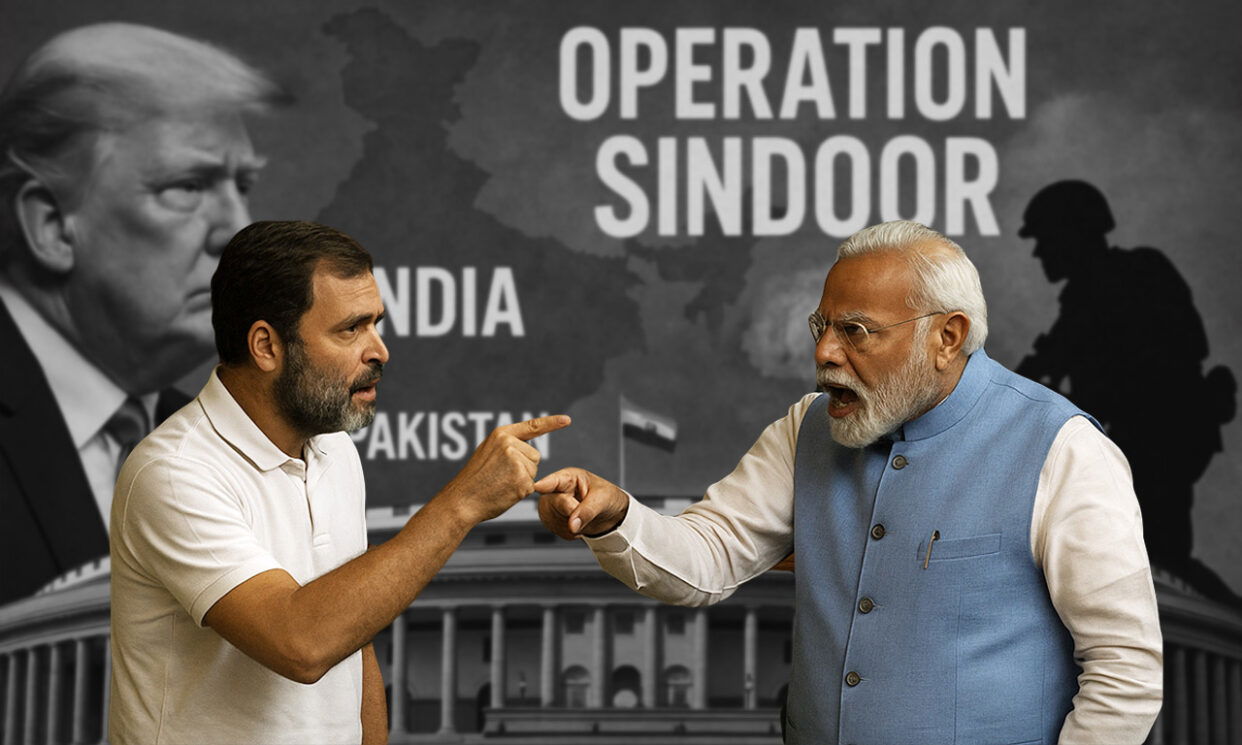
For the first time in a long while, the Parliament didn’t echo with scripted chest-thumping—it roared with real questions. The debate on Operation Sindoor turned into a political battlefield where the Prime Minister, his top ministers, and the entire BJP machinery were called out, cornered, and crushed by the opposition’s fierce and factual onslaught.
Yes, Prime Minister Modi, Home Minister Amit Shah, Defence Minister Rajnath Singh, and EAM Jaishankar gave long, loud speeches—but none of them had the courage or substance to directly answer the barrage of valid, burning questions raised by the opposition.
Leaders like Mallikarjun Kharge, Rahul Gandhi, Priyanka Gandhi Vadra, Kanimozhi, and Akhilesh Yadav didn’t just speak—they shook the very foundations of Modi’s political grandstanding. The Opposition didn’t indulge in drama; they held a mirror to a government that has lost its political will and moral compass—a government that thrives on PR but falters on accountability.
The House witnessed a direct face-off: Narendra Modi vs the Gandhi siblings—and for once, Modi was on the back foot.
Rahul Gandhi’s powerful, piercing words tore through the BJP’s false bravado. His direct challenge: “Say it in this House—Donald Trump is lying; India didn’t agree to a US-brokered ceasefire. Say it, if you even have 50% of Indira Gandhi’s courage!” left the PM speechless. And Priyanka Gandhi’s question was brutal in its honesty—why hasn’t Amit Shah resigned after the Pahalgam attack that killed innocent citizens? Why has no one taken responsibility?
While the government tried to celebrate Operation Sindoor as a victory, Priyanka Gandhi exposed the bitter truth—a truth soaked in the blood of the innocents. She named the victim, Shubham Dwivedi, whose wife waited an hour during the attack and saw no security personnel, no soldier—just bloodshed and fear. That silence, that vacuum of state presence, is the Modi government’s real face.
She shattered BJP’s favourite attack line about 26/11 and the UPA’s alleged inaction. “The terrorists were killed during the attack, and those responsible in the UPA resigned. That’s what accountability looks like—not this shameless denial and blame-shifting,” she said.
The so-called ‘56-inch chest’ shrunk in front of facts.
Rahul Gandhi drove the stake in deeper. He exposed the BJP’s strategic cowardice—tying the military’s hands, refusing to strike military targets in Pakistan, leading to unnecessary losses. He invoked India’s Defence Attaché and quoted the Defence Minister himself—that India lost aircraft because of political constraints.
He made it clear: “The Army is filled with tigers, ready to die for this country. But tigers must be set free. Don’t cage their strength with your cowardice.”
He thundered that India needs a leader who empowers the military like Indira Gandhi did, not someone obsessed with self-image and media optics. Modi was reminded that the nation is bigger than his brand, bigger than his selective patriotism.
Perhaps the most damning moment was when Rahul Gandhi pointed out that not a single country condemned Pakistan after the Pahalgam attack. That’s how low India’s diplomatic credibility has sunk under Modi.
Throughout the 16-hour debate, it became evident: the Modi government had no answers. Their voices echoed, but their words rang hollow. The Opposition was relentless, sharp, factual—and finally, fearless.
For once, Modi didn’t dominate the narrative—he struggled to survive it.
This was not just a debate; it was a democratic storm. And it revealed a hard truth—when you ignore accountability, when you suppress dissent, when your governance becomes a spectacle, the day will come when Parliament itself demands answers.
That day came with Operation Sindoor.
And this time, Modi couldn’t escape.
